Showing posts with label Art. Show all posts

October 31, 2011

Happy Samhain

As I checked twitter today I saw a greeting, "Happy Samhain". I never heard of Samhain before, but it sounded so familiar. A quick look at wikipedia and i found out that Samhain is a Gaelic harvest festival held on October 31. The Modern Irish word Samhain is derived from the Old Irish samain, samuin. And hstorically, Samain or Samuin was the name of the feis or festival at the beginning of winter observed in medieval Ireland.

It only took a minute and suddenly I remembered a planet called Samhuinn in Exodyssey--an awesome book I had for several years now. I quickly grabbed the big hardbound book and opened to the last chapter. And sure enough, the local creatures on the planet, called Samhuinians, had some inspiration from halloween. As a matter of fact, several pages were devoted to what the artists called "Halloweenian Creatures". I feasted my eyes on the biological artworks and wondered about the diversity of alien lifeforms on other planets.


January 25, 2011

Exodyssey

By not posting my review of Exodyssey last year, I have done great injustice to this excellent work of art entitled Exodyssey by Steambot Studio. Exodyssey is actually the first art book ever that used the word “exoplanet” for the very first time. As such, credit is due to them. But even moreso, they deserve the utmost kudos for producing the most amazing concept art book ever.

I’ve been posting pictures from my micro-reviews of the book
since last year (and the year before that). And here is a page
from my own copy of the book which is about
the exoplanet called Samhuinn.
The book is truly inspiring as it gives room for your own imagination to run wild and free. The “awe-mazing” artworks simply gives ‘prompts’ as a starting point for your mind to build upon. This book has that feel of a graphic novel, a comic book, a concept illustration book, and an artist’s scrapbook/portfolio--while managing to be *not* any of those in itself--which makes this book truly unique. It’s like five books in one!

Also, the storyline is great. Check out my summary of their script:

Exodyssey is the name given to the long and war-filled period of time during which humans departed for exo-planets in order to survive their own destruction. The book chronicles the journey of Harry, a highly gifted engineer...a descendant of the first wave of colonists who decided to leave earth. Harry is the key to discovering the origins of an extraterrestrial invasion and is provided the means to travel to a planet called Samhuinn.

I would end my mini-review of Exodyssey by telling you how I useful this book is to me: Whenever i need visual or conceptual inspiration, every now and then, I pull this gem from out of my bookshelf and browse through its pages to take me to a futuristic otherworldly journey which I can describe as an amazing exodyssey!

Links:
Exodyssey

January 24, 2011

Exoplanetary Dreamscapes

As a follow-up to my installments about artsy exoplanetary sceneries, i bring you Exoplanetary Dreamscapes from Kahn & Selesnick. This time, i dare not use the word “surreal” as it will not suffice to describe these otherworldly works of art that send my mind to the wild exo-yonder.
Let my words be few. The links below points you to more of their work which can be accessible via their tumblr and their book, Mars Adrift on the Hourglass Sea.

Surreal Exoplanet Landscapes

One of Joan Fontcuberta's recycled landscape.
For a while now, I’ve been quite lapse on featuring some exoplanet art on this blog. Allow me to make up for it with this post featuring an unlikely source of imaginary digital realms that give a glimpse of exoplanet landscapes.

In Joan Fontcuberta’s Landscapes without Memory, the method in how these landscapes were produced is as interesting as how they were generated. Instead of inputting maps into the scenery-rendering Terragen software, Fontcuberta entered masterpieces by Paul Cezanne, Andre Derain, Gustave LeGray, Jackson Pollock, Edward Weston, and others to make 3D landscapes from the two-dimensional artworks. "The contours and tones of these painted and photographic landscapes were transformed into three-dimensional mountains, rivers, valleys, and clouds. The result gives the user the illusion of navigating in three dimensions which had previously been visualized only as a flat image".

To me, Fontcuberta’s work offers a glimpse of otherworldly landscapes, and it mirrors the unexpected surprises that exoplanets provide as we continue to discover these worlds that could prove to be more surreal than we could ever imagine.

Links:
Joan Fontcuberta’s Recycled Landscapes (From FlavorWire)
Landscapes Without Memory (Book)

March 29, 2010

Exoplanetary Inspiration Through An Artist's Eye

Just a few moments ago, my wife showed me a book she picked from last saturday's trip at a huge Flea Market somewhere in the Meadowlands of New Jersey. The book which was printed in 1988 is entitled Devis Grebu, Through an Artist' Eye. It was a showcase of the Romanian-born painter, cartoonist and graphic artist Devis Grebu whose work was mostly on watercolor and color pencil. I thumbed through the pages, provoked to see some more of his whimsical and seemingly paradoxical illustrations at each turn of the page.

Then suddenly, many of his "otherworldly" paintings began to catch my attention. I realized that they actually have some context in relation to this exoplanetology blog I maintain! And so before I knew it, I was hurriedly writing up this post amidst all the chores I still had to do.

Way back in 1988, the folks probably had no idea that we would have more than 430 exoplanets by 2010. But it seemed that Devis Grebu had a hunch that the human race would be learning about other worlds. With that thought, I simply just had to write this up.

Around 10 of his works featured in the book had planetary connotations (happily mixed among provocative ones), and are quite inspirational to say the least. I show only a couple here that I found quite the most meaningful among the set that I deemed to be "exoplanetary". What really prompted me to write this post was the last page which showed the "green" and titled "The End of The Journey". The contemplative context written about the painting turned out to be quite inspiring to me, even though I don't play golf!

"Two legs firmly planted on the green. The club ready to tap the ball into the hole. But what hole? What ball? What green? Where is the game being played? And who is playing? A god, tired of his creation and opting for a final solution? Or some searcher looking for a new field of thought, an opening for a new start? In this big game called Anywhere Out of This World, each player must find his own way to end the match."

February 22, 2010

Brainwave: On The Sound of Planets

The room was packed. There was a grand piano on the side of the stage, which I thought Philip Glass was going to play while Greg Laughlin would sing for an opening number. But no, both men went straight to their seats and started the discussion right away.

This is Brainwave, one of a series of events at the Rubin Museum in New York City that features Artists and Scientists together in an engaging conversation. This time it was the Laughlin/Glass duo. An Astrophysicist and a Composer discussing the Music of the Spheres. 


Laughlin started with an overview about how just a few years ago, it was mere speculation that other worlds orbited other Suns. And now we have known hundreds of exoplanets at our disposal to analyze. He then proceeded to view our solar system on the Systemic Console, a software he wrote on java.

The Systemic Console is somewhat a simulator, with GUI controls that allows you to play around with planetary properties such as mass, period, eccentricity, and so on . It can then plot charts and graphs, and generate wav files, or "sonify" the planets.

Then he played the sonification of how the inner planets in our solar system sounded like. It was "bland", as Laughlin described it--to which Glass disagreed, saying "no" in a manner as if waking up from a sleepy trance. From then on, Glass periodically injected deep thoughts into the conversation--often catching Laughlin offguard while in the middle of his hand gestures explaining planetary orbits. On the first occasion, Glass raised the question of a 'Cosmic Ear'. He asks, "Is there someone out there listening to the sound of these planets?" The discussion that ensues sometimes ends up with Glass discovering the answer to his own questions, often ending in wonder and amazement. For example, he reached the conclusion that "this exercise makes it personal" as he tried to reflect upon our ability to generate sounds from planetary orbits and to actually listen to them.

For a moment I thought I heard Laughlin say that there is no music of the spheres. We simply use technology to generate audible sounds that we can relate to. But to which Glass remarks that this sound is the incident that makes him interested.

Laughlin mentions that a few seconds of the clips spans a thousand years of a planetary system's evolution. Glass follows up that the resonances that Laughlin describes is actually what musicians often think about.
Then they talked about how they admired Kepler, who tried to make sense of planetary motions. Briefly touching upon the life of the man to whom a planet-hunting telescope is named after.

As I listened, I realized that Glass is curiously funny. Quite a surprise from what I thought at the beginning that he might be grumpy. While Laughlin is soft-spoken and mellow. Together they make a perfect balance.

Laughlin played sounds of other varieties of exoplanets with different parameters. Some of them actually sounded good, like an intro from an ambient song. Then he plotted the orbital evolution and stability of our own solar system. But this time changing the mass of any planet in a what-if scenario alters the stability of the other planets as well. The sound generated by the oscillating system sounded very eerie, like psychotic ghosts singing a comical requiem.

The question and answer portion ensued, with the audience dealing some good questions, eliciting good answers in turn. The discussion ended in a deep and mystical way, as both men reflected upon the great unknown and the mystery that surrounds us in this universe. And that is fascinating, Glass says "That's where Art and Science meets..."

February 17, 2010

Spaceships and Exoplanets

I was admiring all the spaceships in io9's compilation of awesome space artworks when i noticed a pattern: almost all of them have planets!
"But of course! Spaceships are built so that one can go from planet to planet, so that's why planets are present in the background of many pictures of spaceships!" One can say that, but has anyone ever really noticed that fact? And so what? What does it mean? Well, it made me realize that Spaceships and Exoplanets go together!
And maybe there is some kind of golden rule in creating artworks of spaceships--perhaps there must be a planet's crescent somewhere in the canvas to be a masterpiece.
Or maybe i'm just exaggerating. And yes, maybe i'm just excited. After all, it will be on spaceships that our descendants will hop on to go to colonize other worlds.

February 12, 2010

Brainwave: Music of Exoplanets

It's not often that Art and Science converges on something that integrates exoplanets with music. Thus, blogging about the Art and Science of New Worlds renders me captive to an event where I will get a chance to be inspired by Greg Laughlin who created a software that generates music from planetary orbits. And to boot, I will learn more about Philip Glass, the renowned composer of Kepler and Galileo Galilei who will interpret the sound of the musica universalis.

Laughlin said he and Glass will explore commonalities between music and orbital dynamics. The pairing of the two was sparked in part by Laughlin’s articles on his blog oklo.org that delve into ways to "sonify" planetary movements. He developed software to map planetary systems as audible waveforms. He said he became intrigued by the realization that planetary systems can be used as a type of nonlinear digital synthesizer and can provide an enormous palette of sound -- sounds never before heard.

Thus, the Laughlin/Glass Brainwave session appealed to me especially that ive been exploring a genre of music tagged as exogazing music--similar in the kind of mood that shoegazing elicits, but instead of looking down, one looks up at the stars.
Exogaze music is ideally the kind of music to accompany a stargazer while pondering exoplanetary thoughts.

With the synthesis of exoplanets and music, hearing about the Brainwave event is truly music to my ears, so I almost instantly secured a ticket at the Rubin Museum to witness this awesome synthesis of Art and Science. I would soon expect astronomy inclined musicians to insert clips and samples generated from exoplanet orbits into their songs to literally create exogazing music!


How Do We Listen to the Music of the Spheres?
Composer Philip Glass + astronomer Greg Laughlin
Rubin Museum of Art · 150 West 17th Street, New York, NY
Sunday February 21, 6:00 p.m.

February 8, 2010

Do Androids Dream of Exoplanets?

"The ship turned back a sixth of the way to Proxima. Otherwise Rachael would never have seen earth.." Thus that line inspired me to write a post about "Do Androids Dream of Electric Sheep?", the futuristic novel by the legendary author Philip K. Dick (PKD).

Probably known as the story which inspired the cult scifi movie Bladerunner, I also enjoyed it's rendition as a graphic novel. Although the art behind the comics version did not fully capture the kind of world that PKD painted, I honestly did not expect "Do Androids Dream" to be as rich as it is, touching upon a lot of topics that might become apparent in the near future.

First, is the opening introduction to the issue of animal extinction, and how Deckard--the pet-loving bounty-hunter (specializing in retiring "Andys") is yearning to own a real sheep, a real horse or any genuine animal, for that matter. As I write this, thousands of species are actually disappearing from our planet. Perhaps our children may someday own pets that are genetically-modified or fully synthetic versions of extinct species.

Second is the apparent evolution of robots into Androids that are so sophisticated that they are difficult to discern from real human beings. A special kind of modern psychological Turing Test is needed, which is requires a Voight-Kampff machine to detect whether a subject is an android or a human.

And the third one, which is of particular interest to this blog is the mention of Colony Worlds. In the future, we will employ hordes of androids, called "replicants"--to do all the drudgery for us, in building off-world colonies on inhospitable worlds like Mars. Already in the beginning stages of planetary exploration as we use rudimentary robots like the Spirit rover whom we already ascribe with anthropomorphic qualities, and who already moves our emotions in ways we could never explain.

Google perhaps even named their "Android" phones after one of the earlier versions of the replicants called the Nexus-6 (which gives us a hint of what this "evil" company may be up to in the near future). Corporations may utilize the charm of anthropomorphized machines to create profitable products that appeal to the masses and thus secure funding from "gadget-loving" consumers. Now that Human Space Flight is wide open for commercial entrepreneurship, it signals a glimpse of what lies ahead. Planetary exploration and colonization may in fact be undertaken by private firms.

And since humans are so fragile and expensive to transport and land on other planets, could there be good reasons to believe that the future exoplanetary exploration will be done in whole or in part, by artificially intelligent robots and androids operating under the funding or technology of commercial firms? One can never tell, unless of course when they're already staring us right in the face.

But if i was an Andy i will never go back to Earth, especially with that kind of treatment depicted in the novel. I'd rather run away far unto outer planets than be extinguished by narrow-minded humans on this forsaken world.

Links:
"Spirit" from XKCD
"Do Androids Dream" Official Page
Commercial Spaceflight

May 7, 2009

The Sense of Wonder at the Crossroads

The WonderDefinitely, the Crossroads was the best conference I have ever attended in my life. The danger of driving sleepy through foggy roads overnight from Jersey to Cambridge was well worth it. If I was a real journalist, I would have written numerous science topics from that event because all speakers were excellent in their presentations. Every single one of them provided plenty of ideas to write about.
Gerrit Verschuur gave a nice warm-up with the Drake Equation. Dimitar Sasselov mentioned "Life as a Planetary Phenomenon", an idea put forward by Andy Knoll--which is the best phrase I ever heard in years. Maria Zuber's presentation about landing humans on Mars was detailed, and she gave a very informed account of the challenges that a human would undertake on a round-trip mission to Mars. Craig Venter gave an overview about synthetic life which made me very curious how these artificial lifeforms would provide insights to Astrobiologists looking for alien biomarkers on other worlds. Juan Enriquez gave a mesmerizing tour of exciting research brewing around a corner in Cambridge that gave hints of the Singularity, and the coming of Homo Evolutis. Then Peter Ward gave an eye-opening account of his Medea Hypothesis, urging us to stop CO2 and engineer our way out of Global Warming to become true anti-Medeans. David Charbonneau spoke with utmost clarity and eloquence that for a moment I saw Carl Sagan in him. I also think Charbonneau owned the *best* slide ever--Welcome to the Era of Comparative Exoplanetology. He also gave a very positive note about the role of Amateur Astronomy in contributing to Science specially in the field of Planet-hunting. I was delighted to know that the future of Citizen Astronomy is brighter than ever before.
At that point however, the moderator David Aguilar--an Astronomer who's ever so keen, promptly noticed that the conference had already taken an unexpected turn. And it was punctuated by Freeman Dyson who was the last speaker.
Dyson opened his talk with the story about William Herschel who was a dedicated Amateur Astronomer that made excellent contributions to Science and Astronomy. I was moved when Dyson said, "Amateurs, do not be discouraged!"
Thus when I was picked by David Aguilar to have the privilege of asking the last question, I worked hard to contain myself in front of Dyson. "Sir, I am touched by your opening story about Herschel, and how you encouraged Amateurs. And I would like to hear it all over again. May I ask that you inspire us all once more?"
Dyson then proceeds to mention the meeting of Worlds, intersection of Cultures, melding of Disciplines, and the reconnection of Poetry, Science, Art, and the role that technology will play. He then goes on to recommend an upcoming book "The Age of Wonder", by Richard Holmes. It is a tale about the sense of wonder, a common trait among the Romantic Poets and Scientists during Herschel's era.
Finally Dyson concludes the conference saying that we will soon witness the coming of a new Age of Wonder.
Indeed we are on the Crossroads, at the intersection of exciting new worlds where we shall see wondrous things in the coming years.
As I drove back home through the rain, I was mesmerized all the way. I went to Cambridge seeking adventure and inspiration, and I truly found it, with a sense of Wonder.

April 27, 2009

Astronomer's Worlds

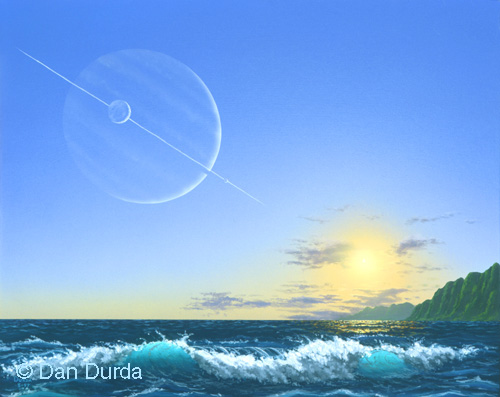
WorldsIn my previous posts, I've linked to some hypothetical exo-lifeforms as imagined by artists with an inclination to science, or scientist inclined to the arts. As shown in Snaiad and Expedition, those works of art--speculative as they may be--provide a glimpse of what could thrive on other planets. This time, I will take you to these worlds as imagined by an astronomer. Meet Dan Durda, a planetary scientist who paints distant worlds in his spare time while not doing daredevil acts like flying jetplanes or diving in underwater caves. Thus, what he comes up with are absolutely breath-taking worlds.

April 24, 2009

An Expedition into a World of Science and Imagination

If i wanted to go into an expedition of an alien safari, I would visit this place: Expedition by Wayne Barlowe.
It is speculative biology and Imaginative science at it's best, all rendered with great artistic skill by an artist with a scientific bent, or perhaps a scientist with an artistic inclination.
Whichever is the case, these exo-lifeforms are a feast to my eyes and a tickle to my imagination.
It's amazing how my foray into Astrobiology and Exobiology has taken me to awe-inspiring discoveries such as this one. The worlds opened up by the marriage of Imagination and Science is an endless adventure.
What will the discovery of thousands of exoplanets bring to the fusion of Science and Art? My mind is simply blown away.

April 12, 2009

Hands for Science Fiction

MechanikaMy whole family dropped by our local bookstore for the last time to say goodbye as it closes down. I chanced upon Mechanika: Creating the Art of Science Fiction by Doug Chiang, and bought it for my son who is a budding artist. If i had the time, I would've doodled around with the techniques of the master craftsman Dave Chiang in creating fantastic machineries of the future and other-worldly animals. But I guess it's time for the next generation to act as the hands for crafting new worlds and the stuff of the future.
This book features a step-by-step tutorial on how to create sci-fi works of art. From concept to sketch stage, all the way to rendering, painting and finishing the details of the masterpiece using Photoshop.
What's great about this tutorial is that not only does it teaches but it inspires, first and foremost. And thus the imagination then runs free.

March 26, 2009

Hello Worlds!

I've now been using "Hello Worlds!" in my code. I guess it's time to redefine the classic "Hello World!" in programming. I have adopted that practice to remind myself of the "Plurality of Worlds" that is upon us. In my opinion, the new generation will suddenly wake up to the continued proliferation of Worlds - in the real, virtual, imaginary and theoretical domains.
With the growing number of new exoplanet discoveries, we are uncovering new worlds that have now begun to enter the thought-sphere of humanity. Our Earth is one among billions and billions of other worlds in outer space, and that's a fact.
On another realm, we have Virtual Worlds that may yet still seem crude and "artificial" at this point in time, but nevertheless can be considered as "Worlds" in their own right. We have the Metaverse, as best represented by Second Life. And we have Massive Multiplayer Online Games (MMORPG) best exemplified by World of Warcraft and Eve-Online. And there's Spore, a new genre, that is between an MMO and a single-player networked game.
We have the so-called "Parallel Worlds" in theoretical physics that seems far-fetched and inaccessible. They are a favorite in Sci-Fi, but who knows what a few decades could have in store for us? Our future progenitors may be crossing them to visit other worlds not only in space, but in time as well.
And last but not the least, I recognize the infinite worlds that are powered by the human imagination. Not to mention the wondrous Worlds that privately exist within each human mind, it is time to recognize these beautiful "Worlds" of fiction - as produced by the mind and the collective consciousness of the human race.
Truly we are in the "Era of New Worlds". And I recognize it as such to introduce "Hello Worlds!" in my programming practice (at least whimsically in my own little world of coding) as a web developer.
Today, we are not merely speculating the existence of other worlds, they are scientifically proven as a fact. The list of exoplanets is growing at an exponential rate to the point where we are on the verge of discovering earth-like worlds. Thus it will have an even greater impact on human culture and society.
I will track the exciting transition of the human psyche as it absorbs the ramifications of the plurality of worlds. I will then share the recoil it will bring in some aspects of the arts and humanities: in culture, media, religion, literature, spirituality, gaming, and other interesting fields.
It could be a lot of hard work, but the joy of discovery is what inspires me. This is a wonderful period in the history of humanity and I am grateful to live in such an era.
I will be your emissary, join me as I say "Hello Worlds"!

Note: This post is a spin-off or reblog from an earlier post in 2008 that I wrote at my other blog Archetyper. The original "Hello Worlds" can be found here: http://archetyper.blogspot.com/2008/04/hello-worlds.html

March 24, 2009

Planetary Art Installations

Springtime is almost here, and as the weather continues to warm I will have a chance to tag along with a friend named Petty who often roams the art galleries of New York. His marathon to visit as many "gallery openings" as possible within two hours is quite fun, moreso that the primary method of hydration is free wine and beer. Sometimes I would come across some art installations that would just often trap me glassy-eyed staring at them as I hold my fifth glass of red wine.
From a cosmic perspective, there is plenty of free booze (energy) in the universe. And I assume that 'life' would arise from booze, such as "us" to consume it. Then I would like to hypothesize that there would be cosmic art installations as well from these restless beings.
For example, Advanced Technological Civilizations could "sprinkle" specific crystals to fashion artificially-created or modded rings around planets to create planetary works of art, or perhaps use nanobot dust to create animated rings.
Natural planetary rings are a true beauty, but there's no telling how the creatives would use nature's idea as an inspiration to make something new. Creativity can never be contained, thus planetary-hacking might just be a matter of time.
Aside from the aesthetics behind such a planetary exhibit, I can only deduce that it must be cleverly designed to provide an obvious mark that it was created artificially and that it was done having art or self-expression in mind. I am assuming that the sense of artistry and creativity is inherent in sentient beings, with the capacity for interstellar travel for the advanced ones.
It would be a stretch to try to imagine how beauty would be expressed by advanced civilizations, but one thing I can speculate is that their art installations probably have a mathematical aspect woven into it, perhaps some code embedded in the ring patterns.
Or perhaps it would be so striking as to be banksy.
Or perhaps it would just be so plain nonsensical that we would immediately recognize it as artificially made, in which case we might consider it as cosmic vandalism.
Exoplanets are so numerous that they lend themselves unwitting targets for planetary artistry and vandalism. Dressing up planets would almost be mundane for anyone who have mastered space travel.
In Manhattan, never have I seen so many art galleries in one area. They are packed in such a way that you may be able to graze more than 10 of them on foot in a span of one hour.
Perhaps there is a stellar "city" somewhere in the Milky Way, hustling and bustling with the myriad of "life". Our star is located in the outskirts of the galaxy and our nearest neighbor is about 4 light years away, Alpha Centauri. Maybe we are in the galactic countryside, and there are no art galleries or art installations nearby, yet.
But our neighborhood is still a galactic city in the making. Some few hundreds of years from now our own solar system will be bustling with interplanetary activity. And perhaps then we will see a glimpse of planetary art installations in our neighborhood. Jupiter? Saturn? Neptune? Perhaps Venus with artificial rings! We can only imagine.
As for those advanced beings out there that got an earlier evolutionary headstart, they have yet to exhibit their presence. And if so, Fermi asks the classic question, "Where are they? Where could they be?"
Why, they're in the "city", of course--mingling and drinking booze!

October 10, 2008

An Exoplanet, its Moon, and Gas Clouds

ExoplanetThis is what hapens when I look too much at exoplanet paintings. Having recently purchased two books that feature the illustrations of Lynette Cook--one of which is Infinite Worlds--I was then inspired to let my imagination run wild, and mess around with Photoshop. What came up was this picture of a terrestrial exoplanet and it's moon with a glowing interstellar cloud in the background.
Both the exoplanet and it's moon is inhabited by alien civilizations. However, the lifeforms on each of them started almost simultaneously, evolved independently and in parallel. Therefore, their ecosystems differ significantly.
The difference in color between the exoplanet and its moon are caused by the distinct chemicals in their atmospheres that are caused by life's unique metabolisms.
The glow in the background is caused by cosmic rays bombarding a giant interstellar gas which cause it to become energetic.
It might be possible that life on both rocks were jump-started and sustained by the energy from the gas cloud.
Basking in an unlikely source of energy, life in this alien planetary system would be so much different than life on earth.
Different. But not impossible.


September 24, 2008

Infinite Worlds

Infinite Worlds
If there is any book at all that best captures Exoplanetology--The Art and Science of Exoplanets, then it is this book: Infinite Worlds by Ray Villard and Lynnette Cook.
If there is any book at all that best captures Exoplanetology--The Art and Science of Exoplanets and Life on other Worlds, then it is this book: Infinite Worlds by Ray Villard and Lynnette Cook. This book is truly a masterpiece worth having in the bookshelf of those who are enthralled by other worlds and beckoned by the prospect of life in other planets.
Although it has been published several years ago, this book will never cease to inspire the next generation of space explorers, and will continue to foster the momentum in exoplanet research by way of inspiration and imagination.
Prior to 1992 there were no known planets orbiting stars outside our own solar system. But the next few years have seen fast-paced developments in astronomy where over 300 extrasolar planets have been discovered by 2008--with more discoveries surely on the way.
Though it will be a few more years before we have compelling direct images of these far-flung worlds, this lavishly illustrated book gives us an idea of what they might look like.
A fascinating exploration of Exoplanetology written for a wide audience, Infinite Worlds brings together Lynette Cook's internationally renowned astronomical artwork, the latest and most dramatic images from the world's top observatories, and scientific findings on subjects ranging from stellar evolution and planetary formation to a possible universe filled with countless planets and life forms.
The newly discovered exoplanets are boggling astronomers' minds with their bizarre characteristics, including an unimagined diversity of sizes and orbits. In Lynette Cook's scientifically based illustrations, we glimpse the landscapes and atmospheres that might adorn these planets. Ray Villard's text elegantly describes the state of astronomy today, imagines where it will take us in the coming years, ponders the chances of success for the Search for Extraterrestrial Intelligence (SETI), and explores the survivability of life in an evolving and accelerating universe.

Links:
Lynnette Cook's SpaceArt

May 27, 2008

Exoplanetology and Science-Fiction

ExoplanetA nice post about Exoplanets from IO9, one of my favorite sci-fi blogs. It's great to have the Sci-Fi community taking a close watch on developments in Exoplanetology - the Art and Science of Exoplanets. And why not? Man simply cannot resist the call of other Worlds. Exoplanetology is a field that beckons the imagination, and Exoplanets appeals to Sci-Fi because they're far enough to stretch the imagination, but close enough for Science. If any object at all represents a kind of missing link between Science and Fiction, then i think it's The Exoplanet.