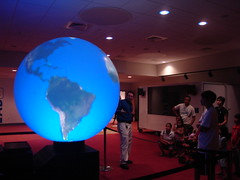
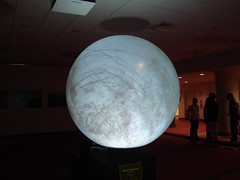
"Life is a pattern." He whispered in an epiphany of realization as he gazed at the patchwork of visualizations displayed on the walls of his control room. Inside the room was an amazing view of a menagerie of extrasolar planets, exomoons and hypothetical microbes and extremophiles that may thrive on the planetary environments. This was a facility doing research on Planetary Science and Astrobiology.
The control room tapped a powerful cloud computing grid with a database that tracked thousands of extrasolar systems. Parameters for the simulations are updated by planet-hunting teams from around the world. Information such as planetary mass, type of planet, distance from the host star, orbital period, chemical make-up, atmospheric density and so on, were fed into a powerful AI software running in the cloud. It's aim was to virtually "find" exolife even before it was discovered in the real world. It was the largest open collaboration of Astronomers, Astrobiologists and Astrophysicists ever set up, and backed up by the leading Computer Scientists.
Throughout the years of manning the control room, Dalro Villaramas has garnered some insight to come up with a solution that might revolutionize the way to search other forms of life. The secret, he thought was to view life in a new way. He was certain that his idea would expand the methods to detect life into other platforms beyond the water-based or carbon-based forms that we know of. He rubbed his hands together excitedly as he decided that he was going to start writing an ArXiv paper. He was going to tell the whole world about it.
Suddenly, he was startled by his manager who barged into the room as he spoke hurriedly, "Dalro, there's a new planet that was detected. Its nothing that's ever been found in history..."
"Hey that's great! But...why do you look so...grim? Are you ok?"
It was odd, very different than the usual when he informs him of new exoplanet discoveries. Instead of the bright sparkle in his eyes, it was glazed. He proceeded, "...please run a simulation of how it would affect the planets in our solar system...earth..."
"What?! Did we just find a new planet in our solar system?"
"Yes...and, no. The planet is
now within
our solar system but it came from
somewhere else. As we speak, a rogue planet--a
Planemo is barreling its way toward our Sun. Amateur Astronomers just detected it after it entered our heliosphere and showed signs of its presence. The parameters are being fed into the grid in real-time. Start the process now and feed the results back to the global network. Please hurry, we don't have much time..."
Dalro hammered on the keyboards and directed all computing resources to this job. In a few minutes, the walls were filled with a view as if from a spaceship's cockpit looking down at the solar system. The 'hypervelocity' Planemo was travelling so fast, way too fast.
For the next few minutes, the simulation showed what would happen--most of the planets would be disturbed from their orbits. The massive planemo would miss Pluto but disturb the Kuiper belt scattering thousands of rocks. It would graze close to Neptune, and hemmorhage Uranus, and distort the rings of Saturn. As it wobbles Jupiter, several moons would be yanked out. Then he gasped as he saw the spheriod rock dig deeper in the solar system. Earth and it's moon would be flung from orbit in a slingshot effect--out into interstellar space.
The alarm sounded in the background. The commotion was now starting to stir other countries around the world. The earth was shaking.
Dalro was now alone in the room. He stood watching the simulated view of the Earth as it made its way out into the cold, dark empty space. The simulation stopped.
He closed his eyes. Images of all his loved ones flashing in his mind, fading with images of Earth--frozen in mid-chaos.
"Life is a pattern..." he whispered as he started to shiver. The temperature was dropping too fast. Darkness fell. Then silence.