Showing posts with label Telescope. Show all posts

June 8, 2010

TRAPPIST, A New Exoplanet-Hunting Telescope

For the record, I'd like to post this info about TRAPPIST, the most recent entry to our slew of planet-hunting telescopes. TRAPPIST (TRAnsiting Planets and PlanetesImals Small Telescope) is a new robotic telescope from ESO at La Silla Observatory, in Chile. It is devoted to the study and detection of exoplanets and it will also study comets orbiting around our Sun. That is a nice combination to deal with the theme in Astrobiology about the study of the origin of Life.
TRAPPIST is a 60-cm telescope being remotely-operated from a control room in Liège, Belgium, 12,000 km away.
As it's name suggests, TRAPPIST will use the transit method, which is the same method that Kepler uses to hunt for planets. From its official website, there is no mention whether it is equipped with Adaptive Optics to counteract the effects of the Earth's atmosphere. But from the excellent night sky in Chile--aside from adding more entries into our known exoplanets database--we hope TRAPPIST will be capable of detecting earth-like planets as well.

Links:
TRAPPIST Official Website

April 1, 2010

Hubble

And it had to come to this, that on April 1st, I had to call in sick due to severe grogginess caused by lack of sleep. After I snoozed my way to recovery, I then had to make a quick escape from the oncoming harrows of the waking life. I headed for the Liberty Science Center to see Hubble in the IMAX dome.

For my case, this short film turned out to be ok for a hurried schedule. For a mere 40 minutes, a lot of substance were crammed into it. It was short but sweet. But of course I would've enjoyed more if it had more of the spacey scenes.

The film tells a mini-story of how the brave astronaut heroes fixed Hubble on the last servicing mission. And it showed spectacular scenes of deep space, with all the galaxies and stars, gliding towards the Orion Nebula, and grazing at "tadpoles" in stellar nurseries, then zooming onto star formations.

The wonders that the Hubble telescope shares to us is already mesmerizing by way of its pictures of stars, nebulae, galaxies and so forth. Yet several times in the film, the narrator (Leonardo DeCaprio) mentioned the search for other worlds. And one of the Astronauts even mentioned how Hubble can study the atmosphere of other planets. Of course, that made my eyes grow wider than the gargantuan dome.

As the film reached its climax and ended with the view of earth, I knew that my little escape from the busy day was over. Yet I realized that even as mankind will always try to escape the planet's pull of gravity, a spacefarer will always look back. And when one scans the starry heavens in search for other earth-like planets, there's no escaping--it always points us back to our own home.

March 8, 2010

Amateur Planet-Hunting via Web-based Observatories (WBO)

Because I live in a light-polluted area, the idea of renting remote telescopes to study or hunt exoplanets has been in my mind for almost 2 years. During that time, it was too expensive and the capabilities of those rental telescopes were not yet sufficient to hunt for exoplanets. But lately, the idea of renting telescopes for planet-hunting is slowly but surely moving closer to reality. The advancement of Web-Based Observatories (WBO) is an exciting event in the history of Astronomy, moreso for our case--in amateur planet-hunting.

There are many WBO's out there, but on this post I mention the exciting features of Global Rent-a-Scope (GRAS) which seems to me as the most appealing for amateur exoplanet hunters so far.

GRAS gives the option to write your own script and run it at a specific time in the future. This is perfect for training planet-hunters by generating their own light curves of known transiting exoplanets. Another great feature of GRAS that is potential for hunting exoplanets is their capability to do photometry via a software called Photometrica. Remember, the Kepler telescope uses the Photometry method!

And for the more advanced users, GRAS offers direct control on the CCD camera plus a host of other software and application such as MaximDL, The Sky, and FocusMax that let you directly control the telescope.

What's next? Perhaps adaptive optics might get incorporated into these amateur WBO's someday. And as CCD technology advances further, plus new technologies in astronomical instrumentations (like Astrophotonics) gets implemented onto larger but hopefully more affordable telescopes, then perhaps a hopeful exoplanet discovery via WBO is near the horizons!

Links:
Web-based Observatories (PDF Direct Link)
Global-Rent-a-Scope (GRAS)

January 6, 2009

Exoplanet data: A landscape to be filled and mined

Exoplanet DataThis post is about the data aspect behind the study of exoplanets.
I learned the other day that Kepler was one of the first advocates of freely sharing scientific data. In the spirit of astronomy and open source, I would like to call on the organizations behind planet-hunting telescopes and the soon-to-be-launched new generation telescopes to eventually share the data to enable amateurs to help in the discovery of new exoplanets. (winks at NASA)
Perhaps we can revolutionize amateursourcing and take it to new levels. "Amateur" comes from latin word amatore which means "lover" or "lover of". You'll be amazed at the power of love!
On another vein, I would like to invite enthusiasts to contribute to exoplanet data on Freebase - an open database of structured information.
When information is structured, you can systematically query and extract useful information far more easily and quickly. With Freebase, you can ask questions like "Which exoplanets are habitable that are older than earth?" or "Which exoplanets discovered via Gravitational Microlensing lie within the Habitable Zone (HZ)?". You can then get answers fairly easily using their query language (MQL). This ability to tap into structured data could provide us with unprecedented insights into the study of Exoplanets.
The only problem right now is that we don't have enough data yet in there to extract useful correlations. And that is why you are needed. Once you jump in and contribute data, you'll have so much fun learning, too.
"I learn as I contribute" is the mantra I have discovered in my experience with Freebase. Alternately, it's also true the other way around: I contribute what I learn.
Here's a tip for any enthusiast, researcher and student of exoplanets: Open Freebase in a window pointed at the exoplanetology base or exoplanet table. Then start with a question. Don't worry if it sounds silly. A question will get you going. Say, "Which terrestrial exoplanet is closest to Earth?" Then try playing with the filters and views. The advanced filter has been the most fun for me, coupled with edting the views.
This exercise will enable you to begin seeing the missing pieces of data that are needed to answer your question(s).
You may then have to go to noteworthy sites like the The Extrasolar Planets Encyclopaedia to get the bits of data that you need. Some other sources of data can be found in this list of catalogs for cross-referencing.
Then try entering these gems of data into Freebase.
Soon enough, you'll find out that having the capability to query structured multi-dimensional data makes Freebase a wonderful tool for Science2.0. But first we need the data and the volunteers to make it happen! :)
Come on, join the fun, and show the love!

January 1, 2009

The Future of Exoplanetology


They say the best way to predict the future is to invent it. Here is how the future will be invented as seen from the lens of Exoplanetology. The list below can be treated as a roadmap for those involved. It can also be considered as a hopeful glimpse of what is to come.

1) Deluge of Exoplanets - between 60 to 80 new exoplanets within 2009 will be discovered. Last year's forecast of 60+ new exoplanets for 2008 came true. Yet again, there is no reason why this year's planet-hunt won't be as exciting as last year.
2) New Eyes - The development of new generation telescopes (both space-based and land-based) will continue from this year onwards to bring unprecedented new discoveries. See this list of telescopes to see astronomy's new arsenal, which includes Kepler, Terrestrial Planet Finder (TPF), James Webb Telescope, Spitzer Telescope, New Worlds Mission, and Space Interferometry Mission (SIM). Although direct imaging technique will continue to make waves in the news, transit method will continue to pile up new exoplanet discoveries. The power of a new set of eyes will set the stage for amazing things that is to come.
3) New Brains - data gathered by some new generation telescopes will gradually be opened up for public consumption starting in 2010 or 2011. Number-crunchers, algorithms and software will sift through terabytes and petabytes of collected data to discover new planets by way of numbers, statistics, and computation. Candidates for "habitables", exoplanets that lie inside the habitable zone (HZ), will be filtered from massive amounts of data, helping telescopes identify good interesting targets.
More powerful but cheaper computers, with dual core or multiple core set up in parallel, will enable more detailed simulations of planet-formations and alien solar systems, providing better insights for exoplanet science.
4) Amateur Boom - Amateur exoplanetology will explode. Projects similar to Systemic, SETI@home (or their mashup) will enable amateurs to contribute to science. Crowdsourcing, baby! Or call it Amateursourcing!
Cheaper and more powerful telescopes, and affordable CCDs for differential photometry will enable amateur astronomers to discover new exoplanets, a la do-it-yourself (DIY) exoplanet-hunting. This will take off, possibly going mainstream in amateur astronomy sometime in 2010 or 2011 onwards.
5) Signs of life - More signs of life beginning in 2010-ish. More organic clues detected in atmosphere of exoplanets. Strong evidence will continue to mount, pointing to the ever-growing possibility of extra-terrestrial life.
6) Superdupers - More Super-Earth detections will become more common starting in 2011 or 2014. "Habitables" or "Habs" will pour in. Water-worlds will flood the news.
7) Exotics - Exomoon detection capability takes off in 2012 to 2014. New exotic discoveries will also start to pour in. Classifying celestial objects becomes even more challenging for astronomers. Imagine earth-sized exomoons with their own moons! What will you call them? Exomoonoids?
8) Earth Galore - More and more Habs and earth-like planets in habitable zones between 2015 to 2020 will pour in. Advances in technology and planet-hunting methods will enable us to resolve exoplanets the size of earth and smaller. There will then be more than a thousand total exoplanets in the list. Direct-imaging methods will be in greater demand as ever.
9) Shockwave - Mankind will be thrown in a theological and religious turmoil. A period of adjustments in worldviews will occur as mankind tries to make sense of their being amidst the impending discovery of another earth with life.
Spiritual individuals have no problems with it whatsoever. But Religions will start to revise old beliefs and begin re-interpreting scriptures to prepare for the ramifications of the discovery of...
10) Life - Scientific confirmation of exo-life happens between 2020 to 2030-ish. Astrobiologists will finally confirm that life exists on another planet of another star. It may not be in an earth-like exoplanet at all, perhaps not even in a planet, and may not even be life-like. It is something so incredible that no one has ever predicted.


November 14, 2008

Out into Space with Kepler

Exoplanetology is going to outer space. Yes, hitchin' a ride to space with the Kepler spacecraft. Haven't been able to take off and yet I already have the certificate to prove it. So what the heck is Kepler? Who the heck is Kepler?

Johannes Kepler was a German mathematician, astronomer and astrologer, and key figure in the 17th century Scientific revolution.

The Kepler Mission is a space photometer being developed by NASA to search for Earth-like planets orbiting other stars. It will be launched on March 5, 2009. So you can expect Earth's "twin" to make waves in the news shortly after that date, when Earth-like planets finally get discovered. Until then I will continue to stare at my certificate framed on the wall of my bedroom.

By the way, did I mention that you can get your name out into space, too and get your certificate as well? All the space-bound names will be stored on a DVD and rocketed into space on board the Kepler spacecraft. Just head over to this page and write a very good message or reason why Kepler is important. A copy of the DVD with all of the names and messages will be given to the Smithsonian Institution’s National Air and Space Museum. I sure hope they don't put it on Blu-ray because i dont have a blu-ray DVD player yet. I'm sure the aliens do. So make sure you write your hello message in good Klingon. Below is the message I wrote. Can anyone please translate it into Klingon:

"To discover the origin and future of life, and to find out mankind's place in the universe. Knowledge worth knowing within one's own lifetime, a simple truth worth knowing by an entire civilization."

Sweet.

Kepler Certificate

Links:
Messages of Kepler
Kepler Official Website

November 13, 2008

Worlds Imaged and Worlds Imagined

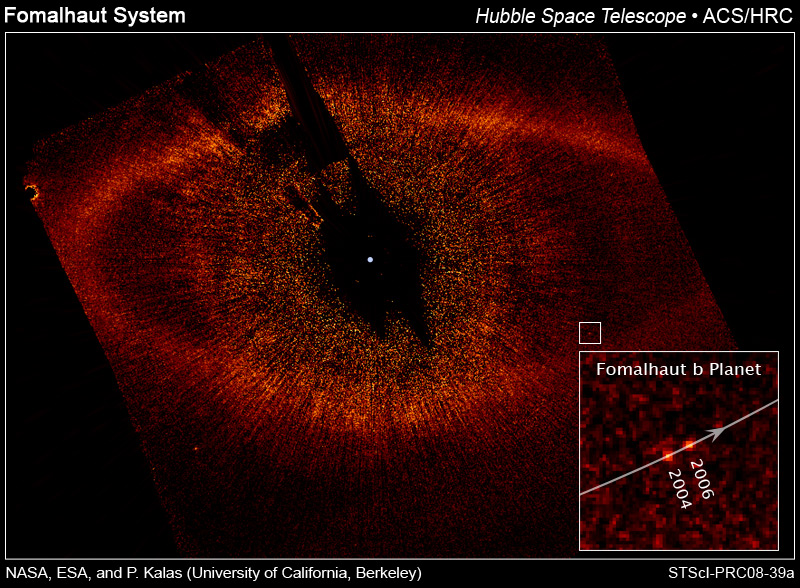
Today marks a great stride in how we see exoplanets, which have always remained as figments of our imagination and speculations. Where previous techniques only enable us to infer their existence by way of statistics, light curves, graphs and spectra, the big news today shows us direct images of extrasolar worlds.
While most exoplanets detected to date have been discovered using techniques such as Astrometry, Radial Velocity, Transit Method or Gravitational Microlensing, none would ever cause so much news coverage and impact as a "photograph" of another world. (Twitter went down shortly after the announcement, perhaps due to too many tweets about it). Although a huge bulk of future exoplanet discoveries would continue to be discovered by indirect techniques of planet detection, the method of Direct Imaging will pick up in the coming years, and soon we will finally see a photo of extrasolar continents.
The promise of the next generation of telescopes such as the Terrestrial Planet Finder (TPF), James Webb Telescope, Spitzer Telescope, New Worlds Mission, Kepler, and Space Interferometry Mission (SIM), will be bring even more amazing imagery. But hats off to good 'ol Hubble, who continues to bring us stunning pictures, in this case a snapshot of Fomalhaut b.
Artists will continue to bring us closer to these alien worlds, while computer simulations will always provide new insights, but imagination always will be our mind's eye.
Just imagine what goes on inside the mind of a child as you stand together gazing up in the night sky, and you point to a star and say, "that star over there has a planet, yeah that one right there..."
It's amazing, NOW we can finally say it with absolute certainty, just like that.
Just like that.


Other Links:
NASA/ESA Hubble
Physorg
Discovery Channel
Cosmic Ray
More on FomalHaut b

March 21, 2008

Google Enters the Field of Exoplanetology

Google joins the the hunt for exoplanets by funding the development of the wide-field digital cameras needed for the Transiting Exoplanet Survey Satellite (TESS). TESS, a satellite-based observatory for hunting Earth-like planets is currently being designed by MIT scientists. TESS would perform its transit method of exoplanet-detection high above the clouds - a big advantage over its ground-based counterparts who use the same technique. Ground-based telescopes are obscured by the earth's atmosphere, hence their resolution is limited in detecting much smaller terrestrial planets like the earth. But a space-based telescope like TESS, being free of interference from atmospheric clouds and dust, will be able to resolve light coming from distant stars in much greater detail, allowing it to detect Earth-like planets, as well as those with larger orbits. Now, more resolution means more data - and this is where Google has shown interest as well - processing huge amounts of data to find useful information. But hold on to your horses though, TESS won't be launched until 2012. So the concept logo for Google Exoplanetology (designed by yours truly) might not be used...yet?

March 15, 2008

Use of Computer Simulations for Exoplanetology

Alpha Centauri BRecent advances in computing power has provided us an even greater tool for study. Half of a mouse's brain has been simulated on neuronal details. In another development, part of a human brain has also been modelled, making me want to get tons of computers to simulate my brain, too. But now, hearing about the star-formation simulations made on Alpha Centauri B is wonderful news for exoplanetology. The findings of the simulation is that terrestrial planets are likely to have formed around the star Alpha Centauri B and to be orbiting in the Habitable Zone (HZ) where liquid water can exist on the planet's surface. The icing on the lake ('pun' intended) is that such planets could be observed using a dedicated telescope.
To study planet formation around Alpha Centauri B, the team ran repeated computer simulations, evolving the system for the equivalent of 200 million years each time. Because of variations in the initial conditions, each simulation led to the formation of a different planetary system. In every case, however, a system of multiple planets evolved with at least one planet about the size of Earth. In many cases, the simulated planets had orbits lying within the habitable zone of the star. This makes Alpha Centauri B an excellent candidate for finding terrestrial planets.

March 14, 2008

Web-Based Google Sky: A Great Tool !

Google's Browser-based Sky launched. Now you don't need to install any software for a quick marvel at the heavens! Google Sky comes default with some known objects, such as M1 and Andromeda, and see them in x-ray, infrared, microwave and ultraviolet modes. Perfect for amateur astronomy. You can also see some showcases of Hubble, Spitzer and other telescopes images and overlay your own information with KML content like in Google Earth. At the top left, there's a link to Google Moon and Google Mars.
This is a wonderful start! I can foresee the day when exoplanets are marked out in sky just like the currently known objects catalogued in there. It'll give us a sense of where they are in the sky. With the launch of new telescopes, we will see an explosion of hi-res images in the next few years. And we'll definitely see them in Google Sky. Gee, thanks Google! Thanks NASA!

March 1, 2008

Do not be afraid of Math

I love this interview of a planet-hunter named Rachel Akeson, who uses the Keck Telescopes in Mauna Kea to hunt for exoplanets. Her advise to enthusiasts on planet-hunting resonates with me. When asked about her advise to people who are interested in the field, she said:

"There are all kinds of people working in this area, so you shouldn't get scared off if math isn't your thing. There are lots of different careers, from science journalism to public outreach, that people can be a part of."

I'm no good in math, but i really am interested in the heavens, the stars and planets therein. Times come when i get uninspired, and hearing something like that from a real planet-hunter makes me continue onwards with this blog and website on exoplanetology.

Link: The Planet Hunters

February 23, 2008

Online Telescopes for Astronomers (and Planet-Hunters, maybe)

The latest issue of Wired Magazine (March 2008, page 060) featured 4 online telescopes for the "urban astro-nerds". Its been said that you can control these telescopes remotely from the web and order prints of your photos. That's very cool, but I have yet to find out if these robotic telescope observatories can effectively be used to hunt for exoplanets. If not, they're still great as an introductory tool for amateur astronomers and budding Exoplaneteers!
Here they are: