Showing posts with label Exoplanet. Show all posts

March 24, 2009

Planetary Art Installations

Springtime is almost here, and as the weather continues to warm I will have a chance to tag along with a friend named Petty who often roams the art galleries of New York. His marathon to visit as many "gallery openings" as possible within two hours is quite fun, moreso that the primary method of hydration is free wine and beer. Sometimes I would come across some art installations that would just often trap me glassy-eyed staring at them as I hold my fifth glass of red wine.
From a cosmic perspective, there is plenty of free booze (energy) in the universe. And I assume that 'life' would arise from booze, such as "us" to consume it. Then I would like to hypothesize that there would be cosmic art installations as well from these restless beings.
For example, Advanced Technological Civilizations could "sprinkle" specific crystals to fashion artificially-created or modded rings around planets to create planetary works of art, or perhaps use nanobot dust to create animated rings.
Natural planetary rings are a true beauty, but there's no telling how the creatives would use nature's idea as an inspiration to make something new. Creativity can never be contained, thus planetary-hacking might just be a matter of time.
Aside from the aesthetics behind such a planetary exhibit, I can only deduce that it must be cleverly designed to provide an obvious mark that it was created artificially and that it was done having art or self-expression in mind. I am assuming that the sense of artistry and creativity is inherent in sentient beings, with the capacity for interstellar travel for the advanced ones.
It would be a stretch to try to imagine how beauty would be expressed by advanced civilizations, but one thing I can speculate is that their art installations probably have a mathematical aspect woven into it, perhaps some code embedded in the ring patterns.
Or perhaps it would be so striking as to be banksy.
Or perhaps it would just be so plain nonsensical that we would immediately recognize it as artificially made, in which case we might consider it as cosmic vandalism.
Exoplanets are so numerous that they lend themselves unwitting targets for planetary artistry and vandalism. Dressing up planets would almost be mundane for anyone who have mastered space travel.
In Manhattan, never have I seen so many art galleries in one area. They are packed in such a way that you may be able to graze more than 10 of them on foot in a span of one hour.
Perhaps there is a stellar "city" somewhere in the Milky Way, hustling and bustling with the myriad of "life". Our star is located in the outskirts of the galaxy and our nearest neighbor is about 4 light years away, Alpha Centauri. Maybe we are in the galactic countryside, and there are no art galleries or art installations nearby, yet.
But our neighborhood is still a galactic city in the making. Some few hundreds of years from now our own solar system will be bustling with interplanetary activity. And perhaps then we will see a glimpse of planetary art installations in our neighborhood. Jupiter? Saturn? Neptune? Perhaps Venus with artificial rings! We can only imagine.
As for those advanced beings out there that got an earlier evolutionary headstart, they have yet to exhibit their presence. And if so, Fermi asks the classic question, "Where are they? Where could they be?"
Why, they're in the "city", of course--mingling and drinking booze!

March 5, 2009

Looking Through Kepler's Eyes

Kepler's Field of ViewAll eyes are upon the Kepler Telescope on the night of March 6 as it launches into space. Kepler will serve as our eyes as we scan the heavens for other Earths. But exactly where will our "Keplerian eyes" be looking at?
Kepler will unblinkingly stare at a small patch of sky in the Cygnus constellation (The Swan), with a field of view that is roughly equivalent to two scoops of the Big Dipper.
Now one must ask, Why did the Kepler team choose the Cygnus constellation?
The Kepler team clearly outlines their reason for choosing Cygnus:

"Since transits only last a fraction of a day, all the stars must be monitored continuously, that is, their brightnesses must be measured at least once every few hours. The ability to continuously view the stars being monitored dictates that the field of view (FOV) must never be blocked at any time during the year. Therefore, to avoid the Sun the FOV must be out of the ecliptic plane. The secondary requirement is that the FOV have the largest possible number of stars. This leads to the selection of a region in the Cygnus and Lyra constellations of our Galaxy as shown."

Kepler's TargetA most excellent choice, I say!
The Cygnus constellation lies along the plane of the Milky Way, and looking in that small section of the sky from our location gives a view of a plethora of stars--greater than a hundred thousand of them! And for Kepler who will trail the earth in it's orbit around the sun--the view to this star-studded patch of sky is wide open the whole year round.
But for those earth-bound stargazers who want to look at the patch of sky where Kepler will be staring at, you'll have to wait until around June because the Cygnus constellation will only become visible in the northern skies around that time until around December.

But that makes summer's arrival even more exciting, because that patch of sky will be a welcome target for exogazers who would want to "connect" with the whole essence of Kepler's endeavor in a more personal way by looking towards Kepler's direction. To thoughtfully gaze at that same patch of sky is to capture the essence of man's ancient longing to find his place in this lonely universe.

Is Earth the only bearer of life? If we find an Earth twin, it will give an insight as to our place in the cosmos. And if we find signs of Life, it will serve as a mirror to find out a little more of ourselves. What is Life? What is Man? This ancient query is echoed by the ancient text of the Psalms.

"When I consider your heavens, the work of your fingers, the moon and the stars, which you have set in place, what is man that you are mindful of him?" - Psalms 8:3

And even in our modern day, depressing as it seems to many, we have not stopped looking to the skies to save us from our own lonesomeness.

"I'm looking to the sky to save me,
Looking for a sign of life,
Looking for something to help me burn out bright
"
- Foo Fighters (Learn to Fly)

AnkhBut is Kepler looking in the right direction for signs of life? The final insight I will provide might seem to be a mere coincidence, and perhaps symbolic in nature.

Cygnus, The Swan is also home to a prominent asterism called the "Northern Cross". But even more striking is that looking at the Northern Cross from an ancient Egyptian's eyes gives the Ankh symbol, a vessel of Life.

Any good part of the Milky Way may have been a good target but the symbolisms behind Cygnus makes it an even sweeter spot to search for Earth-like planets, and life.

As you can see, the view through Kepler's eyes is rich with Science, Technology, Symbolism, Faith, and Legends--all the stuff of Humanity--because in essence Kepler is actually looking inwards towards the heart and soul of Mankind !


Sources:
Kepler Website: http://www.nasa.gov/mission_pages/kepler/main/index.html

February 23, 2009

Is Pluto Truly a Planet? Exoplanets Give Insights

What do exoplanets got to do with Pluto? Everything!
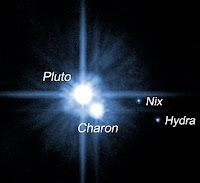
Exoplanets "out there" may actually decide the fate of our poor Pluto, who has been the subject of much heated debates.Pluto As everyone knows, Pluto is no longer considered a planet by the IAU. Why? Because some folks decided that a planet must satisfy three conditions to be considered as a planet:
1) It must orbit a star
2) It must have a round shape
3) It must clear its path of any other object.
Now the third condition is where Pluto fails as a "legitimate" planet, IAU says.
But that's where the newly-discovered exoplanets enter the picture: The discovery of a pair of exoplanets named HD 45364 b & HD 45364 c, the third condition may come under question more than ever.Neptune
HD 45364 b|c actually share orbits at times! Their orbits sometimes touch and may even overlap. They don't collide because they have resonant orbits. They revolve around an orange dwarf star named HD 45364 in the constellation of Canis Major, about 110 light years from Earth. The inner planet completes three orbits around its star in the same time it takes the outer planet to complete two orbits (3:2). Therefore, the inner planet at times lies further from the star than the outer planet--just like Neptune and Pluto.
Both of HD 45364's planets are giants; the inner planet is at least 3.5 times the mass of Neptune. The outer planet is more massive, at least 2.2 times the mass of Saturn. Now if we stick with the IAU's definition, neither of these objects would be considered planets, as they do not "clear their orbits" of one another.Pluto and Neptune Orbital Resonance
The IAU might have made a terrible mistake of deciding too early and hastily declaring a definition of a planet before even considering what might be "out there"--that perhaps we need more samples of other solar systems before deciding what a planet is or is not.
I remember the mantra of Murray Gell-man, about the beauty of things. Truth and Elegance often displays beauty. In my opinion, the third definition of a planet invented by IAU was not pretty. And the havoc and embarassment it wreaked upon the Astronomy community is really quite ugly.
Frankly, I don't see any problem with the number of planets ballooning to thousands if Pluto opens the floodgates to Planethood. It's the petabyte age, baby! Perhaps it's much simpler to see things in large numbers.
Personally, I am prepared with the list of planets or exoplanets numbering up to billions. I'll be long gone by the time the exocatalog even hits six figures, but it's inevitable. The night sky and outer space is a whole database waiting to be known. There's no need to be scared of numbers.
At times, simplicity can be achieved by looking at sheer numbers. But complexity arises with too little data (Talk about paradox!). So in our case, IAU decided what a planet is based on one sample: Our Solar System.
Even as the wonderful International Year of Astronomy unfolds for 2009, Pluto is truly living up to it's name as one of the alternate names of Hades, the Greek god of the Underworld. Pluto is truly having a blast.
With enough exoplanet discoveries, it would soon turn out to be such a simple thing to re-define what a planet is.
"Wanderer" is a pretty good word to begin with, don't you think so?


Links:
http://kencroswell.com/HD45364.html
http://laurele.livejournal.com/7854.html


February 6, 2009

Exogazing

I would like to introduce a new hobby: It's called Exogazing.
Exogazing is like stargazing, except that aside from gazing at the stars, you also gaze at exoplanets. Well, you don't really see the actual exoplanets, but in theory the photons of light that grazed past a transiting exoplanet's atmosphere might reach your eyes. Because as you gaze at a star that hosts a transiting exoplanet, the photons of light that contain some information about the exoplanet may make it to your retina. But too little amount of these photons is not enough for our eyes to perceive it. Most of what our eyes see is the star (but with much better instruments to collect light, you can find out more about an exoplanet's atmosphere--as what scientists do, with the method called Photometry) Exogazing is simple and requires minimal instruments. Anyone can do it.

Exogazing is a contraction of the phrase "Extrasolar Gazing", a term in line with the usual "stargazing". In essence when we look up in the night sky, we are mostly gazing at objects outside our solar system. But "exogazing" is deliberately identifying the location of an exoplanet in the night sky as a pinpoint of light by it's host star.

Exogazing also comes from "Exoplanet Gazing", a term indicative of the wonder and fascination of Extrasolar Worlds. But in relation to actual planet-hunting which involves trying to detect yet-undiscovered planets around other stars, Exogazing is simply gazing at star-filled constellations and "spotting" for which stars have known exoplanets orbiting around it. Exogazing can be considered as a step prior to Exoplanet Observing.

Inspiration.
When the discovery of Fomalhaut b via Direct Imaging came about, I was inspired. To look upon a star, knowing that there is a planet orbiting around it, gives me that Exoplanetary Thinking effect.

The idea of being able to point at a star visible to the naked eye, and tell others about its planets has got me hooked. I love telling my kids about these exoplanets as I point toward their direction in the night sky--at the actual host star, in a familiar constellation. And I would love to stir their imagination about other worlds. What better connection to a young mind than to actually stand beside a child and then point at an actual star with a confirmed planet orbiting around it? It's Astronomy, Science, Imagination, and Inspiration at it's best!

The Method.
To identify and pinpoint the actual star that hosts the exoplanet is the basic task of Exogazing. It's simple. It starts with a simple question, "Which stars have confirmed exoplanets?" Then a little challenge of star-hopping and occasional use of "pointers" makes it all the more fun. Heck, you might even come up with your own directional pointers specific to exogazing.
Currently, there are only few stars visible to the naked eye that have confirmed exoplanets. But a number of some exoplanet-hosting stars are quite faint thus you need a binocular and a starchart to locate them in the sky. Star-hopping is often necessary to avoid getting lost in your field of view. And once you locate the star that hosts the exoplanet, let your eyes gaze upon it for a while and feel free to enjoy the wonderful moment of knowing the fact that this particular pinpoint of light reaching your eyes contain other worlds.

Other Benefits.
Exogazing is a good hobby to allow you familiarize oneself with the stars and constellations, or Astronomy in general. Having a goal in mind, such as trying to locate faint stars which host planets stimulates learning, and enhances information-retention.

And for hopeful amateur astronomers who may eventually join the ranks of that amateur group who will someday contribute to the discovery of new exoplanets, Exogazing is a perfect introductory activity to get familiarized with planet-hunting or exoplanet observing.

Basic Instruments.
Now what instruments do you need for exogazing?
Here are the basics:
Planisphere, starcharts, binoculars, music.

Exogazing Music - I value the human experience, and you need to experience the wonder of the stars. Music is a much-needed factor to complete the experience. I highly recommend songs that have no lyrics, so as to let the stars sing to you in their own "voices". The genre of post-rock or electronic chill works best for me to get that mood and "spiritual" experience. [UPDATE: A new genre has sprouted from this: It's called "Exogazing" music] Besides, there should be a reason why star-parties are called the way it is, so i think Music should definitely be a part of it.
Star Catalogs - Some more challenging stars that are too faint, may require you to consult a more detailed catalog of stars.

Optional Instruments.
Tripod-mounted binoculars would be great but if you want an enhanced experience, an Image Stabilized (IS) binocular will be a great option. Part of the telling factor of exogazing is the human experience. The image stabilization feature eliminates the jittering and makes exogazing a wonderful experience, specially when you often need to pan to-and-fro across the sky as you "star hop" to make your way to the target. So the agility of hand-held binoculars are highly-recommended.
Laptop - You might need it to access updated information about the exoplanets you are gazing at, or to consult astronomy software such as Stellarium or Google Sky. As an option, you may need it to contribute your findings to the open database at Freebase, or to connect to last.fm to play the recommended exogazing music. :)
Green laser pointer - For helping others star-hop in the sky & Instructional purposes
Red flashlight - For checking charts in the dark and preserving night vision

Basic questions.
You need a few basic questions to get you going, which starts with "Where are those doggone Exoplanets?" The rest will follow: What constellations are up tonight? And which visible stars within those constellations have confirmed exoplanets? What are the exoplanets that belong to a particular constellation? What is the type of star of a particular exoplanet? What type of exoplanet is it? How far is it? Is it habitable?

Future.
There will be more Exoplanets to come. And so Exogazing will become ever more fun in the near future. May it serve as the start of a fun new activity for all Astronomers (Amateurs and Professionals alike) in their stargazing nights. And I hope that the Amateur Astronomy community would love Exogazing during star-parties as well!
I will continue to share my Exogazing sessions and open up a section in the Exoplanetology website dedicated for this hobby. I will also continue to tweet and write about it in this blog. So stay tuned!
Happy Exogazing! And Clear skies!

October 24, 2008

Whole Universe In a Magazine

I don't usually buy magazines at newsstands but this one got the better of me. Discover's Whole Universe magazine is by far the most exoplanetology-centric magazine I've come across so far.
The articles are truly educational and the pictures are amazing. Two of its pages even shows the same image I selected for my past post "Extrasolarise" four months ago.
The only thing I can notice is the inconsistent naming convention of the exoplanet names. I was reminded of the cumbersome process of straightening out the exoplanet duplicates at wikipedia and freebase due to naming convention discrepancies where the space was absent between the star name and exoplanet index. For example, in the article - Forbidden Planets on page 36, Gliese 581d should've been Gliese 581 d.
It's quite trivial I know, and Freebase has now so wonderfully remedied this issue. But leniency to naming conventions would make it difficult to catalog the growing number of exoplanets in the long run.
But still, the magazine is splendid. I would love to come across such a kind of magazine in the newsstands once again.

October 10, 2008

An Exoplanet, its Moon, and Gas Clouds

ExoplanetThis is what hapens when I look too much at exoplanet paintings. Having recently purchased two books that feature the illustrations of Lynette Cook--one of which is Infinite Worlds--I was then inspired to let my imagination run wild, and mess around with Photoshop. What came up was this picture of a terrestrial exoplanet and it's moon with a glowing interstellar cloud in the background.
Both the exoplanet and it's moon is inhabited by alien civilizations. However, the lifeforms on each of them started almost simultaneously, evolved independently and in parallel. Therefore, their ecosystems differ significantly.
The difference in color between the exoplanet and its moon are caused by the distinct chemicals in their atmospheres that are caused by life's unique metabolisms.
The glow in the background is caused by cosmic rays bombarding a giant interstellar gas which cause it to become energetic.
It might be possible that life on both rocks were jump-started and sustained by the energy from the gas cloud.
Basking in an unlikely source of energy, life in this alien planetary system would be so much different than life on earth.
Different. But not impossible.


September 24, 2008

Infinite Worlds

Infinite Worlds
If there is any book at all that best captures Exoplanetology--The Art and Science of Exoplanets, then it is this book: Infinite Worlds by Ray Villard and Lynnette Cook.
If there is any book at all that best captures Exoplanetology--The Art and Science of Exoplanets and Life on other Worlds, then it is this book: Infinite Worlds by Ray Villard and Lynnette Cook. This book is truly a masterpiece worth having in the bookshelf of those who are enthralled by other worlds and beckoned by the prospect of life in other planets.
Although it has been published several years ago, this book will never cease to inspire the next generation of space explorers, and will continue to foster the momentum in exoplanet research by way of inspiration and imagination.
Prior to 1992 there were no known planets orbiting stars outside our own solar system. But the next few years have seen fast-paced developments in astronomy where over 300 extrasolar planets have been discovered by 2008--with more discoveries surely on the way.
Though it will be a few more years before we have compelling direct images of these far-flung worlds, this lavishly illustrated book gives us an idea of what they might look like.
A fascinating exploration of Exoplanetology written for a wide audience, Infinite Worlds brings together Lynette Cook's internationally renowned astronomical artwork, the latest and most dramatic images from the world's top observatories, and scientific findings on subjects ranging from stellar evolution and planetary formation to a possible universe filled with countless planets and life forms.
The newly discovered exoplanets are boggling astronomers' minds with their bizarre characteristics, including an unimagined diversity of sizes and orbits. In Lynette Cook's scientifically based illustrations, we glimpse the landscapes and atmospheres that might adorn these planets. Ray Villard's text elegantly describes the state of astronomy today, imagines where it will take us in the coming years, ponders the chances of success for the Search for Extraterrestrial Intelligence (SETI), and explores the survivability of life in an evolving and accelerating universe.

Links:
Lynnette Cook's SpaceArt

September 15, 2008

Young Exoplanet says "Cheese!"

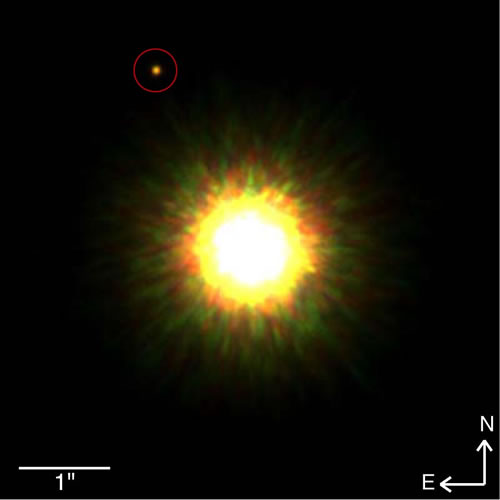
Young ExoplanetIn what may be the first ever picture of an Exoplanet orbiting a sun-like star, the image shown is of a young star named J160929.1-210524 and its potential planet. This extrasolar system lies 500 light-years from Earth and the exoplanet has been measured to have a mass 8 times that of Jupiter.
Until now, the only planet-like bodies that have been directly imaged outside of the solar system are either free-floating in space, or orbit brown dwarfs, which are dim and make it easier to detect planetary companions.
The Gemini North telescope on Mauna Kea in Hawaii was used to take the images utilizing adaptive optics technology to dramatically reduce distortions caused by the Earth’s atmosphere. The near-infrared images and spectra of the suspected exoplanet indicate that it is too cool to be a star or even a more massive brown dwarf, and that it is young. Taken together, such findings confirm that it is a very young, very low-mass object at roughly the same distance from Earth as the star.
Although it will take up to two years to verify the validity of this photograph the method used by the team is quite ingenious by "..targetting young stars so that any planetary mass object they hosted would not have had time to cool, and thus would still be relatively bright. This is one reason we were able to see it at all.”

Links:
http://arxiv.org/abs/0809.1424
http://www.gemini.edu/sunstarplanet
http://www.msnbc.msn.com/id/26722406/

July 30, 2008

Ephemeral Worlds: Visualizing Exoplanets with Bubbles

Alien WorldIndeed Exoplanetology is the Art and Science of Exoplanets. These photographs of bubbles provide stunning insights into visualizing and imagining how unseen exoplanets might look like. Consider the fact that planets especially Jovian planets like Jupiter, are "bubbles" themselves, albeit gargantuan in scale. The biosphere of the Earth is in fact, a bubble. And by the fractal laws of nature, the surface of bubbles provide a striking resemblance to the appearance of planets with a suitable atmosphere.Alien World
Thus soap bubbles, ephemeral as they may seem - can help in visualizing exoplanets since their surfaces follow the same laws of physics. And as how these photographs by Jason Tozer attests to, exoplanets - like soap bubbles - are also works of art.
One photograph bears a striking resemblance to Jupiter's patterns. I am speculating that if it were photographed in zero-gravity it would look a lot more like Jupiter.
The rest of these otherworldly photographs sets my mind careening into outer space, imagining how exoplanets would look like. To imagine and visualize them is what I can do for now, for to even see a glimpse of them is beyond our lifetime.

July 20, 2008

Exosolar Interface

Visualization of Star Sytems and ExoplanetsJust came across this neat "exosolar" interface done in flash. Exosolar.net is an astronomy site where you can find about 2000 stars and their components (mostly within 75 lightyears). This flash-based interface was created to help visualize star-systems and exoplanets across galaxies, so you can imagine them in space, instead of reading columns of numbers like in a scientific journal.
The interface is sleek and smooth. Its a quick fun to get familiarized with Stars and their planets. The data is taken from The Internet Stellar Database, which is a welcome new addition to our references for Exoplanetologists.
Kudos and thanks to its maker, a Flash-guru named George Margaris.

June 10, 2008

What We Still Don't Know (Documentary)

A documentary about searching for the answer to the fascinating question "Are We Alone?" Touches upon Exoplanets and Exobiology. Perfect for Exoplanetology!

June 7, 2008

Past Exhibit about Exoplanets @ AMNH

Exoplanet ExhibitI missed this exhibit at the American Museum of Natural History (AMNH). Its no longer on display but I'm still posting about it anyway as they have this neat informative website about a couple of tools used in searching for exoplanets - The Coronagraph and Interferometer.

June 2, 2008

Space Matters

FreebaseLet me tell you a story: I noticed that the exoplanet count on the freebase exoplanet catalogue were bigger than what should be. It should only be 293 as of writing.
So I started to check the list on freebase. It turned out that there were duplicate entries for some exoplanets. The dupes turned out to be caused by the fact that the exoplanet naming convention were quite prone to a very peculiar error - the ommission of a simple space. For example: XO-1b should be XO-1 b. So i started correcting them on freebase. I renamed some exoplanets by adding the space between the host star name and the letter to denote the planet. (The naming convention is best explained on my previous post entitled "What's in an exoplanet's name?")
Then I noticed that some of the mis-named exoplanets were imported from Wikipedia - the source of the error. So now, I am spending some time correcting the names of exoplanets on Wikipedia.
The moral of the story is that "Space Matters". A simple error in the naming convention - such as a thing as mundane as a "space" can create lots of work, specially when it ripples across different services on the web, moreso when it involves databases where every "character" counts - even the space.
Moving forward, this is a call for everyone who would be entering future exoplanet data into Wikipedia/Freebase to please be wary of the "space".
In the next few months and years, tons of exoplanets will be discovered and paying close attention to detail (naming convention) will greatly help the community involved in cataloguing all these new exoplanets in an open database such as freebase.
Remember, the 'space' between a planet and its parent star (the distance between them) matters for life to flourish.

May 31, 2008

Search for Alien Planets (Documentary)

A documentary about man's Search for Alien Planets - Extrasolar planets.

May 30, 2008

EXOPLANET FORUM 2008

Exoplanet ForumThe Third Annual Forum on Exoplanet Science by NASA is on its closing day. (My apologies; should've posted it much earlier; will do so next time) This year it focuses on seven measurement techniques: astrometry, direct imaging - optical coronagraphy, direct imaging - mid-IR interferometry, exozodiacal disks, radial velocity, transits, and microlensing.
The results of the Forum will be published in book form, as a record of the presentations and discussion, in a format that will be accessible to a broad range of scientists and helpful to science policy makers. The publication target date is fall 2008. This event is sponsored by the NASA's Exoplanet Exploration Program, with organizational and logistics support provided by the Center for Exoplanet Science at JPL.

The Universe: Alien Planets (Documentary)

The Universe: Alien Planets

May 27, 2008

Exoplanetology and Science-Fiction

ExoplanetA nice post about Exoplanets from IO9, one of my favorite sci-fi blogs. It's great to have the Sci-Fi community taking a close watch on developments in Exoplanetology - the Art and Science of Exoplanets. And why not? Man simply cannot resist the call of other Worlds. Exoplanetology is a field that beckons the imagination, and Exoplanets appeals to Sci-Fi because they're far enough to stretch the imagination, but close enough for Science. If any object at all represents a kind of missing link between Science and Fiction, then i think it's The Exoplanet.

May 26, 2008

Exoplanet Visualization Tool (exoExplorer coming soon)

exoExplorerI eagerly await this forthcoming Exoplanet Visualization Tool called 'exoExplorer' being developed by the Planetary Biology Team. The software is set to be released in June 2008.
From the looks of it, the exoExplorer visual interface will depict the exoplanet's surface features and environmental appearance based on its known characteristics as inferred from the exoplanet data.
The interface will be highly interactive - almost like a game, and as such I foresee a kind of immersive 3D experience, and your avatar will be a spaceship or a rover.
Head over to their project page to find out more. June 2008 is just around the corner for its release. I'll keep you posted.

May 25, 2008

Alien Planets

A documentary about the search for exoplanets.

May 24, 2008

Exoplanet Update for May 2008

And I thought May 2008 was going to end without any exoplanet discovery.

Here's the latest stats and info on exoplanet discoveries for May 2008:
Three new exoplanets come from the COROT mission, and one from a team of independent planet-hunters.

The 4 new exoplanets are:
1) CoRoT-Exo-3 b
2) CoRoT-Exo-4 b
3) CoRoT-Exo-5 b
4) XO-5 b

They have now all been added into the Freebase Exoplanet Database

The team that discovered XO-5 b includes Bruce L. Gary. If you remember, he wrote the free eBook for Amateur Exoplanetologists. The team used photometric and spectroscopic Methods to detect XO-5 b. For more details, here is the paper they submitted to the
Astrophysical Journal, as viewed in PDF from Arxiv:
http://fr.arxiv.org/PS_cache/arxiv/pdf/0805/0805.2399v1.pdf

The COROT series of exoplanets was discovered by the french-led COROT mission.
COROT was launched atop the Soyuz from the Baikonour cosmodrome in Kazakhstan on December 2006. If you've watched Borat, you'll know where Kazakhstan is.
COROT is a CNES project with ESA participation. The other major partners in this mission are Austria, Belgium, Brazil, Germany and Spain.-