September 20, 2008

Molecules in the Atmosphere of Exoplanets

There will be a workshop entitled "MOLECULES IN THE ATMOSPHERE OF EXTRASOLAR PLANETS" which will be held in Observatoire de Paris, Cassini Hall, November 19-21, 2008.

More details about the workshop can be found in this link: Molecules 2008 and you may register directly via this page : Registration Page

Below are some more details about the event:

Exoplanets are being discovered at an ever accelerating pace. As a result planetary scientists and astronomers are increasingly called upon to make the transition from discovery to characterization, so that we can begin the long journey of understanding these planets in the same way that we understand those in our own Solar System. Among the known exoplanets, hot-Jupiters and hot-Neptunes that transit their parent stars present the first real opportunities to determine key compositional and atmospheric parameters.

The atmospheres of transiting hot-Jupiters are now starting to be probed for water vapour, carbon/nitrogen/sulphur bearing molecules. The results will provide us with a first insight on the photochemical composition and escape processes on the atmospheres of hot-Jupiters, and pave the way to do such studies on hot-Neptunes, super-Earths, and finally Earth-mass planets. This is a necessary step before proceeding with the study of cooler planets.

The workshop aims at bringing together different scientific communities:
solar system planetary scientists, brown dwarf and exoplanet modellers and observers, molecular spectroscopy and instrument development experts. We will cover different topics: radiative transfer, line lists, photochemical models, dynamics, observations using ground based facilities (high-resolution spectroscopy in the optical and in the IR), and space-based observations. Present day's results will be discussed in the context of the preparation of upcoming warm SPITZER, JWST, SPICA, and the next generation of direct detection mission concepts from ground and space.

Scientific Organising Committee : J.P. Beaulieu (co-chair), T. Guillot, H. Lammer, D. Latham, D. Lin, J.P. Maillard, I. Ribas (co-chair), J. Schneider, F. Selsis, J. Tennyson, G. Tinetti (co-chair), S. Udry.
Local Organising Committee : V. Batista, D. Kipping
Confirmed speakers : A. Aylward, C. Beichman, B. Bezard, A. Bocaletti, A.
Burgasser, A. Burrows, S. Carey, W. Cash, D. Charbonneau, J. Cho, A.
Collier-Cameron, V. Coud du Foresto, R. Gratton, J. Harrington, H.
Knutson, H. Lammer, J.P. Maillard, S. Miller, A. Noriega-Crespo,
F. Selsis, E Serabyn, A. Showman, J. Schneider, M. Swain, J. Tennysson,
G.Vasisht, Y. Yung.

Abstracts for contributed papers and posters should be submitted by
September 29 online.

Registration fees : 200 euros

Proceedings will be published by the ASP Conference Series in 2009.

Final program released on October 15, 2008.

If anyone wishes to sponsor my ticket to Paris (and the 200 euros registration fees for this event) you may send me an email at metapsyche at yahoo dot com to initiate the process. :)

September 16, 2008

Exoplanetology to push Science2.0 to a new level

As many of you may have noticed, Exoplanetology is pretty much entrenched in several Web2.0 outfits such as Freebase, Twine, Netvibes, SocialMedian, Technorati.
Under the hood, Exoplanetology is using (or would be using) APIs and utilities from the likes of Google, Yahoo(pipes), Zoho, openKapow, Tumblr, WetPaint, RSSMixer, FeedBurner, Flickr and so on, not to mention the involvement in several social and media hubs like MyBlogLog, BlogCatalog, BlogBurst, BlogRush, LibraryThing, IntenseDebate, Delicious and oh! did I forget Twitter?
This is the exact reason why I am aiming to visit the ongoing Web2.0 Expo in NY at the Jacob Javits Center.

My goal?

Simply to move Exoplanetology and Science2.0 to a new level.


September 15, 2008

Young Exoplanet says "Cheese!"

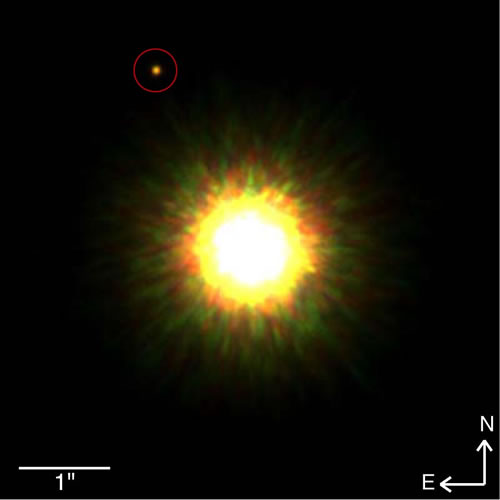
Young ExoplanetIn what may be the first ever picture of an Exoplanet orbiting a sun-like star, the image shown is of a young star named J160929.1-210524 and its potential planet. This extrasolar system lies 500 light-years from Earth and the exoplanet has been measured to have a mass 8 times that of Jupiter.
Until now, the only planet-like bodies that have been directly imaged outside of the solar system are either free-floating in space, or orbit brown dwarfs, which are dim and make it easier to detect planetary companions.
The Gemini North telescope on Mauna Kea in Hawaii was used to take the images utilizing adaptive optics technology to dramatically reduce distortions caused by the Earth’s atmosphere. The near-infrared images and spectra of the suspected exoplanet indicate that it is too cool to be a star or even a more massive brown dwarf, and that it is young. Taken together, such findings confirm that it is a very young, very low-mass object at roughly the same distance from Earth as the star.
Although it will take up to two years to verify the validity of this photograph the method used by the team is quite ingenious by "..targetting young stars so that any planetary mass object they hosted would not have had time to cool, and thus would still be relatively bright. This is one reason we were able to see it at all.”

Links:
http://arxiv.org/abs/0809.1424
http://www.gemini.edu/sunstarplanet
http://www.msnbc.msn.com/id/26722406/

NASA boosts Exoplanetology with Sagan Fellowships

In what may well be a boost to Exoplanetology, the NASA Exoplanet Science Institute announced in September 2008 the introduction of the Sagan Postdoctoral Fellowship Program and solicits applications for fellowships. This probably is NASA's response to the the staggering pace of of discovery of planets beyond our solar system, called exoplanets with more than 300 currently known.
The Sagan Fellowships support outstanding recent postdoctoral scientists to conduct independent research that is broadly related to the science goals of the NASA Exoplanet Exploration area. The primary goal of missions within this program is to discover and characterize planetary systems and Earth-like planets around nearby stars.
The Sagan Fellowships in Exoplanet Exploration was created to inspire the next generation of explorers seeking to learn more about planets, and possibly life, around other stars.
Decades ago, long before any exoplanets had been found, the late Carl Sagan imagined such worlds, and pioneered the scientific pursuit of life that might exist on them. NASA's new Sagan fellowships will allow talented young scientists to tread the path laid out by Sagan. The program will award stipends of approximately $60,000 per year, for a period of up to three years, to selected postdoctoral scientists. Topics can range from techniques for detecting the glow of a dim planet in the blinding glare of its host star, to searching for the crucial ingredients of life in other planetary systems. The proposed research may be theoretical, observational, or instrumental. The selections will be announced in February 2009.
"Only a select few scientists carry the insight, vision and persistence to open entire new vistas on the cosmos," said Neil deGrasse Tyson, astrophysicist and Frederick P. Rose director of the Hayden Planetarium at the American Museum of Natural History in New York. "We know about Einstein. We know about Hubble. Add to this list Carl Sagan, who empowered us all -- scientists as well as the public -- to see planets not simply as cosmic objects but as worlds of their own that could harbor life."

Links:
http://www.nasa.gov/home/hqnews/2008/sep/HQ_08-218_Sagan_Fellowships.html
http://www.astrobiology.net/archives/2008/09/carl_sagan_post.html

July 30, 2008

Ephemeral Worlds: Visualizing Exoplanets with Bubbles

Alien WorldIndeed Exoplanetology is the Art and Science of Exoplanets. These photographs of bubbles provide stunning insights into visualizing and imagining how unseen exoplanets might look like. Consider the fact that planets especially Jovian planets like Jupiter, are "bubbles" themselves, albeit gargantuan in scale. The biosphere of the Earth is in fact, a bubble. And by the fractal laws of nature, the surface of bubbles provide a striking resemblance to the appearance of planets with a suitable atmosphere.Alien World
Thus soap bubbles, ephemeral as they may seem - can help in visualizing exoplanets since their surfaces follow the same laws of physics. And as how these photographs by Jason Tozer attests to, exoplanets - like soap bubbles - are also works of art.
One photograph bears a striking resemblance to Jupiter's patterns. I am speculating that if it were photographed in zero-gravity it would look a lot more like Jupiter.
The rest of these otherworldly photographs sets my mind careening into outer space, imagining how exoplanets would look like. To imagine and visualize them is what I can do for now, for to even see a glimpse of them is beyond our lifetime.

July 26, 2008

Interactive: Four Planet-Hunting Methods

Here's a neat interactive from MSNBC providing an overview of 4 Methods of Exoplanet Detection: Astrometry, Radial Velocity, Transit, and Microlensing. Plus a chart of your local backyard sky showing the locations of some major exoplanet discoveries.
(Hover your mouse on the lower left and click on "Planet Finder").


Source: Other Worlds

July 20, 2008

Exosolar Interface

Visualization of Star Sytems and ExoplanetsJust came across this neat "exosolar" interface done in flash. Exosolar.net is an astronomy site where you can find about 2000 stars and their components (mostly within 75 lightyears). This flash-based interface was created to help visualize star-systems and exoplanets across galaxies, so you can imagine them in space, instead of reading columns of numbers like in a scientific journal.
The interface is sleek and smooth. Its a quick fun to get familiarized with Stars and their planets. The data is taken from The Internet Stellar Database, which is a welcome new addition to our references for Exoplanetologists.
Kudos and thanks to its maker, a Flash-guru named George Margaris.

July 18, 2008

SETI's Way of Celebrating Science & Imagination

SETIThis coming Saturday, July 19, 2008 there will be an interactive Family Science Fair at the SETI Institute, from 1:00-3:00 p.m. At SETI's Celebrating Science 2008 Family Science Faire, you will have the opportunity to meet SETI Institute scientists and discover what the future holds for SETI and astrobiology and learn about the SETI Institute's pioneering exploration of life, our solar system, and beyond, including the search for signals from other civilizations. You will also get to meet the father of SETI and author of the Drake Equation, Dr. Frank Drake.
The SETI Institute is located at 515 N. Whisman Road, Mountain View CA 94043.
Did I happen to mention that some people from Spore will be there? Oh and by the way, volunteers are needed for the event. I am volunteering as an alien specimen mascot. All I need is a teleporter or a spaceship with a warp drive to get me there from here (East Coast) for tomorrow's big day. Can someone give me a lift, please?

July 17, 2008

Seeing the Earth from Alien Perspective

EarthHere's how the Earth looks like from 31 million miles away. This clip was intended to shed light on how other Earth-like worlds would appear.
“Making a video of Earth from so far away helps the search for other life-bearing planets in the universe by giving insights into how a distant, Earthlike alien world would appear to us.”
The features that are most notable are the "sun-glint" caused by light reflected from Earth’s oceans. Similar glints to be observed from extrasolar planets could indicate the existence of alien oceans.
In infrared, land masses with vegetation are more apparent, because plants reflect more infrared light. Hence, infrared-imaging techniques could be used to observe extrasolar planets for signs of vegetation.
The video was captured by the Deep Impact Probe, whose extended mission now is called EPOXI (Extrasolar Planet Observation eXtended Investigation).

Links:
Alien’s-eye view of Earth
EPOXI

July 12, 2008

A Glimpse of Science Behind Spore

SimulationI was surprised to come across a program from the creators of Spore: ParticleMan simulates gravitational attraction between particles in a cloud. It's system was used to study such gravitational dynamics as orbits, nebula formation, star formation and particle streams from sources like pulsars and black holes.
My experience with the ParticleMan was clean. I saw the formation of stars and planets through the process of accretion - dusts and gas "coagulating" to form larger bodies. I also saw clues of binary star formations and interactions. Often, stars dance around tugging each other in circular orbits until some disturbances from planetesimals (or larger bodies) cause one of them to be hurled out of the Solar System at high speed (as is the fate of some unfortunate planetesimals that get in their way). Sometimes, though they merge together forming a bigger blob of mass.
What I can gleam from observing the simulation provided by ParticleMan is that proto-planets seem to battle it out for survival in the early stages of a Solar System's formation. In the chaotic melee, smaller clumps of rocks either get hurled out or get swallowed by bigger, more massive objects. The survivor planets are the ones that now occupy the stable orbits of a Solar System in equilibrium.
After a few minutes of observing, I was impressed with the light-weight program, considering the fact that it was just one of their many prototypes in the early stages of exploring the game's directions.
Stating the lack of science behind the game in my previous post about the Spore Creature Creator might have been premature, as there could be so much more to see in the actual Spore game to be launched in the next few months. I could be blown away when it finally goes out.
If game-makers deal with these kinds of Science, Gaming could be a great ally in teaching a great deal about the actual universe we live in.

July 3, 2008

Fetish: Magic Planet for my Bedroom

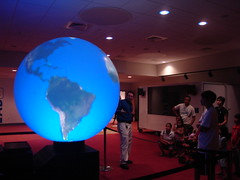
During my recent trip to the newly-renovated Liberty Science Center, a luminous sphere called The Global Microscope became my newest fetish. I later learned that it's called the "Magic Planet", a product from Global Imagination. The "Magic Planet" is indeed magical as it turned, tilted and rotated according to the presenter's whims. Using his wand-like remote control, the presenter provided a grand visual tour of various geologic features of Earth such as tectonic plates, earthquake zones, deep trenches and high areas on the surface of the planet.
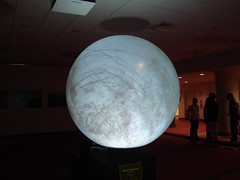
Numerous data sets on various aspects of the earth's climate were also presented - such as a rundown of all the earthquakes and typhoons around the world - using animated graphics superimposed upon varying graphical-representations of the Earth's surface. Europa
The other interesting part of the presentation involved a grand tour of the Solar System, showing all the planets, notably Mars, Venus, Jupiter in crisp detail. Our moon was also shown, as well as Enceladus, and the whole enchilada - Io, Ganymede, and upon my request - Europa.
All this show was done while controlling the tilt and rotation of the globe, and pausing at certain axes to examine points of interest in greater detail. After seeing it all, my curiosity prompted me to investigate it's inner workings.
After examining it up close, I discovered that it's actually a semi-transparent "plastic" sphere with the projector housed inside the base. It's probably similar to how IMAX works (in terms of the projector-lens and dome), except that the computer-generated images being projected from inside the sphere shows through outside the dome's surface. In essence, it's actually a spherized 'computer monitor', obviously tailored to simulate spherical surfaces.
Clearly, this is a wonderful display tool. Perfect for visualizing yet-unseen exoplanets and super-earths, too. I'd love to have one of these in my bedroom, except that I was told it costs around $30,000. Oh well, perhaps I'll just build one someday, DIY-style. So much for my fetish.

links: http://www.lsc.org/educators/jac/globalmicroscope/

July 1, 2008

Earth-like Worlds and the Rare Earth Hypothesis

Rare EarthI sincerely believe that the Earth is rare. I even dare say it is unique, just like how every human being is unique. Earth is truly one of a kind, and that is why I love it so much.
Now by saying that Earth is unique does not mean that there won't be other worlds like it. Thus there could be countless 'earth-like' worlds out there, but only some would have Life. And among those that are life-bearing, possibly only a fraction would be intelligent and sentient.
There is no debate in the argument of the Rare Earth hypothesis that the emergence of complex multicellular life on Earth required an improbable combination of astrophysical and geological events and circumstances. Other than that, it cannot have bearing on how common life is on other parts of the universe.
I appreciate the fact that the "Rare Earth Hypothesis" was aptly named - which simply means that the Earth is rare, which I rather consider the same as saying that diamonds are rare.
The Earth is precious and unique. There is no place like home.