December 12, 2008

Exoplanetary Thinking


Certain things happen to an individual who acts as a steward of this particular word, domain, or an entirely new field of science called Exoplanetology. It is new, and quite odd, having been derived from an alien-sounding word -- exoplanet, it ended up sounding humorous and brings up a cultic or thingamaphoooey tone. Yes, it is totally out of this world, but it is a word whose time has come.
Exoplanetology is unique. It is the overall Thought and study of external planets relative to the Sun and our home planet, but it will always involve our own planet, because it is relative to Earth. So there will always be a "personal" touch.
When I decided to take stewardship of the word (and domain), this word has taken hold of the mind of it's steward. In the process of developing this website, a certain kind of Thought began to pervade my mindset, as I became immersed in thinking about the earth, planets, exoplanets, new worlds, suns, galaxies, and life.
SunsetCould it be what we might call "Exoplanetary thinking"? Because I never think of the Sun the same way again. It is a star, one among billions, and I am standing on one of it's planets - a habitable one for me and all life I share it with.
On the other hand, I never gaze at stars thinking the same way again. They are other Suns, sign-posts for other solar systems with their own planets and moons, and possibly - Life.
I never looked at the horizon the same way again, with the setting or rising sun radiating marvelous rays, almost saying that just like light, the imperative of life is to spread far far away from where it started before it gets extinguished by the very spark that sustains it.
I never looked at the ocean and it's waves the same way again, that it is a magnificent experience just to feel the wind and the water and know that it is the whole planet touching my face.
I never took a deep breath the same way again, without the thought of mankind's responsibility for the planet, and the future of the biosphere at the hands of humanity.
Words will not fully express the mindset of an exoplanetary thinker. It will not suffice to tell of how one's view of earth gets changed by the knowledge of other worlds around other suns, and the idea of life in those planets, all this amidst the ongoing peril of one's home planet to the growing threat of runaway global warming.
It's been said that life is what we make it, thus we are at the cusp of a magnificent period in the history of mankind, where our history joins with the history of cosmic life, or it may well be the end.
We are at the edge of a revolution that is as great, if not greater than the Copernican revolution, or we may be one great tragedy.
Whence it was the realization that we are not the center of the world, or the universe, this time we will realize - we are not center of Life (and of Intelligent Life), but we have become the steward of life in our small corner of the galaxy, a special role to fulfill.
We are at a decision point where we could end up as another extinct civilization - an interesting subject of study for alien intergalactic historians and explorers. Or we could be those future extrasolar and intergalactic explorers, if we learned the proper stewardship of life.
We are at the crux of history and we are undergoing a shift in global and planetary thinking. Our children will grow up in a world knowing they are interplanetary citizens and awesome stewards of life. Welcome to the future and welcome to a brave new world.
And with Exoplanetology, I welcome you to the era of new worlds.


December 6, 2008

Students turned Planet-hunters

Student Planet-hunters: Francis Vuijsje, Meta de Hoon, and Remco van der Burg
Congratulations to the three students from the netherlands who turned out to be planet-hunters. Francis Vuijsje, Meta de Hoon, and Remco van der Burg discovered a very hot exoplanet called OGLE-TR-L9 b around a fast-spinning star.
More details about their discovery will be published in the forthcoming issue of the journal Astronomy and Astrophysics, but a glimpse of their story hints that the discovery is almost serendipitous: the students detected the exoplanet while testing a method for investigating light fluctuations of thousands of stars in the OGLE database in an automated way.
They combed through OGLE's database to sift through massive amounts of data and found the tell-tale pattern of a planet's existence from the fluctuations on the starlight detected over time.
OGLE-TR-L9 b
OGLE stands for Optical Gravitational Lensing Experiment. It is a Polish astronomical project based at Warsaw University that is chiefly concerned with discovering dark matter using the Microlensing technique. Since the project began in 1992, it has discovered several extrasolar planets as a side benefit.
You see, OGLE itself might not have been originally designed to hunt for exoplanets, and that makes it all the more fun serendipitously discovering gems.
Where the recent exoplanet discoveries that made headlines were made via direct imaging method, this one was discovered via some cool pattern-finding algorithms that sifted through differential photometry datasets from OGLE.
This method could usher in a new era for amateur exoplanetology, specially when the deluge of data from the new generation of space telescopes comes, and is made accessible to the public.
And so, many other "hidden" exoplanets could be lurking not only out there in space, but "inside" the hard-drives and database of OGLE that contain photometric data, and the tell-tale patterns of the existence of exoplanets are still be waiting to be discovered.

links:
From Livescience
OGLE

November 25, 2008

Planetology, A Primer to Exo

PlanetologyWhat happens when you team up together a geologist and an astronaut? You get this book, Planetology. It's a good primer for anyone who wants to begin exploring planets and worlds more alien than the planets within our own solar system. After all, one should get familiar with the local neighborhood before venturing out farther to extrasolar systems.
Starting with our home planet, magnificent earth gives us insights about other worlds. And that's where planetary geologist Ellen Stofan and astronaut Tom Jones pair images of Earth with astonishing scenes of alien surfaces beamed home by NASA’s robotic probes. This portrait of our solar system brings into view important contrasts between Earth and its neighbors in space.
This is a good book with vivid pictures of our local neighborhood, plus it contains a good introduction to exoplanets. Planetology first, then Exoplanetology.

November 19, 2008

Rhythm of Life

Rhythm CreatureIf anyone ever noticed the dynamic nature of our universe, one would not miss the property of rhythm embedded within the cosmic infrastructure.
The most obvious is the day and night cycle. Everyone knows it is a result of earth's rotation. Everything seems to be spinning, revolving, rotating -- galaxies, stars, planets and moons.
Now how does this relate to life?
Beginning with yourself, o mortal being, your whole life and consciousness rests upon rhythm and cycle. Your mind and body would not even survive without sleep for more than a week, er maybe a month for some.
The effect of "spin" naturally ripples all the way to the metabolism and physiology of any lifeform that manages to evolve within a "spinning" system.
Lets take a look at how rhythm affects all life on earth: The sleep cycle of every animal on earth is a natural outcome of the day and night caused by a spinning earth. Hibernation is caused by the seasons, a result of earth's tilted axis of rotation. Still other biological processes such as metamorphosis, bird migrations, and mating seasons (everybody's favorite) can be attributed to planetary characteristics of orbit and rotation.
There is no doubt, rhythm is embedded in the cosmos, and ultimately within life itself. Rhythm is one of the properties of life that is seldom mentioned, and yet is one of the primal screams of life itself.
Wherever life exists, on earth, in other planets of other suns, we can be sure that it is definitely ruled by rhythm as well.
Hinging on the fact that most exoplanets discovered so far have elliptical orbits, and speculating upon those whose orbits at least intersect the relative habitable zone, we can expect organisms that develop on that planet to adapt to the cycle of extreme weather patterns and seasons. It will "learn" to "hibernate" during a freezing season when its planet is farthest from its star, and "wake up" when its planet comes closer to its sun.
That was just an example, perhaps a little extreme to illustrate a point--but we can be sure of countless ways on how rhythm may be implemented in an almost infinite number of planets in the universe, each with it's own unique combinations of orbit, rotation, axis tilt, and so on.
And along with those planetary properties, comes the dizzying variety of how the resulting rhythm and cycle affects the development of life on those planets. We can expect those alien lifeforms to have a fair share of the similar rhythmic cycles we know of, such as sleep, hibernation, menstruation, migrations, metamorphoses and other forms of cyclical rhythms that are common to all forms of life.
The diversity of cosmic life, based solely on planet-induced rhythms could be quite unlike anything we've ever imagined, yet on the other hand -- they might behave quite similarly in some way or another, due to the universal rhythm of life.

November 14, 2008

Out into Space with Kepler

Exoplanetology is going to outer space. Yes, hitchin' a ride to space with the Kepler spacecraft. Haven't been able to take off and yet I already have the certificate to prove it. So what the heck is Kepler? Who the heck is Kepler?

Johannes Kepler was a German mathematician, astronomer and astrologer, and key figure in the 17th century Scientific revolution.

The Kepler Mission is a space photometer being developed by NASA to search for Earth-like planets orbiting other stars. It will be launched on March 5, 2009. So you can expect Earth's "twin" to make waves in the news shortly after that date, when Earth-like planets finally get discovered. Until then I will continue to stare at my certificate framed on the wall of my bedroom.

By the way, did I mention that you can get your name out into space, too and get your certificate as well? All the space-bound names will be stored on a DVD and rocketed into space on board the Kepler spacecraft. Just head over to this page and write a very good message or reason why Kepler is important. A copy of the DVD with all of the names and messages will be given to the Smithsonian Institution’s National Air and Space Museum. I sure hope they don't put it on Blu-ray because i dont have a blu-ray DVD player yet. I'm sure the aliens do. So make sure you write your hello message in good Klingon. Below is the message I wrote. Can anyone please translate it into Klingon:

"To discover the origin and future of life, and to find out mankind's place in the universe. Knowledge worth knowing within one's own lifetime, a simple truth worth knowing by an entire civilization."

Sweet.

Kepler Certificate

Links:
Messages of Kepler
Kepler Official Website

November 13, 2008

Worlds Imaged and Worlds Imagined

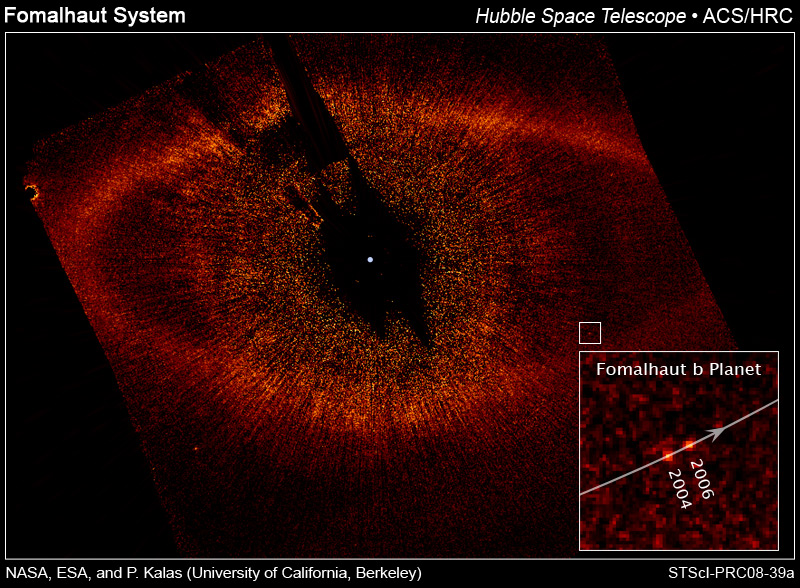
Today marks a great stride in how we see exoplanets, which have always remained as figments of our imagination and speculations. Where previous techniques only enable us to infer their existence by way of statistics, light curves, graphs and spectra, the big news today shows us direct images of extrasolar worlds.
While most exoplanets detected to date have been discovered using techniques such as Astrometry, Radial Velocity, Transit Method or Gravitational Microlensing, none would ever cause so much news coverage and impact as a "photograph" of another world. (Twitter went down shortly after the announcement, perhaps due to too many tweets about it). Although a huge bulk of future exoplanet discoveries would continue to be discovered by indirect techniques of planet detection, the method of Direct Imaging will pick up in the coming years, and soon we will finally see a photo of extrasolar continents.
The promise of the next generation of telescopes such as the Terrestrial Planet Finder (TPF), James Webb Telescope, Spitzer Telescope, New Worlds Mission, Kepler, and Space Interferometry Mission (SIM), will be bring even more amazing imagery. But hats off to good 'ol Hubble, who continues to bring us stunning pictures, in this case a snapshot of Fomalhaut b.
Artists will continue to bring us closer to these alien worlds, while computer simulations will always provide new insights, but imagination always will be our mind's eye.
Just imagine what goes on inside the mind of a child as you stand together gazing up in the night sky, and you point to a star and say, "that star over there has a planet, yeah that one right there..."
It's amazing, NOW we can finally say it with absolute certainty, just like that.
Just like that.


Other Links:
NASA/ESA Hubble
Physorg
Discovery Channel
Cosmic Ray
More on FomalHaut b

November 7, 2008

New Worlds: Exoplanet Discoveries from the Spitzer Space Telescope


An upcoming lecture is about the discovery of New Worlds by the Spitzer Space Telescope. As part of the von Karman Lecture Series, it will be held in Pasadena, California on Nov. 13 & 14 (Thu & Fri) at JPL and Pasadena College, respectively.
What's great is that we can also attend via the webcast at 7pm PST.
You must have the free RealPlayer8 Basic to see it.
More information about the lecture is located here.
Here's a summary of what's in store for the lecture:

New discoveries streaming back from the Spitzer Space Telescope continue to surprise and amaze everyone. No one could have predicted some of the amazing things we're finding, not even the mission scientists themselves! Spitzer has proved itself to be a true pioneer in the characterization of extrasolar planets, providing the first real, if crude, weather map of a world around another star over 250 light years away. We're also finding evidence of planet formation in the oddest places, from the cool, dark space around brown dwarfs to the hard-radiation baked environment near neutron stars. Come watch sunrise and sunset around a massive Jupiter-like planet, or trace high-velocity winds on an alien world where we've found water vapor in the cloud-tops. With Spitzer, these new worlds are becoming real places to us, challenging us to imagine even more.

Links:
More information about the Spitzer Space Telescope

October 24, 2008

Whole Universe In a Magazine

I don't usually buy magazines at newsstands but this one got the better of me. Discover's Whole Universe magazine is by far the most exoplanetology-centric magazine I've come across so far.
The articles are truly educational and the pictures are amazing. Two of its pages even shows the same image I selected for my past post "Extrasolarise" four months ago.
The only thing I can notice is the inconsistent naming convention of the exoplanet names. I was reminded of the cumbersome process of straightening out the exoplanet duplicates at wikipedia and freebase due to naming convention discrepancies where the space was absent between the star name and exoplanet index. For example, in the article - Forbidden Planets on page 36, Gliese 581d should've been Gliese 581 d.
It's quite trivial I know, and Freebase has now so wonderfully remedied this issue. But leniency to naming conventions would make it difficult to catalog the growing number of exoplanets in the long run.
But still, the magazine is splendid. I would love to come across such a kind of magazine in the newsstands once again.

October 10, 2008

An Exoplanet, its Moon, and Gas Clouds

ExoplanetThis is what hapens when I look too much at exoplanet paintings. Having recently purchased two books that feature the illustrations of Lynette Cook--one of which is Infinite Worlds--I was then inspired to let my imagination run wild, and mess around with Photoshop. What came up was this picture of a terrestrial exoplanet and it's moon with a glowing interstellar cloud in the background.
Both the exoplanet and it's moon is inhabited by alien civilizations. However, the lifeforms on each of them started almost simultaneously, evolved independently and in parallel. Therefore, their ecosystems differ significantly.
The difference in color between the exoplanet and its moon are caused by the distinct chemicals in their atmospheres that are caused by life's unique metabolisms.
The glow in the background is caused by cosmic rays bombarding a giant interstellar gas which cause it to become energetic.
It might be possible that life on both rocks were jump-started and sustained by the energy from the gas cloud.
Basking in an unlikely source of energy, life in this alien planetary system would be so much different than life on earth.
Different. But not impossible.


October 1, 2008

Pluto, Plutoids and Exoplutoids

At first I was saddened when Pluto was demoted from planethood. Then I was amused by the new classification called "plutoids". I love playing with words, but plutoid sounded too funny to me. Why not have Jupiteroid, or even Earthoid? And all the debate that ensued about pluto's demotion just prompted me to call Pluto as the Great Hemorrhoid of Astronomy, because it was painful to "lose" such a planet.
However, we are given a consolation by the fact that Pluto is still a planet in some way, eventhough the IAU denies it being so. Yes, it is actually a dwarf planet, and a first in its class called "plutoids".
So let us examine the heirarchy of these 3 terms: Planet, Dwarf Planet, and Plutoid.
A planet is a round object that orbits the sun. Its large enough for its gravity to clear out the rocks and other debris within its orbital path.
A dwarf planet is also a round object that orbits the sun. But it is too small to have anough gravity to clear out debris in its path. Hence there are other objects sharing its orbital path.
A plutoid in turn, is any dwarf planet that orbits farther out than neptune (a trans-neptunian object or TNO).
Ceres is an example of a dwarf planet. It is round and it orbits the sun in the asteroid belt, along with millions of other smaller objects. Pluto and Makemake are also dwarf planets since they also share their orbital path with other objects , but they are also plutoids, as is Eris. They are plutoids because they orbit farther from the sun than the farthest planet, Neptune.
So currently, some established members of the plutoid class are Pluto, Makemake, Haumea, and Eris. But it could well grow to more than 70 in a few years time as more dwarf planets fall into the class of plutoids.
Unlearning is also part of learning. And this is what progress in Science is all about. Painful and controversial as it may have seemed, the IAU's decision to "demote" pluto was necessary to for a better classification of a bewildering array of celestial objects orbiting our sun. To a certain extent, I support the IAU on their decision (even though it still needs a little tweaking). Most often than not, collective intelligence is smarter than emotions, and I believe it will sway one final tweak to simply put dwarf planets as a subset of the broader term "planet" to settle the debate.
Now what does it hold for Exoplanetology? As it will turn out, the term plutoids would actually make it easier to categorize "extrasolar dwarf planets" that fit in place: Exoplutoids! But it will be decades AFTER planet-hunting capabilities resolve to discovering earth-like planets. Then we may actually discover exoplutoids next.

September 29, 2008

Center for Exoplanets and Habitable Worlds

Penn State University has recently opened up a Center for Exoplanets and Habitable Worlds. Directed by Alex Wolszczan, Evan Pugh professor of astronomy and astrophysics, the center is devoted to broad, interdisciplinary research in the field of extrasolar planets, to promoting collaborations among scientists, and to improving science education at Penn State and among the general public.
Wolszczan discovered the first planets ever found outside our solar system in 1992, catapulting the field of extrasolar-planet studies into the forefront of astrophysics. Wolszczan had observed tiny fluctuations in the arrival times of the regular signals from a pulsar -- a telltale sign of the presence of orbiting planets around the rapidly spinning neutron star.
Three years later, the first extra-solar planet around a normal solar-like star, named "51 Pegasi b," was identified by Mayor and Didier Queloz. As of today, scientists have discovered more than 300 planets accompanying various types of stars.
The principal objective of research in the field of Exoplanetology is to find planets where living organisms exist, and to determine their rate of occurrence in the universe.
The research on exoplanets and the search for life is intertwined. Opening up a center focused on this field is welcome news for all enthusiasts of the burgeoning field of Exoplanetology.

Source(s):
http://live.psu.edu/story/34577/nw4

September 24, 2008

Infinite Worlds

Infinite Worlds
If there is any book at all that best captures Exoplanetology--The Art and Science of Exoplanets, then it is this book: Infinite Worlds by Ray Villard and Lynnette Cook.
If there is any book at all that best captures Exoplanetology--The Art and Science of Exoplanets and Life on other Worlds, then it is this book: Infinite Worlds by Ray Villard and Lynnette Cook. This book is truly a masterpiece worth having in the bookshelf of those who are enthralled by other worlds and beckoned by the prospect of life in other planets.
Although it has been published several years ago, this book will never cease to inspire the next generation of space explorers, and will continue to foster the momentum in exoplanet research by way of inspiration and imagination.
Prior to 1992 there were no known planets orbiting stars outside our own solar system. But the next few years have seen fast-paced developments in astronomy where over 300 extrasolar planets have been discovered by 2008--with more discoveries surely on the way.
Though it will be a few more years before we have compelling direct images of these far-flung worlds, this lavishly illustrated book gives us an idea of what they might look like.
A fascinating exploration of Exoplanetology written for a wide audience, Infinite Worlds brings together Lynette Cook's internationally renowned astronomical artwork, the latest and most dramatic images from the world's top observatories, and scientific findings on subjects ranging from stellar evolution and planetary formation to a possible universe filled with countless planets and life forms.
The newly discovered exoplanets are boggling astronomers' minds with their bizarre characteristics, including an unimagined diversity of sizes and orbits. In Lynette Cook's scientifically based illustrations, we glimpse the landscapes and atmospheres that might adorn these planets. Ray Villard's text elegantly describes the state of astronomy today, imagines where it will take us in the coming years, ponders the chances of success for the Search for Extraterrestrial Intelligence (SETI), and explores the survivability of life in an evolving and accelerating universe.

Links:
Lynnette Cook's SpaceArt