Showing posts with label Life. Show all posts
March 12, 2011
Miracle
Just before we head out to the night, let's look a bit into the unknown, for that's where the incredible lurks. Yes, I am paraphrasing a famous quote of Carl Sagan that somewhere, something incredible is waiting...well, you know the rest.
More often than not, the things incredible are unseen--as is the case with more than five hundred exoplanets we have catalogued so far. We infer their existence by detecting their gravitational effects upon their host stars, and by sensing the minute dips of starlight reaching our telescopes.
Exoplanet discoveries are a daily dose of the incredible. These fascinating worlds were unknown just a mere fifteen years ago. But now we live in an incredible moment in history where we can point at the stars and say there’s a planet there, and there.
Yet all these discoveries can shake us to the core, and render us gasping for meaning even more. How do we make sense of all of it? So what?! So what, if there are billions of other worlds out there? So what, if other planets are teeming with life? Worlds and the prospect of exolife can blow our minds, but only up to a certain extent. Only for while, we bask in the knowledge that took humanity thousands of years to uncover, and then at the end of the day, life goes on as usual. We have a busy life to live. And life goes on...
...but sadly, life ends, in different ways, in different places. We are ephemeral partakers in the great churning of the earth.
For a few moments in our lives, we all get a taste of the awe and wonder of what has been revealed during our time, and afterwards we get that feeling of insignificance over our brief stay on this planet. Bernard le Bovier de Fontenelle, a 16th century writer who wrote about the plurality of worlds, echoes that sentiment, "Behold a universe so immense that I'm lost in it. I no longer know where I am. I am just nothing at all."
Tonight, as you bask in the full torrent of human life, reflect on the Moment. And then give a hug to someone when you can, while you can.
I’d like to set a tone with pages from a soulful graphic novel, Daytripper. And i'll end this post with this thought: The Miracle is Everything, with you, here and now altogether.
December 2, 2010
Other Platforms of Life
![]() |
| Mono Lake, where the arsenic-loving GFAJ-1 was found. |
And we think that life can only occur in one way, in one place and at one time in the history of the earth.
Today, all that is about to change.
NASA scientists have found a bacteria whose biochemical make-up is quite different from the carbon-based life that we know of.
A bacteria called GFAJ-1 has been found in Mono Lake that eats arsenic, and also incorporates arsenic in its DNA as replacement for phosphorus--one of the usual set of components of "CHNOPS" (carbon, hydrogen, nitrogen, oxygen, phosphorus and sulfur) that form the basis of all life on earth.
I’ve always believed that our form of life is the only possible configuration. And now there is direct scientific evidence that it is possible for life to occur in other platforms.
This finding is mindblowing. It gives a preview of a "shadow biosphere" that could exist on our planet, and may strengthen the idea that life may be rampant elsewhere in the universe. All the more that this fascinating discovery was announced a day after astronomers revealed that the number of stars is 3 times more numerous than previously known--which means that there are gazillions more of exoplanets exist!
If we just found a hint of “shadow life” on our very own planet, then one can imagine the richness of life originating on other conditions and other chemicals on other planets.
Links:
Arsenic-eating microbe may redefine chemistry of life
Arsenic-Eating Bacteria Opens New Possibilities
September 10, 2010
Sentient Probes
Frankly, I am tired of us anthropomorphizing our space probes and imbuing them with personalities that aren't true.
It is time we do it for real.
We need probes that can make choices without human intervention. We need probes with actual personalities. We need not just Artificial Intelligence. We need Artificial Minds loaded on Sentient Probes.
Just imagine if the New Horizons probe, or Voyager--actually tweeted it’s own thoughts!
The trip to other worlds is such a boring affair for anyone, or any thing, such as a lifeless probe loaded with computers that merely process decisions and commands from humans sitting at the control center.
If we are ever going to send probes to other planets, let us give them minds of their own. Let’s give them more autonomy and a soul to squeeze. I am all for sentient probes.
But there is one crucial caveat: minds are restless.
Loading a sentient mind onto a probe that would traverse interstellar space for hundreds, even thousands of years is like torturing a virtual soul. Therefore, we need some way to keep them occupied. We need to load them up with lots of toys, playgrounds and what-have-you’s. Perhaps provide a companion with an opposing personality to keep them company. It would also serve to balance their collective behaviour. Kind of like left-brain/right-brain metaphor. It seems that virtual worlds are the most economical way to do it with regards to energy consumption on a long trip.
These probe-minds have to be active and humming and must be given an incentive to continue their mission. They must also be able to continually learn. And if their mission is to find life, what better incentive than to actually keep their life as an incentive.
It seems cruel, i know. That’s why I must elaborate upon that idea via a short story entitled "Life Begets Life" that I wrote for #FridayFlash. Of course, it has a tiny bit of exoplanet science so i can mention it on this blog.
And to make it exciting, I’ve put in some speculation regarding the presence of life on a tidally-locked planet, which is often orbiting relatively close to it’s host star. My guess is, life could be jump-started on the boundary where the roasted part of the planet meets the cold dark regions. I believe that Life is at the edge of Chaos and Order.
It is time we do it for real.
We need probes that can make choices without human intervention. We need probes with actual personalities. We need not just Artificial Intelligence. We need Artificial Minds loaded on Sentient Probes.
Just imagine if the New Horizons probe, or Voyager--actually tweeted it’s own thoughts!
The trip to other worlds is such a boring affair for anyone, or any thing, such as a lifeless probe loaded with computers that merely process decisions and commands from humans sitting at the control center.
If we are ever going to send probes to other planets, let us give them minds of their own. Let’s give them more autonomy and a soul to squeeze. I am all for sentient probes.
But there is one crucial caveat: minds are restless.
Loading a sentient mind onto a probe that would traverse interstellar space for hundreds, even thousands of years is like torturing a virtual soul. Therefore, we need some way to keep them occupied. We need to load them up with lots of toys, playgrounds and what-have-you’s. Perhaps provide a companion with an opposing personality to keep them company. It would also serve to balance their collective behaviour. Kind of like left-brain/right-brain metaphor. It seems that virtual worlds are the most economical way to do it with regards to energy consumption on a long trip.
These probe-minds have to be active and humming and must be given an incentive to continue their mission. They must also be able to continually learn. And if their mission is to find life, what better incentive than to actually keep their life as an incentive.
It seems cruel, i know. That’s why I must elaborate upon that idea via a short story entitled "Life Begets Life" that I wrote for #FridayFlash. Of course, it has a tiny bit of exoplanet science so i can mention it on this blog.
And to make it exciting, I’ve put in some speculation regarding the presence of life on a tidally-locked planet, which is often orbiting relatively close to it’s host star. My guess is, life could be jump-started on the boundary where the roasted part of the planet meets the cold dark regions. I believe that Life is at the edge of Chaos and Order.
September 2, 2010
Musings on the Implications of Synthetic Life on Astrobiology
A year before Craig Venter announced the successful creation of the first synthetic lifeform, i asked him what insights it could bring to the science of Astrobiology. I asked what it would mean if synthetic lifeforms gave off different biosignatures and how that would be beneficial to those curious about life on other worlds.
I don’t think i got a concrete answer from Craig Venter at that time, and even after that, I’ve never really read any writeup about the tremendous impact synthetic life will bring to Astrobiology. That was then during the Crossroads conference, way back in May 2009 where Dimitar Sasselov was present as well.
I simply headed home that night with a glimpse of the ground-breaking event that lay ahead.
A year later came Venter's announcement of the first ever synthetic lifeform. Now Fast forward to July 2010, Sasselov suddenly mentions Synthetic Life in his controversial TED talk. But everyone was simply distracted by the controversy and confusion introduced by Dimitar when he used the word "earth-like" rather than "earth-sized". Perhaps many missed another big picture--which is the link between Synthetic Biology and Astrobiology and the impact it would bring to our culture and future.
Now imagine this scenario:
Consider a planet, and know it’s properties, such as surface gravity, atmospheric composition, pressure and chemical characteristics, temperature, and so on. Then create a model of that environment, or a subset of it--called a “hab bubble”. Virtually design an extremophile microbe that would survive within that bubble. Simulate the microbe and it's habitable bubble in a "virtual world". Send that simulator on-board a probe, continuously adjusting the parameters as the probe travels toward an exoplanet. Feed the simulator with updated data as new findings are discovered along the way. Upon reaching the destination, manufacture the microbe using local resources or chemicals on that planet, "build and live off the land". Then unleash the lifeform by setting it loose on the surface of the exoplanet.
This simple scenario became the inspiration for a short story, my first #fridayflash or #FlashFiction entitled “The Biosynthe”.
Links:
The Biosynthe (Short Story)
Craig Venter's Synthetic Lifeform
Dimitar Sasselov's TED Talk
I don’t think i got a concrete answer from Craig Venter at that time, and even after that, I’ve never really read any writeup about the tremendous impact synthetic life will bring to Astrobiology. That was then during the Crossroads conference, way back in May 2009 where Dimitar Sasselov was present as well.
I simply headed home that night with a glimpse of the ground-breaking event that lay ahead.
A year later came Venter's announcement of the first ever synthetic lifeform. Now Fast forward to July 2010, Sasselov suddenly mentions Synthetic Life in his controversial TED talk. But everyone was simply distracted by the controversy and confusion introduced by Dimitar when he used the word "earth-like" rather than "earth-sized". Perhaps many missed another big picture--which is the link between Synthetic Biology and Astrobiology and the impact it would bring to our culture and future.
Now imagine this scenario:
Consider a planet, and know it’s properties, such as surface gravity, atmospheric composition, pressure and chemical characteristics, temperature, and so on. Then create a model of that environment, or a subset of it--called a “hab bubble”. Virtually design an extremophile microbe that would survive within that bubble. Simulate the microbe and it's habitable bubble in a "virtual world". Send that simulator on-board a probe, continuously adjusting the parameters as the probe travels toward an exoplanet. Feed the simulator with updated data as new findings are discovered along the way. Upon reaching the destination, manufacture the microbe using local resources or chemicals on that planet, "build and live off the land". Then unleash the lifeform by setting it loose on the surface of the exoplanet.
This simple scenario became the inspiration for a short story, my first #fridayflash or #FlashFiction entitled “The Biosynthe”.
Links:
The Biosynthe (Short Story)
Craig Venter's Synthetic Lifeform
Dimitar Sasselov's TED Talk
October 4, 2009
Exoplanetology on TED Talks
I love TED Talks. A few months ago, I wished that someone do a talk on Exoplanets. And here's a dream come true! Please welcome Garik Israelian talk about stars, exoplanets and how spectroscopy could reveal alien life.
June 25, 2009
The Living Rings of an Exoplanet
An idea came to my mind immediately after I learned that one of the rings of Saturn is being replenished by ejected material from Enceladus.What if on a distant exoplanetary system, life manages to spark and thrive within the sub-surface ocean of an Enceladus-like exomoon? And if that exomoon spews out material the same way Enceladus does, then microscopic lifeforms may get ejected along with the salty nutrients, perhaps by piggybacking on ice crystals or water droplets of the plumes. If they survive the trip outward through the vents, what comes next is fascinating: Life on Exoplanetary rings! They will then thrive off the minerals and nutrients of the rings as it is replenished by the exomoon.
We call these resilient organisms as Extremophiles. They are those that thrive in harsh environments where we don't expect life to flourish.
Do you remember the water bear that survived in outer space? Remember the recently-discovered species of bacteria that live in Earth's Stratosphere? We can almost say that with extremophiles, anything is possible! Therefore, this conjecture of life on planetary rings is worth pondering upon.
What will these "Living Exoplanet Rings" look like? Well, if it exists then it would provide a spectacular sight to behold.

Imagine a multi-colored band of rings, each band occupied by different species adapted to the properties of each ring. If this scenario happened on Enceladus, it would not just be the E-rings that would be populated by micro-organisms. As they feed, evolve and grow in size, some species would migrate to another orbit or band of ring.
And if these living ring ecosystem evolves with enough complexity, they may even pulsate, sparkle or glitter. Imagine all the colors and beauty that a "living ring" of a planet would exhibit. It would be like a flat coral reef in space. The beauty of an artificial Planetary Ring Art Installation is no match for the primeval art created by Nature and Life.
And what would these microscopic "ring organisms" look like? Well, perhaps it may look just like any other cellular lifeform but in this scenario it may develop a crytal-like structure in it's membrane to enable itself to link and separate with other crystals. Or perhaps they may exploit the ionized particles in the rings to use magnetism for 'locomotion'. I am simply postulating a mechanism by which they can increase or decrease their size and mass in order to migrate to other rings of orbit. They may utilize crystals for other purposes as well, bending and focusing light for cellular communication, and perhaps for chemical synthesis--in other words--for cooking!
I speculate that once a migration loop occurs between those thriving on the rings and those living on the exomoon, then the rate and diversity of evolution of these ring-lifeforms may be boosted, along with hastened mutations caused by cosmic rays. Those that get swept back onto the orbiting moon would reproduce to create another set of species that is already adapted to live on the planetary rings, plus some random extra qualities of the next generation. All they need to do is ride on the jet stream from the sub-surface ocean through the vents and out into space and onto the rings, and the cycle goes on.
If we further take into account the possibility that the ring organisms may eventually end up on the planet itself, then a diverse ecosystem will be created that encompasses a moon, a planet, and it's rings.
You see, the presence of life makes things a little bit more exciting. And for planetary rings, it may be true as well--even when it is within the confines of conjecture and imagination.
Links:
ESA: Sodium salts point to subsurface ocean on Enceladus
April 12, 2009
Happy Easter! A Greeting to take to Brave New Worlds!
Today, it's either you greeted someone or you have been greeted with a "Happy Easter!". Such exchanges have a deeper meaning that goes beyond those simple words. Easter has something to do with Life, the greatest force in the Cosmos.We seek life in every planet to know our place in the universe. And we plan to someday fare in space. The human race has a potential future bound for the stars to colonize other worlds. But as individuals, we are here for a moment, and then gone. Like a twinkling flicker, the spark of life within us is but a momentary gift. Our bodies are star stuff and we will rejoin the dust of earth. The featureless state of death is the ultimate fate, even for the most advanced lifeform that thrives a thousand galaxies away. So I suppose that any civilization that arises will have some kind of "Easter" in a similar vein, some kind of hope for immortality.
The Second Law of Thermodynamics runs true in every part of the cosmos, and Entropy is the tombstone of every living thing. The hope of the Singularity is but a life-extension fancy. And the defeat of Death is in another realm.
Easter is a great chronicle of humanity's longing to be saved--or perhaps a Saviour's longing to save humanity--from Death. Whichever is the case, such longing will remain in the human psyche wherever life takes them, even to other planets!
And wherever any form of life takes hold, perhaps in much due time the highest state of sentience and consciousness will never fail to grasp the mortality of itself. And will tend to make the most of that dwindling spark.
As such, a Happy Easter is meant to be celebrated with the utmost joy. For happiness can be had at each moment, whether you believe you will return to nothingness or whether you will attain the everlasting life that you hope for.
Hug your loved ones and kiss them, as you say those words. Revel in the wonder that your greeting will be shared by them and their children's children onward as they take it to the stars, and onto those brave new worlds.
Happy Easter!
March 5, 2009
Looking Through Kepler's Eyes
All eyes are upon the Kepler Telescope on the night of March 6 as it launches into space. Kepler will serve as our eyes as we scan the heavens for other Earths. But exactly where will our "Keplerian eyes" be looking at?Kepler will unblinkingly stare at a small patch of sky in the Cygnus constellation (The Swan), with a field of view that is roughly equivalent to two scoops of the Big Dipper.
Now one must ask, Why did the Kepler team choose the Cygnus constellation?
The Kepler team clearly outlines their reason for choosing Cygnus:
"Since transits only last a fraction of a day, all the stars must be monitored continuously, that is, their brightnesses must be measured at least once every few hours. The ability to continuously view the stars being monitored dictates that the field of view (FOV) must never be blocked at any time during the year. Therefore, to avoid the Sun the FOV must be out of the ecliptic plane. The secondary requirement is that the FOV have the largest possible number of stars. This leads to the selection of a region in the Cygnus and Lyra constellations of our Galaxy as shown."
A most excellent choice, I say!The Cygnus constellation lies along the plane of the Milky Way, and looking in that small section of the sky from our location gives a view of a plethora of stars--greater than a hundred thousand of them! And for Kepler who will trail the earth in it's orbit around the sun--the view to this star-studded patch of sky is wide open the whole year round.
But for those earth-bound stargazers who want to look at the patch of sky where Kepler will be staring at, you'll have to wait until around June because the Cygnus constellation will only become visible in the northern skies around that time until around December.
But that makes summer's arrival even more exciting, because that patch of sky will be a welcome target for exogazers who would want to "connect" with the whole essence of Kepler's endeavor in a more personal way by looking towards Kepler's direction. To thoughtfully gaze at that same patch of sky is to capture the essence of man's ancient longing to find his place in this lonely universe.
Is Earth the only bearer of life? If we find an Earth twin, it will give an insight as to our place in the cosmos. And if we find signs of Life, it will serve as a mirror to find out a little more of ourselves. What is Life? What is Man? This ancient query is echoed by the ancient text of the Psalms.
"When I consider your heavens, the work of your fingers, the moon and the stars, which you have set in place, what is man that you are mindful of him?" - Psalms 8:3
And even in our modern day, depressing as it seems to many, we have not stopped looking to the skies to save us from our own lonesomeness.
"I'm looking to the sky to save me,
Looking for a sign of life,
Looking for something to help me burn out bright"
- Foo Fighters (Learn to Fly)
But is Kepler looking in the right direction for signs of life? The final insight I will provide might seem to be a mere coincidence, and perhaps symbolic in nature.Cygnus, The Swan is also home to a prominent asterism called the "Northern Cross". But even more striking is that looking at the Northern Cross from an ancient Egyptian's eyes gives the Ankh symbol, a vessel of Life.
Any good part of the Milky Way may have been a good target but the symbolisms behind Cygnus makes it an even sweeter spot to search for Earth-like planets, and life.
As you can see, the view through Kepler's eyes is rich with Science, Technology, Symbolism, Faith, and Legends--all the stuff of Humanity--because in essence Kepler is actually looking inwards towards the heart and soul of Mankind !
Sources:
Kepler Website: http://www.nasa.gov/mission_pages/kepler/main/index.html
January 29, 2009
Another Earth
Could we be unique in the universe or is there another planet similar to earth somewhere in the cosmos? Is it possible that Alpha Centauri, our nearest star, is home to another earth-like planet? Earth sized planets have been hard to find, but indirect methods are coming on line to give scientists a good survey of how many such bodies may be in the universe. How rare would it be to find life on another earth-like planet?
For more info, please visit http://www.history.com/universe
January 15, 2009
Mars as an exoplanet
What do i think about the methane on Mars? Is it geological in nature, or biological? At this point, it can go either way. I could end this post with a 50/50 to play it safe. But that would be boring.
So i'll share what's on my mind: I have a 60% hunch that the methane is caused by microbes. 40% chance it is caused by geochemical means.
Let me give 2 clues why i think so.
First, Mars has no magnetic field. It may have little movement going on within it's interior by way of lava. That is why there are no active volcanos on Mars.
Second, there are microbes known to man that can thrive in temperatures as frigid as Mars. If "psychrotolerant" doesn't ring a bell, feel free to visit this discovery made by NASA scientists themselves way back in 2005. I think the Marsian organisms responsible for the methane are similar to Carnobacterium pleistocenium, an extremophile that can survive a frozen state.
The "seasonal" detection of methane may be due to the thawing of these hardy creatures. And you know what happens when microbes wake up during the warmer Martian summers - they eat, and fart (there goes your methane). Then they sleep again when the Martian winter sets in.
It will take years to send probes and dig up the site, or do some methane isotope-testing to settle the score. Until then, one thing i can suggest is to measure the seasonal methane emissions at exact intervals and see if they increase over time. If the level of seasonal methane increases every Martian year, then that could mean the population of microbes are increasing. Now that further increases the probability that the methane is indeed caused by, well...microbes.
If I'm wrong, well just remember: I was pretending that Mars was an exoplanet. Now if there are tons of Mars-like exoplanets out there, my scenario must be right in at least one of them!
January 1, 2009
The Future of Exoplanetology

They say the best way to predict the future is to invent it. Here is how the future will be invented as seen from the lens of Exoplanetology. The list below can be treated as a roadmap for those involved. It can also be considered as a hopeful glimpse of what is to come.
1) Deluge of Exoplanets - between 60 to 80 new exoplanets within 2009 will be discovered. Last year's forecast of 60+ new exoplanets for 2008 came true. Yet again, there is no reason why this year's planet-hunt won't be as exciting as last year.
2) New Eyes - The development of new generation telescopes (both space-based and land-based) will continue from this year onwards to bring unprecedented new discoveries. See this list of telescopes to see astronomy's new arsenal, which includes Kepler, Terrestrial Planet Finder (TPF), James Webb Telescope, Spitzer Telescope, New Worlds Mission, and Space Interferometry Mission (SIM). Although direct imaging technique will continue to make waves in the news, transit method will continue to pile up new exoplanet discoveries. The power of a new set of eyes will set the stage for amazing things that is to come.
3) New Brains - data gathered by some new generation telescopes will gradually be opened up for public consumption starting in 2010 or 2011. Number-crunchers, algorithms and software will sift through terabytes and petabytes of collected data to discover new planets by way of numbers, statistics, and computation. Candidates for "habitables", exoplanets that lie inside the habitable zone (HZ), will be filtered from massive amounts of data, helping telescopes identify good interesting targets.
More powerful but cheaper computers, with dual core or multiple core set up in parallel, will enable more detailed simulations of planet-formations and alien solar systems, providing better insights for exoplanet science.
4) Amateur Boom - Amateur exoplanetology will explode. Projects similar to Systemic, SETI@home (or their mashup) will enable amateurs to contribute to science. Crowdsourcing, baby! Or call it Amateursourcing!
Cheaper and more powerful telescopes, and affordable CCDs for differential photometry will enable amateur astronomers to discover new exoplanets, a la do-it-yourself (DIY) exoplanet-hunting. This will take off, possibly going mainstream in amateur astronomy sometime in 2010 or 2011 onwards.
5) Signs of life - More signs of life beginning in 2010-ish. More organic clues detected in atmosphere of exoplanets. Strong evidence will continue to mount, pointing to the ever-growing possibility of extra-terrestrial life.
6) Superdupers - More Super-Earth detections will become more common starting in 2011 or 2014. "Habitables" or "Habs" will pour in. Water-worlds will flood the news.
7) Exotics - Exomoon detection capability takes off in 2012 to 2014. New exotic discoveries will also start to pour in. Classifying celestial objects becomes even more challenging for astronomers. Imagine earth-sized exomoons with their own moons! What will you call them? Exomoonoids?
8) Earth Galore - More and more Habs and earth-like planets in habitable zones between 2015 to 2020 will pour in. Advances in technology and planet-hunting methods will enable us to resolve exoplanets the size of earth and smaller. There will then be more than a thousand total exoplanets in the list. Direct-imaging methods will be in greater demand as ever.
9) Shockwave - Mankind will be thrown in a theological and religious turmoil. A period of adjustments in worldviews will occur as mankind tries to make sense of their being amidst the impending discovery of another earth with life.
Spiritual individuals have no problems with it whatsoever. But Religions will start to revise old beliefs and begin re-interpreting scriptures to prepare for the ramifications of the discovery of...
10) Life - Scientific confirmation of exo-life happens between 2020 to 2030-ish. Astrobiologists will finally confirm that life exists on another planet of another star. It may not be in an earth-like exoplanet at all, perhaps not even in a planet, and may not even be life-like. It is something so incredible that no one has ever predicted.
December 12, 2008
Exoplanetary Thinking

Certain things happen to an individual who acts as a steward of this particular word, domain, or an entirely new field of science called Exoplanetology. It is new, and quite odd, having been derived from an alien-sounding word -- exoplanet, it ended up sounding humorous and brings up a cultic or thingamaphoooey tone. Yes, it is totally out of this world, but it is a word whose time has come.
Exoplanetology is unique. It is the overall Thought and study of external planets relative to the Sun and our home planet, but it will always involve our own planet, because it is relative to Earth. So there will always be a "personal" touch.
When I decided to take stewardship of the word (and domain), this word has taken hold of the mind of it's steward. In the process of developing this website, a certain kind of Thought began to pervade my mindset, as I became immersed in thinking about the earth, planets, exoplanets, new worlds, suns, galaxies, and life.
Could it be what we might call "Exoplanetary thinking"? Because I never think of the Sun the same way again. It is a star, one among billions, and I am standing on one of it's planets - a habitable one for me and all life I share it with.On the other hand, I never gaze at stars thinking the same way again. They are other Suns, sign-posts for other solar systems with their own planets and moons, and possibly - Life.
I never looked at the horizon the same way again, with the setting or rising sun radiating marvelous rays, almost saying that just like light, the imperative of life is to spread far far away from where it started before it gets extinguished by the very spark that sustains it.
I never looked at the ocean and it's waves the same way again, that it is a magnificent experience just to feel the wind and the water and know that it is the whole planet touching my face.
I never took a deep breath the same way again, without the thought of mankind's responsibility for the planet, and the future of the biosphere at the hands of humanity.
Words will not fully express the mindset of an exoplanetary thinker. It will not suffice to tell of how one's view of earth gets changed by the knowledge of other worlds around other suns, and the idea of life in those planets, all this amidst the ongoing peril of one's home planet to the growing threat of runaway global warming.
It's been said that life is what we make it, thus we are at the cusp of a magnificent period in the history of mankind, where our history joins with the history of cosmic life, or it may well be the end.
We are at the edge of a revolution that is as great, if not greater than the Copernican revolution, or we may be one great tragedy.
Whence it was the realization that we are not the center of the world, or the universe, this time we will realize - we are not center of Life (and of Intelligent Life), but we have become the steward of life in our small corner of the galaxy, a special role to fulfill.
We are at a decision point where we could end up as another extinct civilization - an interesting subject of study for alien intergalactic historians and explorers. Or we could be those future extrasolar and intergalactic explorers, if we learned the proper stewardship of life.
We are at the crux of history and we are undergoing a shift in global and planetary thinking. Our children will grow up in a world knowing they are interplanetary citizens and awesome stewards of life. Welcome to the future and welcome to a brave new world.
And with Exoplanetology, I welcome you to the era of new worlds.
November 19, 2008
Rhythm of Life
If anyone ever noticed the dynamic nature of our universe, one would not miss the property of rhythm embedded within the cosmic infrastructure.The most obvious is the day and night cycle. Everyone knows it is a result of earth's rotation. Everything seems to be spinning, revolving, rotating -- galaxies, stars, planets and moons.
Now how does this relate to life?
Beginning with yourself, o mortal being, your whole life and consciousness rests upon rhythm and cycle. Your mind and body would not even survive without sleep for more than a week, er maybe a month for some.
The effect of "spin" naturally ripples all the way to the metabolism and physiology of any lifeform that manages to evolve within a "spinning" system.
Lets take a look at how rhythm affects all life on earth: The sleep cycle of every animal on earth is a natural outcome of the day and night caused by a spinning earth. Hibernation is caused by the seasons, a result of earth's tilted axis of rotation. Still other biological processes such as metamorphosis, bird migrations, and mating seasons (everybody's favorite) can be attributed to planetary characteristics of orbit and rotation.
There is no doubt, rhythm is embedded in the cosmos, and ultimately within life itself. Rhythm is one of the properties of life that is seldom mentioned, and yet is one of the primal screams of life itself.
Wherever life exists, on earth, in other planets of other suns, we can be sure that it is definitely ruled by rhythm as well.
Hinging on the fact that most exoplanets discovered so far have elliptical orbits, and speculating upon those whose orbits at least intersect the relative habitable zone, we can expect organisms that develop on that planet to adapt to the cycle of extreme weather patterns and seasons. It will "learn" to "hibernate" during a freezing season when its planet is farthest from its star, and "wake up" when its planet comes closer to its sun.
That was just an example, perhaps a little extreme to illustrate a point--but we can be sure of countless ways on how rhythm may be implemented in an almost infinite number of planets in the universe, each with it's own unique combinations of orbit, rotation, axis tilt, and so on.
And along with those planetary properties, comes the dizzying variety of how the resulting rhythm and cycle affects the development of life on those planets. We can expect those alien lifeforms to have a fair share of the similar rhythmic cycles we know of, such as sleep, hibernation, menstruation, migrations, metamorphoses and other forms of cyclical rhythms that are common to all forms of life.
The diversity of cosmic life, based solely on planet-induced rhythms could be quite unlike anything we've ever imagined, yet on the other hand -- they might behave quite similarly in some way or another, due to the universal rhythm of life.
October 10, 2008
An Exoplanet, its Moon, and Gas Clouds
This is what hapens when I look too much at exoplanet paintings. Having recently purchased two books that feature the illustrations of Lynette Cook--one of which is Infinite Worlds--I was then inspired to let my imagination run wild, and mess around with Photoshop. What came up was this picture of a terrestrial exoplanet and it's moon with a glowing interstellar cloud in the background.Both the exoplanet and it's moon is inhabited by alien civilizations. However, the lifeforms on each of them started almost simultaneously, evolved independently and in parallel. Therefore, their ecosystems differ significantly.
The difference in color between the exoplanet and its moon are caused by the distinct chemicals in their atmospheres that are caused by life's unique metabolisms.
The glow in the background is caused by cosmic rays bombarding a giant interstellar gas which cause it to become energetic.
It might be possible that life on both rocks were jump-started and sustained by the energy from the gas cloud.
Basking in an unlikely source of energy, life in this alien planetary system would be so much different than life on earth.
Different. But not impossible.
Tags:
Alien,
Art,
Astrobiology,
Earth-like,
Exobiology,
Exoplanet,
Extra-Terrestrial,
Life,
Lynnette Cook
July 17, 2008
Seeing the Earth from Alien Perspective
Here's how the Earth looks like from 31 million miles away. This clip was intended to shed light on how other Earth-like worlds would appear.“Making a video of Earth from so far away helps the search for other life-bearing planets in the universe by giving insights into how a distant, Earthlike alien world would appear to us.”
The features that are most notable are the "sun-glint" caused by light reflected from Earth’s oceans. Similar glints to be observed from extrasolar planets could indicate the existence of alien oceans.
In infrared, land masses with vegetation are more apparent, because plants reflect more infrared light. Hence, infrared-imaging techniques could be used to observe extrasolar planets for signs of vegetation.
The video was captured by the Deep Impact Probe, whose extended mission now is called EPOXI (Extrasolar Planet Observation eXtended Investigation).
Links:
Alien’s-eye view of Earth
EPOXI
July 1, 2008
Earth-like Worlds and the Rare Earth Hypothesis
Now by saying that Earth is unique does not mean that there won't be other worlds like it. Thus there could be countless 'earth-like' worlds out there, but only some would have Life. And among those that are life-bearing, possibly only a fraction would be intelligent and sentient.
There is no debate in the argument of the Rare Earth hypothesis that the emergence of complex multicellular life on Earth required an improbable combination of astrophysical and geological events and circumstances. Other than that, it cannot have bearing on how common life is on other parts of the universe.
I appreciate the fact that the "Rare Earth Hypothesis" was aptly named - which simply means that the Earth is rare, which I rather consider the same as saying that diamonds are rare.
The Earth is precious and unique. There is no place like home.
May 24, 2008
Extremophiles increases the Possibility of Life Elsewhere
Finding life on extreme conditions on our own planet might gives us a better gauge as to how life might fare on other worlds. The record-breaking discovery of microbes 1.6 kilometers beneath the ocean floor is the latest clue. The microbes are an Archaean species of the heat-loving Pyrococcus which can thrive at temperatures of 100°C, a temperature which would destroy most living organisms.If the whole universe were a laboratory for testing the resiliency of life, then the sheer number of exoplanets and their moons, which are far greater than the number of stars, would have provided a diverse landscape for life to flourish, thereby increasing the possibility of extrasolar life even more.
Link: Nature News
May 6, 2008
ExoGaia Hypothesis
My short answer is simply because Life is fun! But we may in fact leave it plain and simple as the pure science of exoplanets. But I'm afraid that definition will be temporary. In due time, life will ultimately be detected on other worlds. And those who are familiar with James Lovelock's Gaia Hypothesis knows that a planet is never the same once Life takes hold of it. It becomes a planet-life symbiosis. The planet becomes a living organism.
Life ultimately alters the make-up of planets, while on the other hand the undulations of the surface of the planet (earthquakes, volcanic activities, tectonics, etc) affects the course of life's evolution. The metabolisms of life changes the "atmosphere" of planets, vise-versa and so on. For example, the planktons, green algae or microscopic plants have been responsible for the copious amounts of Oxygen on Earth's atmosphere, where previously - some few millions of years ago, there was Methane and other gases instead. Now humans are about to replace it with CO2!
So, in the study of exoplanets, the parameter of life is inherently entwined. As a matter of fact, in trying to understand the gases in an exoplanet's atmosphere, an inference to the presence of life is almost always taken into account as a possible catalyst.
Hence, there is no other way but to add "the search for Life" to Exoplanetology at this point. And this is also to inspire all the those who undertake the task of answering one of man's deepest questions, "Are We Alone?". So for now, while we're still searching, we can leave it at that. (Besides, I think its time for interdisciplinary collaborations between related sciences: Isnt it fun to bring aspects of Astrobiology, Astronomy, Cosmology and even Climatology together into Exoplanetology?)
But once we finally discover exoplanetary life, I will immediately change the definition of Exoplanetology to "The Art and Science of Exoplanets and Life on Other Worlds."
And by the way, if Gaia is to Earth, then could ExoGaia be for Exoplanets?
April 20, 2008
Other Platforms of Life
Imaginary but possible lifeforms on a jupiter-like planet. Photo from page 42 of Carl Sagan's Cosmos.
I'm reminded of the musings and calculations of the late Carl Sagan (with his colleague E. E. Salpeter) regarding the form of life that may arise from a Jupiter-like planet. They would look like gigantic Jellyfish basked in gasses (such as ammonia and methane) that may be poisonous to us, but is the basis of their very life.
Because life that happens to sprout in a certain environment thrives off the available "resources" that happen to be there. We've seen it in extremophiles on our very own planet. It may very well be the case elsewhere.
With the multitude of combinations of different properties of stars and exoplanets (such as mass, temperature, chemical make-up) the possibilities and variety of life across the universe might be endless and may be totally anything we could ever imagine.
March 17, 2008
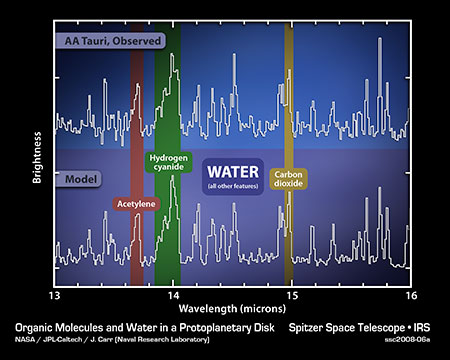
Water and Organic Molecules on AA Tauri
Great news today. Water and some organic molecules has been detected on AA Tauri's protoplanetary disk.
AA Tauri is a star 450 lightyears from earth. Protoplanetary disks are dust, rocks and clouds around a star that are raw materials for planet-formation. The particular disk where the organic molecules were detected are within 3 Astronomical Units (AU) from AA Tauri. Spitzer Space Telescope’s spectrograph captured data from the disk which very much resembles the signature of organic molecules and water on Earth.
What does this mean? There's a big chance that the planet that will form from such water-abundant and organic-rich materials will be conducive to life.
Links:
Centauri-Dreams
Science Mag Abstract
Photo Credit: NASA/JPL-Caltech/Naval Research Laboratory
AA Tauri is a star 450 lightyears from earth. Protoplanetary disks are dust, rocks and clouds around a star that are raw materials for planet-formation. The particular disk where the organic molecules were detected are within 3 Astronomical Units (AU) from AA Tauri. Spitzer Space Telescope’s spectrograph captured data from the disk which very much resembles the signature of organic molecules and water on Earth.
What does this mean? There's a big chance that the planet that will form from such water-abundant and organic-rich materials will be conducive to life.
Links:
Centauri-Dreams
Science Mag Abstract
Photo Credit: NASA/JPL-Caltech/Naval Research Laboratory
Tags:
AA Tauri,
Earth,
Life,
organic,
Planet-formation,
Protoplanetary Disk,
Spitzer,
Star,
water
Subscribe to:
Posts (Atom)