So you've heard that planets are more numerous than stars? That discovery is mind-blowing by itself, but even more fascinating is how that exogasmic discovery was made. Dig deep into the technology behind Gravitational Microlensing and you’ll find out something playfully interesting; A graphics card originally intended for videogames was used to discover the rogue planets!
A member of the astrophysics team named Joe Ling has turned his love of computer games into a way of discovering the wandering planets in our galaxy. He took a $400 gaming graphics card and wired it into the team's computer, which sped up the process known as microlensing modelling.
Without the gaming card it would take hundreds of computers and cost thousands of dollars; and it would take one month to process on a normal desktop computer. But with the graphics processing unit inside the gaming card it only takes six hours.
Gaming not only inspires imagination and creativity, it's also a source of technological marvels as it constantly strives for deeper levels of immersion. No wonder I've been rekindling the joy of immersing myself into the virtual worlds of videogames even more. And I often find myself reflecting and realizing that there is no difference between "virtual" and "real". The intersection of Videogames and Exoplanet Science is just one proof of that metaphysical fact.
Links:
Planets Outnumber Stars
Intersection of Videogames and Exoplanet Science
Videogames: A Path to Reflection and Self-enlightenment (Kill Screen)
Showing posts with label planet-detection. Show all posts
June 8, 2011
June 8, 2010
TRAPPIST, A New Exoplanet-Hunting Telescope
For the record, I'd like to post this info about TRAPPIST, the most recent entry to our slew of planet-hunting telescopes. TRAPPIST (TRAnsiting Planets and PlanetesImals Small Telescope) is a new robotic telescope from ESO at La Silla Observatory, in Chile. It is devoted to the study and detection of exoplanets and it will also study comets orbiting around our Sun. That is a nice combination to deal with the theme in Astrobiology about the study of the origin of Life.
TRAPPIST is a 60-cm telescope being remotely-operated from a control room in Liège, Belgium, 12,000 km away.
As it's name suggests, TRAPPIST will use the transit method, which is the same method that Kepler uses to hunt for planets. From its official website, there is no mention whether it is equipped with Adaptive Optics to counteract the effects of the Earth's atmosphere. But from the excellent night sky in Chile--aside from adding more entries into our known exoplanets database--we hope TRAPPIST will be capable of detecting earth-like planets as well.
Links:
TRAPPIST Official Website
TRAPPIST is a 60-cm telescope being remotely-operated from a control room in Liège, Belgium, 12,000 km away.
As it's name suggests, TRAPPIST will use the transit method, which is the same method that Kepler uses to hunt for planets. From its official website, there is no mention whether it is equipped with Adaptive Optics to counteract the effects of the Earth's atmosphere. But from the excellent night sky in Chile--aside from adding more entries into our known exoplanets database--we hope TRAPPIST will be capable of detecting earth-like planets as well.
Links:
TRAPPIST Official Website
May 30, 2009
The First Exoplanet of Astrometry: VB 10b
The planet-hunting technique called Astrometry has finally snagged it's first catch -- a Jupiter-like planet called VB 10b, orbiting a small star.Astrometry involves measuring the motions of a star as an unseen planet tugs the star back and forth. This technique has been in the list of planet-hunting methods for quite a while now. Actually, since around 1950's that several claims of exoplanets discoveries were made using this technique. But only now has it's first discovery been verified.
It has taken 12 years for VB 10b's discoverers, Pravdo and Shaklan--to finally announce the existence of an exoplanet orbiting a dim M-Dwarf star located 20 light-years away in the constellation Aquila.
This finding may mean that astrometry could be a powerful planet-hunting technique for both ground- and space-based telescopes. It may also enliven the amateur planet-hunting community involved with this technique using CCDs.
The discovery is very exciting. It has elicited wonderful remarks from the scientists active in the field. The chief scientist for NASA's Exoplanet Exploration Program at JPL said that this "is a hint that nature likes to form planets, even around stars very different from the Sun". And Steven Pravdo himself says that "this could mean planets are more common than we thought."
And it continues to ring in my ears: Nature likes to form planets, they are more common than we thought.
Links:
Astronomy.com
January 1, 2009
The Future of Exoplanetology

They say the best way to predict the future is to invent it. Here is how the future will be invented as seen from the lens of Exoplanetology. The list below can be treated as a roadmap for those involved. It can also be considered as a hopeful glimpse of what is to come.
1) Deluge of Exoplanets - between 60 to 80 new exoplanets within 2009 will be discovered. Last year's forecast of 60+ new exoplanets for 2008 came true. Yet again, there is no reason why this year's planet-hunt won't be as exciting as last year.
2) New Eyes - The development of new generation telescopes (both space-based and land-based) will continue from this year onwards to bring unprecedented new discoveries. See this list of telescopes to see astronomy's new arsenal, which includes Kepler, Terrestrial Planet Finder (TPF), James Webb Telescope, Spitzer Telescope, New Worlds Mission, and Space Interferometry Mission (SIM). Although direct imaging technique will continue to make waves in the news, transit method will continue to pile up new exoplanet discoveries. The power of a new set of eyes will set the stage for amazing things that is to come.
3) New Brains - data gathered by some new generation telescopes will gradually be opened up for public consumption starting in 2010 or 2011. Number-crunchers, algorithms and software will sift through terabytes and petabytes of collected data to discover new planets by way of numbers, statistics, and computation. Candidates for "habitables", exoplanets that lie inside the habitable zone (HZ), will be filtered from massive amounts of data, helping telescopes identify good interesting targets.
More powerful but cheaper computers, with dual core or multiple core set up in parallel, will enable more detailed simulations of planet-formations and alien solar systems, providing better insights for exoplanet science.
4) Amateur Boom - Amateur exoplanetology will explode. Projects similar to Systemic, SETI@home (or their mashup) will enable amateurs to contribute to science. Crowdsourcing, baby! Or call it Amateursourcing!
Cheaper and more powerful telescopes, and affordable CCDs for differential photometry will enable amateur astronomers to discover new exoplanets, a la do-it-yourself (DIY) exoplanet-hunting. This will take off, possibly going mainstream in amateur astronomy sometime in 2010 or 2011 onwards.
5) Signs of life - More signs of life beginning in 2010-ish. More organic clues detected in atmosphere of exoplanets. Strong evidence will continue to mount, pointing to the ever-growing possibility of extra-terrestrial life.
6) Superdupers - More Super-Earth detections will become more common starting in 2011 or 2014. "Habitables" or "Habs" will pour in. Water-worlds will flood the news.
7) Exotics - Exomoon detection capability takes off in 2012 to 2014. New exotic discoveries will also start to pour in. Classifying celestial objects becomes even more challenging for astronomers. Imagine earth-sized exomoons with their own moons! What will you call them? Exomoonoids?
8) Earth Galore - More and more Habs and earth-like planets in habitable zones between 2015 to 2020 will pour in. Advances in technology and planet-hunting methods will enable us to resolve exoplanets the size of earth and smaller. There will then be more than a thousand total exoplanets in the list. Direct-imaging methods will be in greater demand as ever.
9) Shockwave - Mankind will be thrown in a theological and religious turmoil. A period of adjustments in worldviews will occur as mankind tries to make sense of their being amidst the impending discovery of another earth with life.
Spiritual individuals have no problems with it whatsoever. But Religions will start to revise old beliefs and begin re-interpreting scriptures to prepare for the ramifications of the discovery of...
10) Life - Scientific confirmation of exo-life happens between 2020 to 2030-ish. Astrobiologists will finally confirm that life exists on another planet of another star. It may not be in an earth-like exoplanet at all, perhaps not even in a planet, and may not even be life-like. It is something so incredible that no one has ever predicted.
November 13, 2008
Worlds Imaged and Worlds Imagined
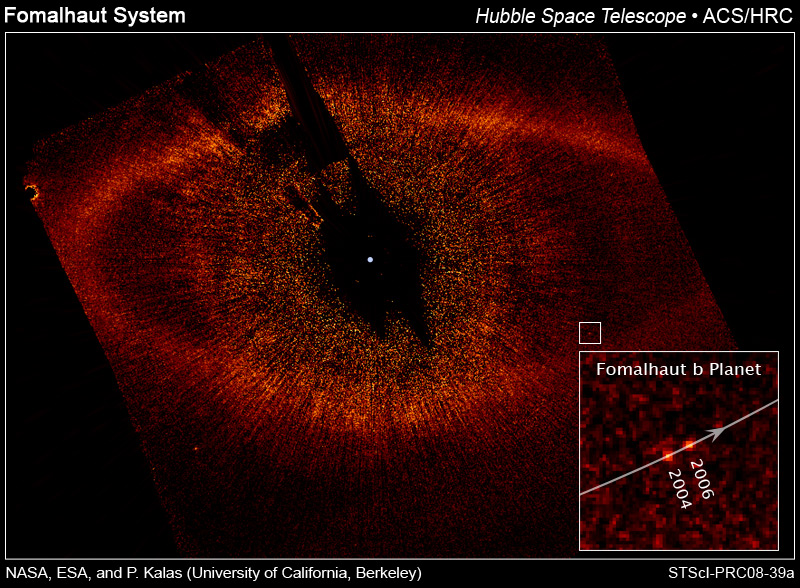
Today marks a great stride in how we see exoplanets, which have always remained as figments of our imagination and speculations. Where previous techniques only enable us to infer their existence by way of statistics, light curves, graphs and spectra, the big news today shows us direct images of extrasolar worlds.While most exoplanets detected to date have been discovered using techniques such as Astrometry, Radial Velocity, Transit Method or Gravitational Microlensing, none would ever cause so much news coverage and impact as a "photograph" of another world. (Twitter went down shortly after the announcement, perhaps due to too many tweets about it). Although a huge bulk of future exoplanet discoveries would continue to be discovered by indirect techniques of planet detection, the method of Direct Imaging will pick up in the coming years, and soon we will finally see a photo of extrasolar continents.
The promise of the next generation of telescopes such as the Terrestrial Planet Finder (TPF), James Webb Telescope, Spitzer Telescope, New Worlds Mission, Kepler, and Space Interferometry Mission (SIM), will be bring even more amazing imagery. But hats off to good 'ol Hubble, who continues to bring us stunning pictures, in this case a snapshot of Fomalhaut b.
Artists will continue to bring us closer to these alien worlds, while computer simulations will always provide new insights, but imagination always will be our mind's eye.
Just imagine what goes on inside the mind of a child as you stand together gazing up in the night sky, and you point to a star and say, "that star over there has a planet, yeah that one right there..."
It's amazing, NOW we can finally say it with absolute certainty, just like that.
Just like that.

Other Links:
NASA/ESA Hubble
Physorg
Discovery Channel
Cosmic Ray
More on FomalHaut b
May 25, 2008
May 13, 2008
Planet Hunters (Documentary)
A documentary about the search for extrasolar planets and about the people who dedicated their lives to hunt for exoplanets.
May 5, 2008
Look Ma, No Lens! Just a Sheet of Metal for Planet-hunting!
A proposed telescope would focus light primarily with a patterned sheet of metal rather than a large mirror or lens. The telescope would have amazingly sharp vision and could spot Earth-size planets around other stars.The technique takes advantage of light's diffraction, which enables light to be focused into an image simply by passing it through a certain pattern of holes carved in an opaque sheet. Such patterned sheets have long been used for focusing laser beams, but have so far not been used for astronomy, much more for Exoplanetology. These patterned metal plates are called Fresnel zone plates, after the French physicist Augustin-Jean Fresnel, who studied diffraction in the 1800s.
Because it relies on a foil sheet rather than a massive mirror, it could be much more lightweight, and therefore less expensive to launch, than a traditional telescope.
A Fresnel imager with a sheet of a given size has vision just as sharp as a traditional telescope with a mirror of the same size, though it collects just 10% or so of the light. It can also observe in the ultraviolet and infrared, in addition to visible light.
The imager can take very detailed images with high contrast, which is great for being able to see a very faint object in the close vicinity of a bright one, making it perfect for obtaining images of exoplanetary systems. Such images have so far been very difficult to make because exoplanets are so faint they get lost in their host stars' glare.
A 30-metre Fresnel imager would be powerful enough to see Earth-sized planets within 30 light years of Earth, and measure the planets' light spectrum to look for signs of life, such as atmospheric oxygen.
Now don't get excited yet because there still a lot of challenges for this approach, such as how to unfurl the plate during deployment in space. Oh and by the way, the fresnel plate may still require a secondary mirror called a fresnel lens to correct some errors, har har. The blog title was just a trick!
Links:
Newscientist
Gizmodo
February 15, 2008
The Living Cosmos: An Inspiration for Exoplanetology
If there is any book at all that magnified my enthusiasm for exoplanetology, then it is The Living Cosmos by Chris Impey. It's mostly on Astrobiology but the parallels to exoplanetology are unmistakable. An exoplanetologist will learn most from the whole book, but Chapter 6, "Distant Worlds" is what i think is the most devoted to exoplanetology. It's where the planet-hunters are mentioned (such as Geoff Marcy, Debra Fischer and Greg Laughlin) as well as the current techniques used in planet-detection (such as Planetary Transit Method). Future initiatives such as NASA's Terrestrial Planet Finder (TPF) which will be launched in 2015 is mentioned as well.
The book is highly readable, and most of all truly inspiring.
Subscribe to:
Posts (Atom)