Showing posts with label Spitzer. Show all posts

January 31, 2009

Simulation & Visualization of Exoplanet HD 80606 b

HD 80606 bSimulation reared its head again. This enigmatic photo was rendered from data of an exoplanet known as HD 80606 b. This planet circles a star 200 light years from Earth, is four times the mass of Jupiter, and has the most eccentric orbit of any known planet. It spends most of its 111.4-day orbit at distances that would place it between Venus and Earth in our own solar system, while the closest part of its orbit brings it within 0.03 astronomical units of its star (one astronomical unit is the distance between Earth and the Sun).
I enjoy the fact that the exoplanet was imaged from data taken by the Spitzer Space Telescope. It is an amazing piece of visualization. We will see more of Simulation, Visualization and Imaging as data comes pouring in from planet-hunting telescopes.


http://www.astrobio.net/news/modules.php?op=modload&name=News&file=article&sid=3021&mode=thread&order=0&thold=0

November 13, 2008

Worlds Imaged and Worlds Imagined

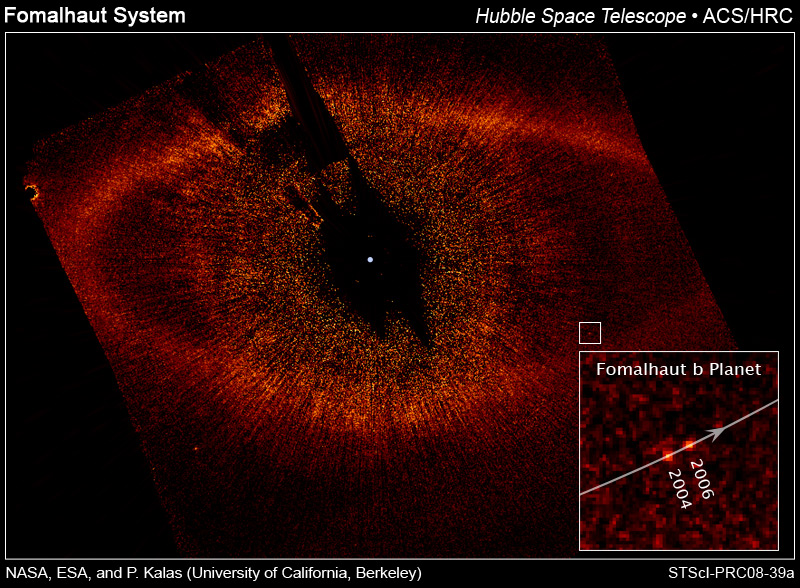
Today marks a great stride in how we see exoplanets, which have always remained as figments of our imagination and speculations. Where previous techniques only enable us to infer their existence by way of statistics, light curves, graphs and spectra, the big news today shows us direct images of extrasolar worlds.
While most exoplanets detected to date have been discovered using techniques such as Astrometry, Radial Velocity, Transit Method or Gravitational Microlensing, none would ever cause so much news coverage and impact as a "photograph" of another world. (Twitter went down shortly after the announcement, perhaps due to too many tweets about it). Although a huge bulk of future exoplanet discoveries would continue to be discovered by indirect techniques of planet detection, the method of Direct Imaging will pick up in the coming years, and soon we will finally see a photo of extrasolar continents.
The promise of the next generation of telescopes such as the Terrestrial Planet Finder (TPF), James Webb Telescope, Spitzer Telescope, New Worlds Mission, Kepler, and Space Interferometry Mission (SIM), will be bring even more amazing imagery. But hats off to good 'ol Hubble, who continues to bring us stunning pictures, in this case a snapshot of Fomalhaut b.
Artists will continue to bring us closer to these alien worlds, while computer simulations will always provide new insights, but imagination always will be our mind's eye.
Just imagine what goes on inside the mind of a child as you stand together gazing up in the night sky, and you point to a star and say, "that star over there has a planet, yeah that one right there..."
It's amazing, NOW we can finally say it with absolute certainty, just like that.
Just like that.


Other Links:
NASA/ESA Hubble
Physorg
Discovery Channel
Cosmic Ray
More on FomalHaut b

November 7, 2008

New Worlds: Exoplanet Discoveries from the Spitzer Space Telescope


An upcoming lecture is about the discovery of New Worlds by the Spitzer Space Telescope. As part of the von Karman Lecture Series, it will be held in Pasadena, California on Nov. 13 & 14 (Thu & Fri) at JPL and Pasadena College, respectively.
What's great is that we can also attend via the webcast at 7pm PST.
You must have the free RealPlayer8 Basic to see it.
More information about the lecture is located here.
Here's a summary of what's in store for the lecture:

New discoveries streaming back from the Spitzer Space Telescope continue to surprise and amaze everyone. No one could have predicted some of the amazing things we're finding, not even the mission scientists themselves! Spitzer has proved itself to be a true pioneer in the characterization of extrasolar planets, providing the first real, if crude, weather map of a world around another star over 250 light years away. We're also finding evidence of planet formation in the oddest places, from the cool, dark space around brown dwarfs to the hard-radiation baked environment near neutron stars. Come watch sunrise and sunset around a massive Jupiter-like planet, or trace high-velocity winds on an alien world where we've found water vapor in the cloud-tops. With Spitzer, these new worlds are becoming real places to us, challenging us to imagine even more.

Links:
More information about the Spitzer Space Telescope

March 17, 2008

Water and Organic Molecules on AA Tauri

Water Signature
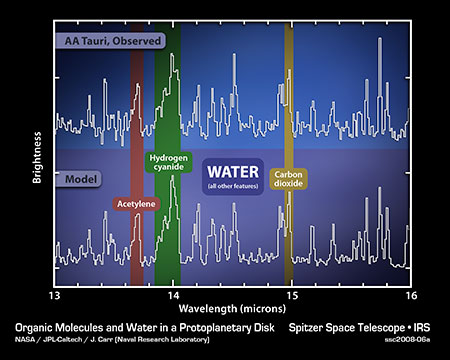
Great news today. Water and some organic molecules has been detected on AA Tauri's protoplanetary disk.
AA Tauri is a star 450 lightyears from earth. Protoplanetary disks are dust, rocks and clouds around a star that are raw materials for planet-formation. The particular disk where the organic molecules were detected are within 3 Astronomical Units (AU) from AA Tauri. Spitzer Space Telescope’s spectrograph captured data from the disk which very much resembles the signature of organic molecules and water on Earth.
What does this mean? There's a big chance that the planet that will form from such water-abundant and organic-rich materials will be conducive to life.

Links:
Centauri-Dreams
Science Mag Abstract
Photo Credit: NASA/JPL-Caltech/Naval Research Laboratory

March 14, 2008

Web-Based Google Sky: A Great Tool !

Google's Browser-based Sky launched. Now you don't need to install any software for a quick marvel at the heavens! Google Sky comes default with some known objects, such as M1 and Andromeda, and see them in x-ray, infrared, microwave and ultraviolet modes. Perfect for amateur astronomy. You can also see some showcases of Hubble, Spitzer and other telescopes images and overlay your own information with KML content like in Google Earth. At the top left, there's a link to Google Moon and Google Mars.
This is a wonderful start! I can foresee the day when exoplanets are marked out in sky just like the currently known objects catalogued in there. It'll give us a sense of where they are in the sky. With the launch of new telescopes, we will see an explosion of hi-res images in the next few years. And we'll definitely see them in Google Sky. Gee, thanks Google! Thanks NASA!