Did you know that the earth can be considered as an exoplanet? Well, that is if you look back in time (and space), in the distant past of the early earth, billions of years ago. During that time, our planet would not resemble anything close to our present day earth.
However, imagining how the earth was a few hundred millions of years ago may give us good insights in studying the habitability of exoplanets as well. And that is exactly what the Planetary Habitability Lab at the University of Puerto Rico at Arecibo has done with their latest visualization, the Visible Paleo-Earth project.
Headed by Prof. Abel Méndez, the Visible Paleo-Earth project is a true-color visualization of the evolution of the Earth’s surface from paleo-climates to the present day. Using paleogeography and paleoclimate reconstructions combined with NASA satellite imagery, the team generated a global visual appearance of Earth in the last 750 million years, around the late Cambrian Period.
Now sit back and take a trip to the distant past by visiting The Planetary Habitability Lab as they present this project on Earth Day, April 22, 2011.
Showing posts with label Earth. Show all posts
April 21, 2011
April 24, 2009
My One and Only
You will always be my one and only. Even if we find another planet that looks like you. We love you even more.
--@Exoplanetology
March 31, 2009
Post-Apocalyptic New York on Earth Hour
What came out of my observations during Earth Hour was a little "dark", in all sense of the word. This is the Empire State Building with it's lights turned off during a cloudy, gloomy and star-less night. Captured on the night of Earth Hour, this image gives me an eerie feeling of an impending apocalypse as the Monolith looms over New York City "on the rocks".
March 28, 2009
Earth Hour and Exogazing
Not everyone believes that planet earth is in crisis. But our planet is undergoing a major shift in it's climate. In case you haven't noticed, the weather is all messed up. Some say that the earth is just fine, It's us that is screwed. Some are cynical, some are still curious, some would shrug off their shoulders with indifference. Some would care enough to at least do something in their own small way. And some are active in making a difference with regards to the state of our home planet.
If you don't see yourself in any of these groups, you're not alone. And it's perfectly alright. What is happening to earth is probably the nature of things. Things may proceed the way they are supposed to, and there's absolutely nothing that anyone can do but observe.
Tonight is the perfect night to do exactly that. At around 8:30 pm, try looking up and observe the night sky. If you're a city dweller--as I am, you may actually notice a difference. Stars would shine more brightly than usual.
The reason is Earth Hour. People would turn off their lights for one hour. And the night sky minus the light pollution is something worth observing.
As for me, I'll head out with my family to a nice safe place by the waterfront to witness the city lights go out. Then I will look-up. I'll probably do some exogazing and drown myself in exoplanetary thinking. In a rare moment from within a city, I will have that precious 60 minutes to reflect upon our planet and observe the stars.
Whatever comes out of it, I know i'll never be the same again. Because with the changes that the earth is going through, i might never see our planet this way again.
March 10, 2009
November 25, 2008
Planetology, A Primer to Exo
What happens when you team up together a geologist and an astronaut? You get this book, Planetology. It's a good primer for anyone who wants to begin exploring planets and worlds more alien than the planets within our own solar system. After all, one should get familiar with the local neighborhood before venturing out farther to extrasolar systems.Starting with our home planet, magnificent earth gives us insights about other worlds. And that's where planetary geologist Ellen Stofan and astronaut Tom Jones pair images of Earth with astonishing scenes of alien surfaces beamed home by NASA’s robotic probes. This portrait of our solar system brings into view important contrasts between Earth and its neighbors in space.
This is a good book with vivid pictures of our local neighborhood, plus it contains a good introduction to exoplanets. Planetology first, then Exoplanetology.
July 30, 2008
Ephemeral Worlds: Visualizing Exoplanets with Bubbles
Indeed Exoplanetology is the Art and Science of Exoplanets. These photographs of bubbles provide stunning insights into visualizing and imagining how unseen exoplanets might look like. Consider the fact that planets especially Jovian planets like Jupiter, are "bubbles" themselves, albeit gargantuan in scale. The biosphere of the Earth is in fact, a bubble. And by the fractal laws of nature, the surface of bubbles provide a striking resemblance to the appearance of planets with a suitable atmosphere.
Thus soap bubbles, ephemeral as they may seem - can help in visualizing exoplanets since their surfaces follow the same laws of physics. And as how these photographs by Jason Tozer attests to, exoplanets - like soap bubbles - are also works of art.
One photograph bears a striking resemblance to Jupiter's patterns. I am speculating that if it were photographed in zero-gravity it would look a lot more like Jupiter.
The rest of these otherworldly photographs sets my mind careening into outer space, imagining how exoplanets would look like. To imagine and visualize them is what I can do for now, for to even see a glimpse of them is beyond our lifetime.
July 17, 2008
Seeing the Earth from Alien Perspective
Here's how the Earth looks like from 31 million miles away. This clip was intended to shed light on how other Earth-like worlds would appear.“Making a video of Earth from so far away helps the search for other life-bearing planets in the universe by giving insights into how a distant, Earthlike alien world would appear to us.”
The features that are most notable are the "sun-glint" caused by light reflected from Earth’s oceans. Similar glints to be observed from extrasolar planets could indicate the existence of alien oceans.
In infrared, land masses with vegetation are more apparent, because plants reflect more infrared light. Hence, infrared-imaging techniques could be used to observe extrasolar planets for signs of vegetation.
The video was captured by the Deep Impact Probe, whose extended mission now is called EPOXI (Extrasolar Planet Observation eXtended Investigation).
Links:
Alien’s-eye view of Earth
EPOXI
July 3, 2008
Fetish: Magic Planet for my Bedroom
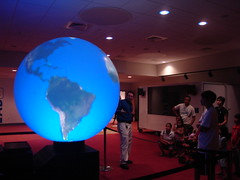
During my recent trip to the newly-renovated Liberty Science Center, a luminous sphere called The Global Microscope became my newest fetish. I later learned that it's called the "Magic Planet", a product from Global Imagination. The "Magic Planet" is indeed magical as it turned, tilted and rotated according to the presenter's whims. Using his wand-like remote control, the presenter provided a grand visual tour of various geologic features of Earth such as tectonic plates, earthquake zones, deep trenches and high areas on the surface of the planet.Numerous data sets on various aspects of the earth's climate were also presented - such as a rundown of all the earthquakes and typhoons around the world - using animated graphics superimposed upon varying graphical-representations of the Earth's surface.
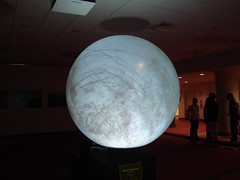
The other interesting part of the presentation involved a grand tour of the Solar System, showing all the planets, notably Mars, Venus, Jupiter in crisp detail. Our moon was also shown, as well as Enceladus, and the whole enchilada - Io, Ganymede, and upon my request - Europa.
All this show was done while controlling the tilt and rotation of the globe, and pausing at certain axes to examine points of interest in greater detail. After seeing it all, my curiosity prompted me to investigate it's inner workings.
After examining it up close, I discovered that it's actually a semi-transparent "plastic" sphere with the projector housed inside the base. It's probably similar to how IMAX works (in terms of the projector-lens and dome), except that the computer-generated images being projected from inside the sphere shows through outside the dome's surface. In essence, it's actually a spherized 'computer monitor', obviously tailored to simulate spherical surfaces.
Clearly, this is a wonderful display tool. Perfect for visualizing yet-unseen exoplanets and super-earths, too. I'd love to have one of these in my bedroom, except that I was told it costs around $30,000. Oh well, perhaps I'll just build one someday, DIY-style. So much for my fetish.
links: http://www.lsc.org/educators/jac/globalmicroscope/
July 1, 2008
Earth-like Worlds and the Rare Earth Hypothesis
Now by saying that Earth is unique does not mean that there won't be other worlds like it. Thus there could be countless 'earth-like' worlds out there, but only some would have Life. And among those that are life-bearing, possibly only a fraction would be intelligent and sentient.
There is no debate in the argument of the Rare Earth hypothesis that the emergence of complex multicellular life on Earth required an improbable combination of astrophysical and geological events and circumstances. Other than that, it cannot have bearing on how common life is on other parts of the universe.
I appreciate the fact that the "Rare Earth Hypothesis" was aptly named - which simply means that the Earth is rare, which I rather consider the same as saying that diamonds are rare.
The Earth is precious and unique. There is no place like home.
June 20, 2008
Super-Earth vs. ExoGaia
The truth is that it is a misnomer.
The basis of any terrestrial exoplanet being called a Super-Earth is based on mass. Whenever a rocky exoplanet is a bit more massive than the Earth, specifically up to 10 times the mass of the earth, then it falls into the criterion of a "Super-Earth".
Yet, nobody really knows if any given Super-Earth is similar to our Earth. It may have a different climate, or different surface features (icy/dry), different atmosphere. The list of differences may go on, and by far outweighs the similarities. Yet we still choose to name it Super-Earth. The exact history behind the word evades me, but it tells me something about humanity's yearning to find a twin of our home, possibly fueled by our desire to find out if life is unique to our planet - if we are alone in the universe.
This brings me to the question: what if exoplanetologists finds an exoplanet that has exactly the same mass as the earth...and has Life? Earth's Twin - it has got to be called 'ExoGaia'. Welcome to the beginning of the ExoGaia Hypothesis.
And so, the search for ExoGaia continues...
March 17, 2008
Water and Organic Molecules on AA Tauri
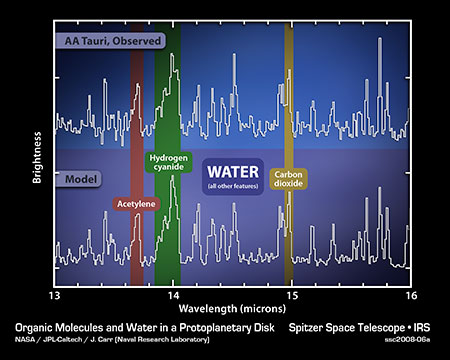
Great news today. Water and some organic molecules has been detected on AA Tauri's protoplanetary disk.
AA Tauri is a star 450 lightyears from earth. Protoplanetary disks are dust, rocks and clouds around a star that are raw materials for planet-formation. The particular disk where the organic molecules were detected are within 3 Astronomical Units (AU) from AA Tauri. Spitzer Space Telescope’s spectrograph captured data from the disk which very much resembles the signature of organic molecules and water on Earth.
What does this mean? There's a big chance that the planet that will form from such water-abundant and organic-rich materials will be conducive to life.
Links:
Centauri-Dreams
Science Mag Abstract
Photo Credit: NASA/JPL-Caltech/Naval Research Laboratory
AA Tauri is a star 450 lightyears from earth. Protoplanetary disks are dust, rocks and clouds around a star that are raw materials for planet-formation. The particular disk where the organic molecules were detected are within 3 Astronomical Units (AU) from AA Tauri. Spitzer Space Telescope’s spectrograph captured data from the disk which very much resembles the signature of organic molecules and water on Earth.
What does this mean? There's a big chance that the planet that will form from such water-abundant and organic-rich materials will be conducive to life.
Links:
Centauri-Dreams
Science Mag Abstract
Photo Credit: NASA/JPL-Caltech/Naval Research Laboratory
Tags:
AA Tauri,
Earth,
Life,
organic,
Planet-formation,
Protoplanetary Disk,
Spitzer,
Star,
water
March 6, 2008
Habitable Zone: Starting from Home
Its very anthropomorphic, I know, and is constrained for water-based and carbon-based lifeforms, but it's a very good start in the search for exoplanets and life in deep space.
Probabilities and the likelihood of finding life in other places begins with Earth as the model and guide, hinging on Water. Planetary missions, such as the Mars Exploration are on the lookout for signs of water. Because water means life, er to begin with.
Slowly but surely, we are now expanding our sphere of thought from the basic Habitable Zone concept to other worlds. From Mars, Jupiter and its moon Europa, all the way to an exoplanet called Gliese 581c. Soon there will be more worlds to think about. And more platforms of life to speculate on, not just carbon, but perhaps methane.
And the day will come when a variety of Habitable Zones will be identified, not just the traditional Earth-like or water-based kind that we know of.
When we finally find signs of life or life itself on a distant exoplanet, we will remember the day when the concept of the most basic Habitable Zone was formulated...hey, we had to start somewhere.
Tags:
carbon-based,
Earth,
Earth-like,
Europa,
Exoplanet,
Gliese 581c,
Habitable Zone,
Jupiter,
Life,
Mars,
Star,
water
February 27, 2008
Exoplanetology and The Encyclopedia of Life
Life is what we make it, they say, so they made an Encyclopedia of it! The Encyclopedia of Life (eol.org) was launched today. It's inspiring, and yet saddening at the same time. It mentioned that some species might never make it there because of mass extinction, a result of the destruction to Mother Earth.
Also, in connection to Exoplanetology.com and this blog which I launched just a few days earlier, it gives me a "de-energizing" feeling whenever I am reminded of the thought:
"We haven't even fully catalogued all life on our own Planet, so why would we want to look for life on alien worlds ?"
Just by thinking of the variety of life on Earth, i already feel overwhelmed. Double that by the magnitude of the endeavor to find new exoplanets and life in them.
But despite it all, the Encyclopedia of Life still inspires me more.
It is a great start! Look, they named it as Encyclopedia of Life, hence it does not exclude life on other planets or exoplanets! So i am imagining the day when a new category will appear on its pages: Exoplanetary Life - Flora and Fauna from other Worlds!
It's a vision worth pursuing, therefore, onwards we must go with the science of exoplanets! Go exoplanetology!
Source: EOL.org goes online
Link: Encyclopedia of Life (eol.org)
Tags:
Alien,
Earth,
Exoplanet,
Exoplanetology,
exoplanetology.com,
Life,
Planet-hunter
Subscribe to:
Posts (Atom)