Showing posts with label Worlds. Show all posts

March 29, 2012

Connected Worlds

For those of you who have been playing Mass Effect 3, you've seen how the 'Galactic Readiness' affects the outcome of the game. Playing the multiplayer mode increases your 'readiness' rating which helps you in the final run of your single-player campaign. The message is clear: There is a connection between multiplayer mode and the campaign storyline of Mass Effect 3.

Although some will dismiss this 'connection' as a mere ploy just to keep gamers playing, what I am about to reveal highlights the fact that this kind of simple 'connection' actually gives a hint of a very important innovation in gaming that is coming.

To highlight what I mean I'll need to point you to an awesome game called Dust 514.

Dust 514 is an upcoming shooter game whose settings are on the surface of different planets. It's already enticing that Eve fans and game developers have been discussing how the battle would occur on different types of planet. But what interests me even more is the fact that what happens on the surface of the planet--where all the action occurs--is connected with the persistent universe of Eve Online.

Eve Online is an MMO and Dust 514 is a shooter game. CCP ties them together in one persistent Virtual Universe. To illustrate the connection, just imagine this scenario: While you're in a battle on one planet, you request an airstrike from your pal who is the pilot of a warship hovering above the planet at that moment. You see, connection is a powerful thing.

I recognize this feature as a very important aspect in the evolution of gaming and I am quite excited about it. I'd like to see this innovation in all the other sci-fi games that I play. Kudos to the developers of Mass Effect, Eve Online, and Dust 514. You guys are truly exoplanetary!

December 22, 2010

Exoplanet is the new Planet

I try to stay away from the debate about Pluto. My issue is not about Pluto. It's about the Planet. One can mock Pluto a thousand times over, and the best (or worst) it could do is annoy people. Sometimes it does get to me, so i have to remind myself that I am more concerned about the concept of the planet, and the idea it represents, and the ideal it imparts to the human psyche.

Let me begin by saying that I think I am falling in love with planets. I don’t know how, but during the course of following the saga of exoplanets it must have been inevitable (after all, the ‘exoplanet’ bears the name of ‘planet’).

With new discoveries that pour in almost daily about planets in other star systems, Exoplanets are a constant source of amazement. They continue to remind me that I can never know enough, that this fascinating universe is an endless source of wonder.

But...something keeps getting in the way. Something mind-numbing creeps in when I read something about what a ‘planet’ is defined to be. It has bothered me so much that I had to use “worlds” as an alternative keyword to hook me back in wonder about these spherical objects in space.

Why? What happened with the term “planet”? What happened with the magical and mythical concept that the Greeks once started with, saying that these mysterious points of light are ‘wanderers’?

The problem began when mankind started to *define* the Planet. We relentlessly squished the concept of a planet with words so that it could fit within our tiny skulls.

I looked into the two sides of the debate, learning as much as I can to understand, but the mandated definition of the Planet really does not appeal to me. In the spirit of freethinking, I humbly decline to subscribe in the 'official' definition of the planet.

Why? What have humans done to the concept of the planet?

There is nothing inherently wrong with classifying things, and certainly nothing wrong with identifying the boundaries in order to characterize objects, but I think we had the wrong attitude when we made up the criteria for planets.

And that is the sad thing about it. Instead of trying to widen the concept of the Planet, we tried to limit it. The kind of thinking that is promoted by the current definition of the planet is a divisive mode of mentality. You see, in our world, much strife is borne out of a discriminating mindset--a way of thinking that focuses on the differences and not on the similarites.

"The major problems in the world are the result of the difference between how nature works and the way people think." ~Gregory Bateson

Today, dwarf planets are not considered planets at all, despite calling them 'dwarf planets'. Is it a matter of linguistic fallacy that makes it all nonsensical? (Dwarf galaxies are galaxies, and dwarf stars are stars, but dwarf planets are not planets?)

Or is it just the mode of thinking? Why deny dwarf planets of being planets? Such judgement mirrors a way of thinking that is alienating and divisive.

It is certainly valid if you consider dwarf planets as a subset or variation of the wide scope of planets. This alternative method of classification exemplifies a way of thinking that respects differences and yet aims to see things as One.

You can choose a mindset that seeks to see all kinds of planets in a wholistic fashion, and delight in their diversity. Or you could choose a discriminating mentality, segregating a class of planet-worlds that don’t fit in your limited notion based on one star system alone--yours.

The Pluto debate is a clash of mentalities. And it has marred the concept of the planet. I hope that the next generation never inherits the discriminating mentality that is present in that conflict.

I rest my case in the lessons that exoplanets are teaching us. They continue to challenge our pre-defined notions of what a planet truly is. They continue to be a source of wonder, in the same way that the Ancient Greeks felt about their ‘wanderers’. In our modern era, only the Exoplanet can conjure that feeling of mystery and discovery ascribed to such mysterious objects.

For me, Exoplanet is the new Planet.

I wish we never end up defining the Exoplanet in the same way we did for the Planet, for I wish to keep the concept of the Exoplanet with awesomeness and wonder.

December 2, 2010

The Exoplanet Generation

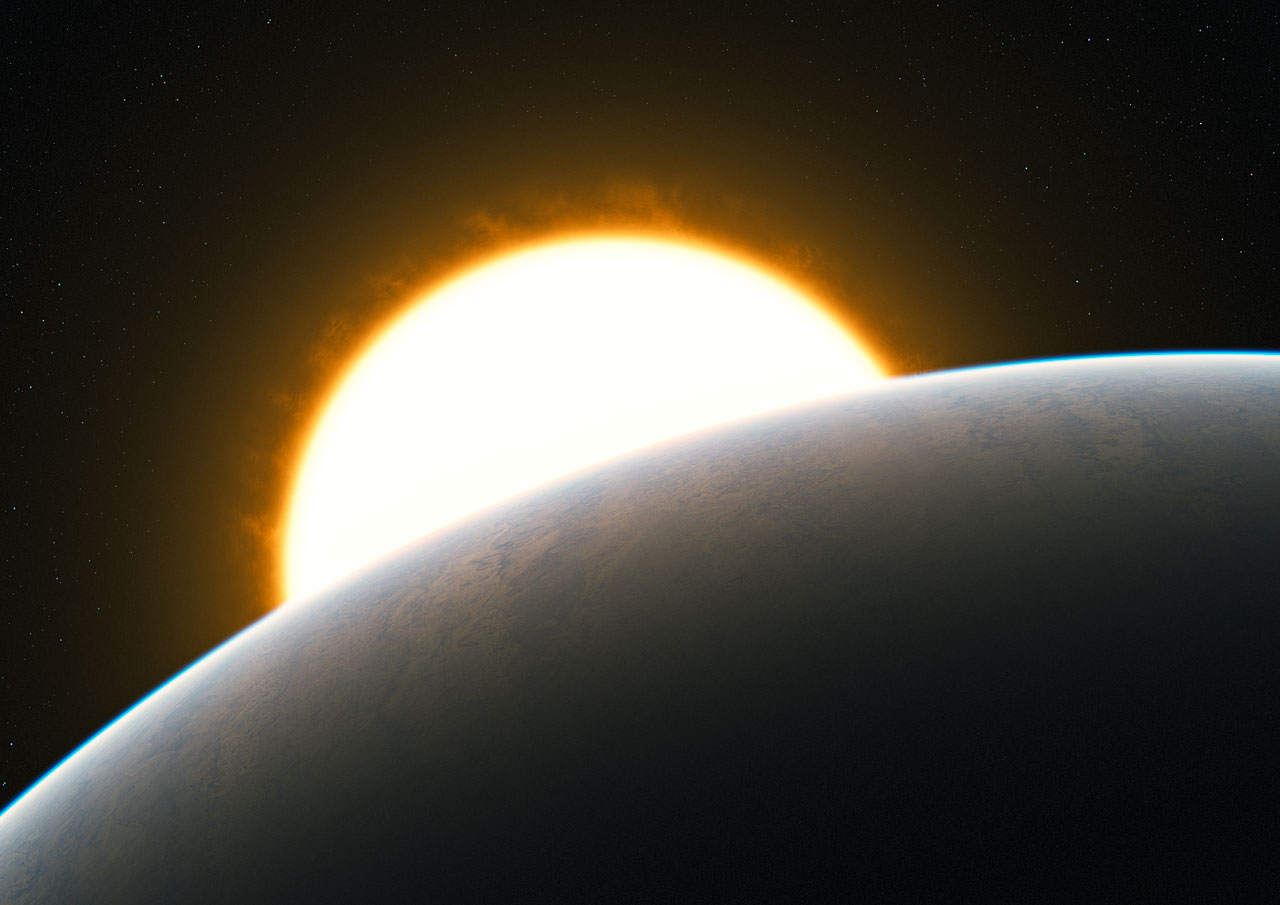
Image credit: ESO
I asked my seven-year-old daughter, "What do you call a planet outside our solar sys..." I didn't even finish my question when she excitedly exclaimed, "EXOPLANET!!!"

I laughed. She smiled. And then I realized: I am talking to a child of the "Exoplanet Generation", the young ones that were born from 1992 and onwards. It's the year when the first discovered exoplanet (orbiting a pulsar called PSR B1257+12) was announced. From then onwards, the accelerating rate of discovery defined the pulse of the Exoplanet Generation.

These "ExoGen" kids will grow up in a world very different from our own. When I was seven, i had no idea about other worlds. But the children of the exoplanet generation will bask in the weekly or daily news about the new exoplanet discoveries. They will wake up hearing new discoveries about how other lifeforms in platforms other than carbon may be able to thrive, or how life is possible on planets and moons outside our solar system.

Perhaps, in their lifetime they will witness the discovery of exolife, or be the ones to make the discovery itself, of life on other worlds!

And so, ExoGen kids...Welcome to brave New Worlds!

November 24, 2010

Giordano Bruno, Imaginative Logic, and the Plurality of Worlds

I am gripped by a certain sense of nostalgia every time I read old books. There's something about those archaic sentences, or the fonts, which I imagine being printed by old, rusty movable types. Even more so, is that I am intrigued by the authors’ way of thinking in those early days when Science and Astronomy were in its infancy.

Thus, in the inquiry about other Worlds, what were the thinker's methods of thought in the olden days when there was no internet? How far can their ideas go when all they had were just the pure sight of Nature to power their brains?

Yesterday, I came across this book "Giordano Bruno and Renaissance Science", in which the author reevaluates Bruno's contribution to the scientific revolution. We all heard about that the guy before, that pesky hooded friar who got burned at the stake for his heretical views.

Now let’s take a peek at how Bruno came up with his Philosophy and way of thinking. In one instance, Bruno “wishes to prove that opaque bodies lying between the eye and luminous bodies can easily disappear from the field of vision: a point which he illustrates by holding a matchstick between his eyes and a lighted candle."

Albeit primitive, Bruno noted the same difficulty involved in exoplanet-hunting; that it's like trying to find a firefly across the backdrop of a searchlight, as modern-day astronomers would often say. Had Bruno written that the distant star's light would be dimmed in a measurable way by an orbiting planet passing across the viewer's line of sight, he would have hinted at one of the most successful methods in Exoplanet-hunting, the Transit Method.

In his time, such an insight is not bad. Apparently, Bruno used "Imaginative Logic" (in contrast to rational logic) as his thinking method to come up with his ideas, which were considered quite radical at that time. Nevertheless, Bruno stumbled onto something bigger, an idea so true and powerful that he was willing to give up his life for it.

Today with more than five hundred known worlds on other stars, we are basking in that idea now.

The Plurality of Worlds "...constitutes the essential premise for the new cosmology of Bruno, whose universe is filled with infinite worlds, most of which are invisible to the naked eye."


"In space there are countless constellations, suns and planets; we see only the suns because they give light; the planets remain invisible, for they are small and dark. There are also numberless earths circling around their suns, no worse and no less than this globe of ours. For no reasonable mind can assume that heavenly bodies that may be far more magnificent than ours would not bear upon them creatures similar or even superior to those upon our human earth."
~ Giordano Bruno, 1584


"All philosophy is based on two things only: curiosity and poor eyesight; if you had better eyesight you could see perfectly well whether or not these stars are solar systems, and if you were less curious you wouldn't care about knowing, which amounts to the same thing. the trouble is, we want to know more than what we can see."
~ Bernard le Bovier de Fontenelle, Conversations on the Plurality of the Worlds, 1686

Links:
Giordano Bruno and Renaissance Science

September 16, 2010

Into the Armor [ Review of Halo: Reach ]

So, I finally stepped into the armor, and into the world of Halo. Yes, I've started playing videogames and Halo:Reach was the first one I loaded into the console, overtaking Mass-Effect2 which I plan to play next.

As I look back into the first few hours of my gameplay experience, I appreciated the fact that the narrative behind Reach is given much weight--that its not just all about shooting aliens. Well, maybe perhaps--as it’s what you’re gonna do most of the time to finish the rest of the game. But, the great thing is that the sense of teamwork is emphasized, “..no lone wolf this time,” as I heard in the dialogue. So i’m itching to play multiplayer mode someday.

Being a noob, I started with the solo campaign. But I felt reassured that I have teammates that will cover me as I fumbled with the controls during a heated battle with The Covenant (aliens). It was quite easy to imagine that the soldiers fighting beside me are not just characters programmed with algorithmic AI behaviours, but each of them has a story to tell. We are the Noble team, and I play the part of the newcomer--a replacement to their previous colleague. And as i donned that Spartan helmet, it wasn’t long before i started to internalize the character of Noble Six, running around, shooting aliens, intently listening to my teammates, tracking and staying close to them as much as I can.

That was the great part. But here comes the bad. And it’s sad because i have to write it about such a great game. And I have to say it because this blog is focused on things Exoplanetary.

Walking around Planet Reach did not make me feel like I was on another planet at all. It was so earth-like. I felt disappointed because the quality of the graphics is stunning but it failed to immerse me in another world.

At times, I often had to gaze up at the sky to see the gorgeous ringed planet just to "remind" myself that i am on an exoplanet, and that i'm there on a noble mission. But the moment i resume and see the familiar trees, the usual grass, the same old rock formations and typical mountains-- I am suddenly just pulled back to Earth!

Am I asking too much? All I wanted was just a little bit of the taste of “otherworldliness”. What could be missing? Well, perhaps some weird flora would be a good start. Maybe some kind of orchid here and there would have done the trick. Or maybe some trees with some unique growth patterns or odd textures.

How about the animals? Well, what were the ostriches doing on planet Reach?! Or were those turkeys and livestock by human colonists there? I just shot them in frustration. I even saw a falcon. Or was it an osprey, oh my. I wish there were alien animals there that did not remind me about what we have here on Earth.

People are clamoring for the discovery of an earth-like planet. And there's media frenzy on every chance to delight the public with sensational news about earth-like worlds. Yet here i am, begging for an alien world from a videogame! From a videogame for Pete’s sake!

Stepping into the armor was fluid and natural. But stepping onto the exoplanet called Reach was not. I wish the makers of Halo had a little bit more creativity in terms of the planetary aspect. Or perhaps they should have hired some Astrobiologist to decorate that Planet.

Now that Microsoft is taking over of the franchise, I hope the next one will be much more awesome. I wish Halo to be Kinect-enabled to bring more immersion into gameplay. And I hope this review will be seen as a constructive criticism to the Halo franchise, or to any game that would be so much better if it immersed players into other worlds.

Yes, immersion is what i seek. And the reason why i started playing games is because i want to visit other worlds, and be immersed in them.

So now, for me to finish Halo: Reach, i must imagine a bit harder that the setting of Halo Reach is on an exoplanet. And if my mind gets tired of going against the grain, then i’ll just make an excuse that Planet Reach is simply the most Earth-like exoplanet I have ever seen.

June 3, 2010

On IKAROS and Interplanetary/Interstellar Kites

I love kites. I have three stunt kites among others which I sometimes fly on summer weekends at the park near Liberty Science Center (overlooking New York City) where the constant breeze is best for kite-flying around the area. To this day, I am still amazed how the wind translates to flight.
As a child growing up in the Philippines, I often ran in the streets with a kite I made out of newspapers and "walis tingting". As I pulled on the string (which i stole from my grandmother's sewing kit), I wondered how high and how far my kites could go. I remember myself asking if they could go past the clouds, the blue sky, and out beyond the unknown expanse.
The answer came many years later, but its so much better than it could ever be.
On May 20, 2010, an interplanetary kite has been launched that will fly to another world. The IKAROS will go to Venus and beyond.
The IKAROS (Interplanetary Kite-craft Accelerated by Radiation Of the Sun) is a solar sail mission powered solely by sunlight. A solar sail is pushed by the photons from the Sun. In other words, it uses sunlight to sail.
When a photon is reflected it exerts a small force on the surface reflecting it. The Sun generates a lot of photons, so if you have a large, lightweight, reflective surface, it will be pushed by the force of many photons being reflected off it. It is the reflected photons that creates the "pushing" effect.
The solar sail hitched a ride aboard an H-2A rocket from Japan's Tanegashima Space Center. That rocket carries the main mission of the Japan Aerospace Exploration Agency (JAXA), the Venus Climate Orbiter called Akatsuki.
IKAROS is the first of it's kind to ever be launched and I hope it will work because it's success will pave the way for future solar sail missions that may even extend past our Sun into other stars. Thus, I have whimsically labeled a future acronym for it's successor: Interplanetary Kite ARound Other Stars (IKAROS).
I am very excited about IKAROS so I watched it's launch on a live feed. Perhaps watching its launch was related to the fact that launching my jetstream kite from the ground is also my favorite part.
My kite is initially in a launch position, facing the wind, facing me, and pointing up. I wait for a suitable gust of wind to pass through my back and reach the kite. At the right moment, I pull both strings and step backwards, I can feel the strength of the wind as I watch the kite accelerate upwards. For me, it is the most exhilarating part of flying kites. I advise you to try it.
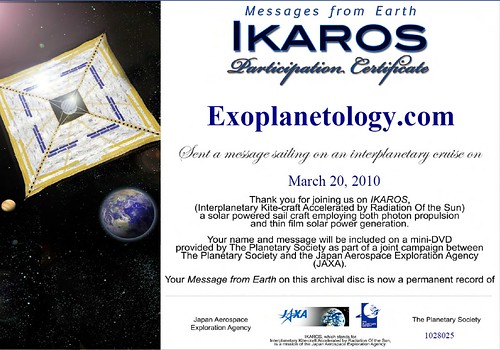
By the way, did I mention that "Exoplanetology" is actually riding the IKAROS? Yes, a few months back I actually filled up a form at The Planetary Society's website to send a message to be carried along with IKAROS. Unfortunately, it wasn't encoded in the certificate of participation that was provided, but my message was "Interplanetary Now, Exoplanetary Next".
I hope that this short message encourages others in the hope that one day, we will have a probe exploring another solar system, and most importantly--an extrasolar planet!

Links:
Light Sail: Solar Sail from Planetary Society
From Centauri Dreams: http://www.centauri-dreams.org/?p=12588

May 14, 2010

Gasp! Exoplanellites!

Several times upon looking at the moon, I've always been inclined say that it is a planet in its own right. In fact I did say it on twitter. And by a slip of the twit-thumb, I've also mistakenly referred to exomoons as planets.
The allure of considering moons as planets is inescapable. Many scientists even describe Titan as "similar" to Earth! Another moon called Io was even singled out to describe an exoplanet by introducing a new type of planet called "Super-Io"!
Perhaps the inherent planet-like qualities of moons is the reason why the principal investigator on the New Horizons mission to Pluto couldn't hold the idea any longer.
Thus, Alan Stern proposes that we call large moons as "Satellite Planets". Yes, you heard that right: Satellite Planets!
And here's what I have to say to this idea: I like it!
A "planet" that is orbiting another planet may seem counter-intuitive at first but somehow it simplifies things once it sinks in. A "satellite" after all, is defined as a celestial body that revolves around a larger celestial body.
Now because we have this debate about what a planet is, we must forget for a moment the whole confusion about Pluto, and look at these round moons as Worlds in their own right, then perhaps one might see them as planets as well.
When the time is right, try looking at the moon in the blue morning sky. That gray crescent looks like a planet, right? Umm...well maybe its just me. Perhaps because I love planets. But now because Alan Stern is a big defender of Pluto, this idea will definitely elicit violent reactions from plutagonists. On the other hand, if he didn't love Pluto that much, he might not have been bold enough to put forward this idea. So let's see what comes of it.

In the meantime, I wouldn't mind introducing the term "Planellites" for twitter brevity.
Gasp! What have I done?! That means that we will have "exoplanellites" as another word for exomoons!


Links:
Should Large Moons be called...
Super-Earth may be a Super-Io

Grouping the Planets
Image taken from this page 

April 9, 2010

Giantess: A Possibilian Tale

I came across the Possibilian from a tweet. The Neuroscientist, David Eagleman coined the term to describe someone who is actively open to different ideas. In a nutshell,

"Our ignorance of the cosmos is too vast to commit to atheism, and yet we know too much to commit to a particular religion. A third position, agnosticism, is often an uninteresting stance in which a person simply questions whether his traditional religious story (say, a man with a beard on a cloud) is true or not true. But with Possibilianism I'm hoping to define a new position -- one that emphasizes the exploration of new, unconsidered possibilities. Possibilianism is comfortable holding multiple ideas in mind; it is not interested in committing to any particular story."

The idea of "Possibilianism" appealed to me because it aligns quite well with my twitter manifesto regarding my stance about God (check the last portion of my twanifesto). So I dug deeper into this worldview, finding clues as to how this neuroscientist arrived at a similar view that I hold.
Apparently, David introduced this term during an interview about his book, Sum: Forty Tales from the Afterlives. I am now reading this book because I was curious as to the kind of work that a Possibilian would share to the world.
And so I found Sum quite enjoyable, being a collection of short metaphysical stories, it suited my reading style of digesting bite-sized portions, reading one story at a time.
And so I came across a story that gave me a reason to write about it on this blog. The story is called Giantess.
In a nutshell, the story illustrates emergence on a grand scale. An enormity that is expressed only via a metaphor using cellular biology wherein planets, ah yes, exoplanets are merely proteins within a cell we call "The Milky Way", which is one among billions of galaxies within an immeasurable living mass called the Giantess.
On this grand cosmic scale, our tiny solar system dont matter much to the uber-emergent entity, like how we casually wipe away a tiny drop of blood from a pinprick. Life on planets can be wiped away by a rain of asteroids, and entire galaxies would be devoured by blackholes, and the Giantess couldn't care less.
Here's some tidbits from the story to give you a feel of Eagleman's style of writing,

"To be clear," he says to you, "I am not your God. Instead, you and I are galactic neighbors; I am from a planet associated with the star you call Terzan Four..."

"For a long time, we have been studying our neighbors: You Earthlings and thirty seven other planets besides. We have developed highly accurate systems of equations to predict the future growth and social directions of your planets."

The common theme of the book revolves around hypothetical afterlife scenarios and the different playful manifestations of God. But collectively, the stories in Sum covers a wide range of topics that any enthusiast or scholar in many fields (Philosophy, Spirituality, Psychology, Theology, Computer Science, Physics and Metaphysics, Cosmology, etc) will find a 'connecting point' or their own metaphor, and a reason to write about it in their blogs, the same way I did for exoplanetology.
As I keep a close watch over the ongoing march of the Plurality of Worlds, the ever-growing discovery of exoplanets opens up a lot of possibilities, and synthesizes different fields--that the best way to tread is to simply maintain fresh eyes on fascinating wonders of new discoveries, and to keep an open mind to the challenges it would bring to long-held worldviews and beliefs.
Is there life out there? Are there intelligent, conscious beings on other worlds? How does their existence affect humanity's concept of God? How will it affect my Faith?
In light of those kinds of questions, the kind of attitude suggested by Eagleman's book is summed up by it's simple meta-message: We don't know...

Links:
Possibilian
David Eagleman 40 Afterlives
Exoplanetology Twitter Manifesto

Photo Credit:
The Final April Fools, Light & Illusion – Art by Randall Klopping

February 8, 2010

Do Androids Dream of Exoplanets?

"The ship turned back a sixth of the way to Proxima. Otherwise Rachael would never have seen earth.." Thus that line inspired me to write a post about "Do Androids Dream of Electric Sheep?", the futuristic novel by the legendary author Philip K. Dick (PKD).

Probably known as the story which inspired the cult scifi movie Bladerunner, I also enjoyed it's rendition as a graphic novel. Although the art behind the comics version did not fully capture the kind of world that PKD painted, I honestly did not expect "Do Androids Dream" to be as rich as it is, touching upon a lot of topics that might become apparent in the near future.

First, is the opening introduction to the issue of animal extinction, and how Deckard--the pet-loving bounty-hunter (specializing in retiring "Andys") is yearning to own a real sheep, a real horse or any genuine animal, for that matter. As I write this, thousands of species are actually disappearing from our planet. Perhaps our children may someday own pets that are genetically-modified or fully synthetic versions of extinct species.

Second is the apparent evolution of robots into Androids that are so sophisticated that they are difficult to discern from real human beings. A special kind of modern psychological Turing Test is needed, which is requires a Voight-Kampff machine to detect whether a subject is an android or a human.

And the third one, which is of particular interest to this blog is the mention of Colony Worlds. In the future, we will employ hordes of androids, called "replicants"--to do all the drudgery for us, in building off-world colonies on inhospitable worlds like Mars. Already in the beginning stages of planetary exploration as we use rudimentary robots like the Spirit rover whom we already ascribe with anthropomorphic qualities, and who already moves our emotions in ways we could never explain.

Google perhaps even named their "Android" phones after one of the earlier versions of the replicants called the Nexus-6 (which gives us a hint of what this "evil" company may be up to in the near future). Corporations may utilize the charm of anthropomorphized machines to create profitable products that appeal to the masses and thus secure funding from "gadget-loving" consumers. Now that Human Space Flight is wide open for commercial entrepreneurship, it signals a glimpse of what lies ahead. Planetary exploration and colonization may in fact be undertaken by private firms.

And since humans are so fragile and expensive to transport and land on other planets, could there be good reasons to believe that the future exoplanetary exploration will be done in whole or in part, by artificially intelligent robots and androids operating under the funding or technology of commercial firms? One can never tell, unless of course when they're already staring us right in the face.

But if i was an Andy i will never go back to Earth, especially with that kind of treatment depicted in the novel. I'd rather run away far unto outer planets than be extinguished by narrow-minded humans on this forsaken world.

Links:
"Spirit" from XKCD
"Do Androids Dream" Official Page
Commercial Spaceflight

June 19, 2009

Aren't You Glad You're Not on Daxam?

Sodam YatI still remember the time when i looked at Orion's belt, the big and small Dipper and the Pleiades when I was a young child. Looking back, I now appreciate even more those times as a teenager when I spent countless hours laying on our roof just gazing at the stars.
Imagine if someone stopped you from looking up. Imagine if it was against the law to look at the stars. What a terrible world that would be!
Believe it or not, but that world exists. It's called Daxam. It's the home planet of Sodam Yat, the Daxamite member of the Green Lantern Corps.
As a young child, Sodam was prohibited from exploring the stars. His father shattered his telescopes and lenses to keep his eyes from the skies.
Fiction as it may be, this story is worth mentioning to inspire others to look up. No one is stopping us from looking up but ourselves. Each of us is only here for a moment to walk the earth and taste the immensity and infinity of the cosmos by simply gazing at the night sky. It's a precious moment and a wonderful privilege to be able to look at the stars!

June 18, 2009

Bizarre New Worlds

Bizarre New WorldsThis issue is simply too interesting for me to go unnoticed. Imagine the core of worlds made of diamonds. With enough pressure, it's possible! And there's plenty of ways that pressure is generated in the universe.
Now the cover art is also worth taking a look. Do you notice anything unusual with the ringed planet in the background? Aside from the beauty of it, take a look at how many rings that huge planet has. It has got 3 rings! Multi-layered rings? Is that possible? I hope some Astrophysicist writes up an ArXiv article about the possibility of it because it's beautiful! Or perhaps is it too good to be true?

April 27, 2009

Astronomer's Worlds

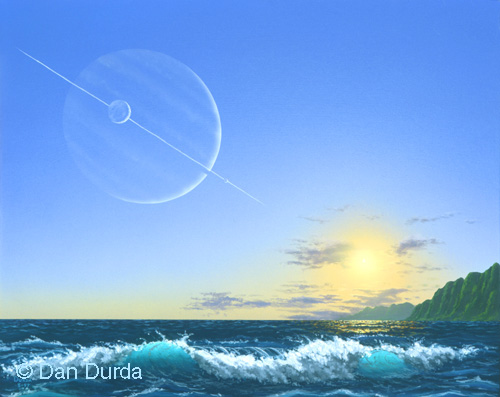
WorldsIn my previous posts, I've linked to some hypothetical exo-lifeforms as imagined by artists with an inclination to science, or scientist inclined to the arts. As shown in Snaiad and Expedition, those works of art--speculative as they may be--provide a glimpse of what could thrive on other planets. This time, I will take you to these worlds as imagined by an astronomer. Meet Dan Durda, a planetary scientist who paints distant worlds in his spare time while not doing daredevil acts like flying jetplanes or diving in underwater caves. Thus, what he comes up with are absolutely breath-taking worlds.

April 23, 2009

A World in Progress: Snaiad

What happens when Imagination glues together Speculative Biology and Exoplanetology? You get Snaiad, a compilation of hand-drawn creatures straight from an imagined world.

"Snaiad is one of Humanity's first off-world colonies, the jewel in the sky, the realm of the sublime. The hopeful colonists arriving from the war-weary Mediterranean found themselves not in a second Garden of Eden, but an unusual new world they had to understand and adapt in order to survive. Understand it they did, and here is what they found."

The world of Snaiad is given life in this site. It has a timeline history nicely chronicled, and even extends up to 550 years later from today. According to this "legend-in-progress", its not until 250 to 433 years from now that extrasolar colonization will occur. It also has a map and geography of the planet.
The Snaiadi creatures are given detailed information regarding their physiology, anatomy and biology. An explanation is also provided on how they are created in a step-by-step process straight from the artist's mind. It is truly amazing!
But here's the best part: You can actually go into this world right now. Yes! You can join the further development of Snaiad. It has a venue for collaboration. It is somehow connected to DeviantArt and some other projects of a similar vein. I am currently pondering how i can contribute to these awesome endeavors. As such, I would gladly recommend these types of projects to spacehack in a kind of off-beat category.
I will continue to explore Snaiad and others like it for I am truly delighted by the discovery of incredible Worlds borne of Imagination and Science.


Snaiadi Creatures
Links: Alien para-tetrapods of Snaiad

March 26, 2009

Hello Worlds!

I've now been using "Hello Worlds!" in my code. I guess it's time to redefine the classic "Hello World!" in programming. I have adopted that practice to remind myself of the "Plurality of Worlds" that is upon us. In my opinion, the new generation will suddenly wake up to the continued proliferation of Worlds - in the real, virtual, imaginary and theoretical domains.
With the growing number of new exoplanet discoveries, we are uncovering new worlds that have now begun to enter the thought-sphere of humanity. Our Earth is one among billions and billions of other worlds in outer space, and that's a fact.
On another realm, we have Virtual Worlds that may yet still seem crude and "artificial" at this point in time, but nevertheless can be considered as "Worlds" in their own right. We have the Metaverse, as best represented by Second Life. And we have Massive Multiplayer Online Games (MMORPG) best exemplified by World of Warcraft and Eve-Online. And there's Spore, a new genre, that is between an MMO and a single-player networked game.
We have the so-called "Parallel Worlds" in theoretical physics that seems far-fetched and inaccessible. They are a favorite in Sci-Fi, but who knows what a few decades could have in store for us? Our future progenitors may be crossing them to visit other worlds not only in space, but in time as well.
And last but not the least, I recognize the infinite worlds that are powered by the human imagination. Not to mention the wondrous Worlds that privately exist within each human mind, it is time to recognize these beautiful "Worlds" of fiction - as produced by the mind and the collective consciousness of the human race.
Truly we are in the "Era of New Worlds". And I recognize it as such to introduce "Hello Worlds!" in my programming practice (at least whimsically in my own little world of coding) as a web developer.
Today, we are not merely speculating the existence of other worlds, they are scientifically proven as a fact. The list of exoplanets is growing at an exponential rate to the point where we are on the verge of discovering earth-like worlds. Thus it will have an even greater impact on human culture and society.
I will track the exciting transition of the human psyche as it absorbs the ramifications of the plurality of worlds. I will then share the recoil it will bring in some aspects of the arts and humanities: in culture, media, religion, literature, spirituality, gaming, and other interesting fields.
It could be a lot of hard work, but the joy of discovery is what inspires me. This is a wonderful period in the history of humanity and I am grateful to live in such an era.
I will be your emissary, join me as I say "Hello Worlds"!

Note: This post is a spin-off or reblog from an earlier post in 2008 that I wrote at my other blog Archetyper. The original "Hello Worlds" can be found here: http://archetyper.blogspot.com/2008/04/hello-worlds.html