June 15, 2010

On Kepler Data and Beyond

It's almost a dream come true. For so many months, I've been wishing to take a look at actual Kepler data, and I often tweeted how Citizen Science could help analyze exoplanet data. And now that moment is close at hand!
For starters, when you look into this arXiv paper you'll see some data on 306 of the 706 exoplanet candidates.
Also, an important tidbit is that the paper lists 5 multi-planetary transiting systems. If any one among them is confirmed, then it will be the first case of a transiting multi-planet system known.
I was patiently monitoring the MAST website where the promised new data set can be downloaded from, but it didn't come as of yet. In my boredom, I just downloaded the FITS file of Kepler-4, hoping to practice with it before handling the exciting new data.
When I finally got hold of the FITS files via FTP from the MAST website, my initial reaction was: "So now I have the data! But What Next?!"
It was a sudden realization: Yes it is very good that the exoplanet data is being shared to the public, but now we need tutorials on how to analyze those data. Suddenly, I am now wishing that Scientists and Astronomers would post how-to's and tutorials on how to analyze FITS data to find planets! And I am hopeful, that day will come!
For now, I scrambled my way in the dark on finding the right software to be able to view and edit FITS files. Once I found the excellent "FV", I played with the data set and it felt nice seeing regular dips in the curve. So I am thankful for all the people responsible for giving us this chance to see actual scientific data.
Looking at all this, I realized that we are now at a threshold moment where ordinary people can do Science. This is definitely the beginning of a new era of Scientific Discovery. And I say, it's amazing! I can't wait to see what's beyond!!!

Links:
Abstract: http://lanl.arxiv.org/abs/1006.2799 
PDF (Direct Link) http://lanl.arxiv.org/ftp/arxiv/papers/1006/1006.2799.pdf

June 11, 2010

ExoComets

Behold! Thy ExoComet Cometh!
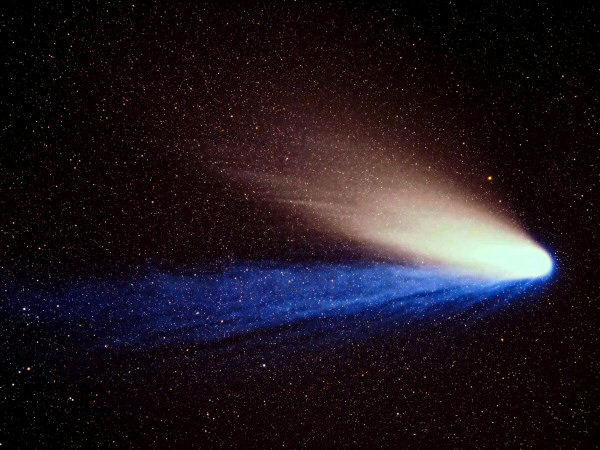
Just a day after I posted an entry about Comet McNaught and showed how "otherworldy" it seems to me, along comes an article that says that maybe 90% of comets lurking in the outer parts of our solar system are from other planetary systems!
I'm tempted to call them "exoComets" even if they're already part of our solar system, because some famous comets such as Halley, Hale-Bopp and McNaught might have originated from around other stars!
Wait! How did that happen? The nearest star is Proxima Centauri, which is 4.2 light-years away. Surely it would take thousands of years for an interstellar comet to travel to our solar system!
Well, here's the reason why some of these comets may be "exo": Stars often form in clusters. And perhaps a long long time ago, our Sun may have shared comets with her stellar "sisters" who may have been quite nearer at that time. When you think about it, our Oort cloud which is estimated to have around 400 billion comets, is spread so far and wide past Pluto that its already a quarter of the distance to Proxima Centauri (but some estimates say that the spherical Oort cloud extends up to 3 light-years from our sun!).
Computer simulations reveal that perhaps the green Comet McNaught featured in my previous post may have had a long history that ties it with other stars in the distant past.
Hey, you never know, these pretty comets might be messengers from Alpha Centauri!

Source:
http://www.sciencemag.org/cgi/content/abstract/science.1187535

June 9, 2010

That ain't no Comet, It's a Green Lantern Ring!

As many poozers know, I am a fan of Green Lantern and that multi-alien group of intergalactic, exoplanetary police force called The Green Lantern Corps. So the moment I saw the photo of the Comet McNaught, a comics-style bubble popped up above my head with this text: "Hey! That looks like a Green Lantern ring zooming through our sector!"
Depictions of Green Lantern rings flying across interstellar space are only seen in comic books. But I believe that nothing else comes close to these pictures as to how lantern rings in flight might look like in our real world.
Sure, it is a comet, and that tail is made of gas and particles blown off by the solar wind from the comet's icy nucleus, and the green glow is actually caused by ionized atoms. Maybe "real" Green Lantern rings won't leave trails like that because it won't shave off ice, gas and dust. But if you leave some room for your child-like imagination, it will be an even more wonderful sight seeing that green glow of pure energy!
Now here's some trivia: This particular Comet McNaught is just one among many. In other words, there are many Comet McNaughts. Yes, just like the legend of Green Lantern rings, there's a whole bunch of Comet McNaughts. Well, perhaps not as many as lantern rings which could number up to thousands. But I can make a good guess (based on explanations from BadAstronomy) that the other McNaughts are colored green, too. Its probly even more exciting imagining some of them are yellow, blue or orange...
But if you wanted to see nature's depiction of a Green Lantern ring racing across the night sky, you might actually have a chance to see it in the next few days.
You never know, Comet McNaught might just be a Green Lantern ring in disguise, roaming our solar system looking for the next bearer! So always be ready. It might choose you!

Links:
It's Easy Being Green
Comet in the June Dawn

Photo Credits:
Comet McNaught by Anthony Ayiomamitis and Michael Jaeger

June 8, 2010

TRAPPIST, A New Exoplanet-Hunting Telescope

For the record, I'd like to post this info about TRAPPIST, the most recent entry to our slew of planet-hunting telescopes. TRAPPIST (TRAnsiting Planets and PlanetesImals Small Telescope) is a new robotic telescope from ESO at La Silla Observatory, in Chile. It is devoted to the study and detection of exoplanets and it will also study comets orbiting around our Sun. That is a nice combination to deal with the theme in Astrobiology about the study of the origin of Life.
TRAPPIST is a 60-cm telescope being remotely-operated from a control room in Liège, Belgium, 12,000 km away.
As it's name suggests, TRAPPIST will use the transit method, which is the same method that Kepler uses to hunt for planets. From its official website, there is no mention whether it is equipped with Adaptive Optics to counteract the effects of the Earth's atmosphere. But from the excellent night sky in Chile--aside from adding more entries into our known exoplanets database--we hope TRAPPIST will be capable of detecting earth-like planets as well.

Links:
TRAPPIST Official Website

June 3, 2010

On IKAROS and Interplanetary/Interstellar Kites

I love kites. I have three stunt kites among others which I sometimes fly on summer weekends at the park near Liberty Science Center (overlooking New York City) where the constant breeze is best for kite-flying around the area. To this day, I am still amazed how the wind translates to flight.
As a child growing up in the Philippines, I often ran in the streets with a kite I made out of newspapers and "walis tingting". As I pulled on the string (which i stole from my grandmother's sewing kit), I wondered how high and how far my kites could go. I remember myself asking if they could go past the clouds, the blue sky, and out beyond the unknown expanse.
The answer came many years later, but its so much better than it could ever be.
On May 20, 2010, an interplanetary kite has been launched that will fly to another world. The IKAROS will go to Venus and beyond.
The IKAROS (Interplanetary Kite-craft Accelerated by Radiation Of the Sun) is a solar sail mission powered solely by sunlight. A solar sail is pushed by the photons from the Sun. In other words, it uses sunlight to sail.
When a photon is reflected it exerts a small force on the surface reflecting it. The Sun generates a lot of photons, so if you have a large, lightweight, reflective surface, it will be pushed by the force of many photons being reflected off it. It is the reflected photons that creates the "pushing" effect.
The solar sail hitched a ride aboard an H-2A rocket from Japan's Tanegashima Space Center. That rocket carries the main mission of the Japan Aerospace Exploration Agency (JAXA), the Venus Climate Orbiter called Akatsuki.
IKAROS is the first of it's kind to ever be launched and I hope it will work because it's success will pave the way for future solar sail missions that may even extend past our Sun into other stars. Thus, I have whimsically labeled a future acronym for it's successor: Interplanetary Kite ARound Other Stars (IKAROS).
I am very excited about IKAROS so I watched it's launch on a live feed. Perhaps watching its launch was related to the fact that launching my jetstream kite from the ground is also my favorite part.
My kite is initially in a launch position, facing the wind, facing me, and pointing up. I wait for a suitable gust of wind to pass through my back and reach the kite. At the right moment, I pull both strings and step backwards, I can feel the strength of the wind as I watch the kite accelerate upwards. For me, it is the most exhilarating part of flying kites. I advise you to try it.
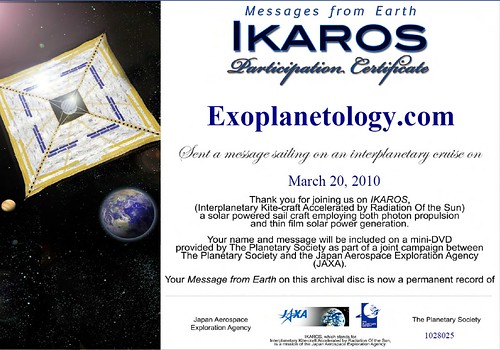
By the way, did I mention that "Exoplanetology" is actually riding the IKAROS? Yes, a few months back I actually filled up a form at The Planetary Society's website to send a message to be carried along with IKAROS. Unfortunately, it wasn't encoded in the certificate of participation that was provided, but my message was "Interplanetary Now, Exoplanetary Next".
I hope that this short message encourages others in the hope that one day, we will have a probe exploring another solar system, and most importantly--an extrasolar planet!

Links:
Light Sail: Solar Sail from Planetary Society
From Centauri Dreams: http://www.centauri-dreams.org/?p=12588

May 14, 2010

Gasp! Exoplanellites!

Several times upon looking at the moon, I've always been inclined say that it is a planet in its own right. In fact I did say it on twitter. And by a slip of the twit-thumb, I've also mistakenly referred to exomoons as planets.
The allure of considering moons as planets is inescapable. Many scientists even describe Titan as "similar" to Earth! Another moon called Io was even singled out to describe an exoplanet by introducing a new type of planet called "Super-Io"!
Perhaps the inherent planet-like qualities of moons is the reason why the principal investigator on the New Horizons mission to Pluto couldn't hold the idea any longer.
Thus, Alan Stern proposes that we call large moons as "Satellite Planets". Yes, you heard that right: Satellite Planets!
And here's what I have to say to this idea: I like it!
A "planet" that is orbiting another planet may seem counter-intuitive at first but somehow it simplifies things once it sinks in. A "satellite" after all, is defined as a celestial body that revolves around a larger celestial body.
Now because we have this debate about what a planet is, we must forget for a moment the whole confusion about Pluto, and look at these round moons as Worlds in their own right, then perhaps one might see them as planets as well.
When the time is right, try looking at the moon in the blue morning sky. That gray crescent looks like a planet, right? Umm...well maybe its just me. Perhaps because I love planets. But now because Alan Stern is a big defender of Pluto, this idea will definitely elicit violent reactions from plutagonists. On the other hand, if he didn't love Pluto that much, he might not have been bold enough to put forward this idea. So let's see what comes of it.

In the meantime, I wouldn't mind introducing the term "Planellites" for twitter brevity.
Gasp! What have I done?! That means that we will have "exoplanellites" as another word for exomoons!


Links:
Should Large Moons be called...
Super-Earth may be a Super-Io

Grouping the Planets
Image taken from this page 

May 10, 2010

SETI and Kepler-4b

For some curious post to warm up a chilly monday, I just came across a surprising analysis of Kepler-4b signals not from planet-hunters, but from someone tinkering with SETI! There seems to be a "non-random" pattern that shows up in the graph. Could it be a clue to some alien message encoded within the signal?
Not too fast.
Apparently, someone who "likes analyzing signals" posted his baudline analysis of the Kepler-4 exoplanet data file from SETIquest. I'm just starting to dip my foot into Digital Signal Processing (DSP) here, but because I am interested in Data Visualization, I was drawn into it, which led me to write this quick post with lots of linktrails.
For the big question: Is there an alien message in the signal? No. There are still too many parameters to settle in order to say that it is an extraterrestrial code. But I wish to get back more into this as I am interested in finding patterns. The "spinal" pattern in the photo above seems like a good start for learning about Fast Fourier Transforms!
I downloaded the 2 Gig .dat file from SETIquest and tried to open it just to peek, but my computer almost crashed due to the humongous filesize. I wish they'd break it down into smaller bits. I'm sure SETIquest will improve in the coming days.
Many questions pop up as a result of this baudline analysis post, such as the directional source of the signal. According to the forum at SETIquest, its really from the Kepler-4 star system (but I still need a valid RA/Dec info, which was not provided in the .dat file description). Other issues need a little more work to confirm, such as whether it might have been our own artificial signals, which may include transmissions from our satellites and perhaps even signals from the Kepler telescope itself(!) Also, I think it would be great if the Allen Telescope Array will listen in on the list of star systems with known exoplanets.
There's some interesting bits of information regarding signal analysis, and bits about Kepler telescope, and some exoplanet related data files posted in the forum so check it out.
Kepler-4b is among the first batch of exoplanet discoveries announced by Kepler early this year. The host star Kepler-4 is also one of my adopted stars (ahem!) from the Pale Blue Dot project, so i took some time to look into this.
And as I mentioned in my past post about SETIquest with a quick review of His Master's Voice by Stanislaw Lem (that book was lent to me by @leebillings, by the way) the data is open for public consumption. So we can consider this post as a preview of things to come between the intersections of Planetary Science, Astronomy, SETI, Exoarchaeology(?), Citizen Science, and just plain ol' geekiness.


Links:


April 28, 2010

On Stephen Hawking's Xenophobia

By now, everybody's probly tired of all this Hawking's xenophobia reverberating across the web and twittercosm. What Hawking said must've been brilliant. Its got the elements of good news and bad news and everything in between. Kinda like good cop, bad cop. He's both right and wrong and fuzzy so it got the buzz. I am glad he's getting in on the topic, except he got everybody thinking and chattering about xenocidal stuff.
Just for fun, let me join the blabbing fray.
I'll start with Hawking's fear that aliens might simply raid Earth for its resources and then move on. You see, there's so many planets out there. Billions of exoplanets, dammit! And earth's resources are almost sucked up by humans already. So implying that Aliens will kill us all to get the resources of our planet (or solar system) is a major fail.
But then again, the reasons that Aliens will kill us all depends on a lot of reasons. Or perhaps they won't kill us in the "kill" sense of the word. The prospect of merging or being usurped by an alien culture is a long and fuzzy romance.
But a major aspect, I think, is that it all depends on the timing. It has a bearing on how advanced the alien race is, and how advanced--or retarded we are--at the time of contact. For example, thousands of years from now, if by some lucky fluke, we somehow reach Kardashev Type 2 and the aliens are Type 3, they might consider us a threat to them, and vice-versa. War would ensue. But if the technological level is too far apart, as in our state right now (Type 0) versus their Type 3, then they might just leave us alone. If they suddenly arrive right now, I think our civilization would make a curious subject for highly-advanced galactic scholars and scientists. Or depending on their personalities, values and morals, they might just bet for fun and game about whether we'll destroy ourselves on our own.
It also depends on how cute we are. You see, it may also depend upon planetary affinity. If these advanced aliens evolved from an Earth-like world, then they might just find some kind of common ground with us. Perhaps deep within their "telluric" roots (as previous dwellers of a rocky planet), they might find us cute. That is, if the history of their planetary origin is still in their characteristics (or culture) even if they already evolved a space-faring biology. But if they evolved from an entirely different type of planet (for example a slushy dense planet) then they might find us revolting. The kind of response it would elicit from them might be similar to the disparity between one's reactions upon touching a cockroach or a puppy--splat or pat.
The parameters are so many, that we might as well create a Drake-like equation for xenosociological encounters. The aliens might destroy us, or they might not. Anything could happen. Or not happen. We do not know.
Perhaps the final verdict will depend on the quality of our existence and the footprints we leave in the Cosmos. There's plenty of reasons for us to remain quiet, as Hawking suggests. But its already too late. We've already sent signals and blown our cover. For example, our decades-old broadcasts are already speeding outwards to other stars (see the chart below). And our fate may entirely depend upon which of our TV programs they happen to see. Folks from Aldebaran might immediately obliterate us upon seeing our footages of World War II. While Mu Araens might simply enjoy our twilight zone episodes and leave us alone for a little while.

April 27, 2010

Mirror Planets

The universe--and the science we use to probe it, never ceases to amaze me. News just came out that gives more weight to the existence of "Mirror Matter" that possibly fills the universe. We all know that Dark Matter is that elusive missing matter that exerts certain influences on galaxies and cluster of galaxies. They exhibit tell-tale signs of their existence, but they are unseen.
In the race among physicists to produce direct evidence of Dark Matter, an Italian group announced that they have found signs of Dark Matter from their experiment called DAMA/LIBRA. Then, a US-based experiment called CoGent also found evidence of Dark Matter.
In an effort to reconcile the findings from the two experiments, Liam Fitzpatrick at Boston University suggested that a light, weakly interacting dark matter particle could explain both results. And now, Robert Foot from the University of Melbourne says that the existence of Mirror Matter could explain it better.
In a nutshell, Dark matter, which contains the "missing mass" that's needed to explain why galaxies stay together, could take any number of forms--and Mirror Matter could be one of them.
Most of these ideas are somewhat hypothetical as of yet. At this point I need to clarify that mirror matter is not anti-matter. Whereas anti-matter has more to do with particles of the opposite charge (i.e an electron with a positive charge, called a positron), mirror matter owes it's distinction to parity or chirality. To understand it better, let's use the analogy of left-handed molecules where chirality arises from geometry not composition.
Another difference between mirror matter and antimatter is that anti-matter plus ordinary matter is highly reactive and explosive--both will be annihilated in a burst of energy upon contact. But mirror matter and normal matter reacts so weakly, where the effect of gravity could be the only noticeable "symmetrical" interaction between the two.
Now that you have an idea of mirror matter, here's the mind-blowing aspect of it. The implications of the existence of mirror matter is astounding because when you consider the fact that in the observable universe alone, we already say that there are billions and billions of stars. How much more if there are additional mirror galaxies, mirror stars, and mirror planets? The observable universe that we infer, based on what we have "seen" thus far with our telescopes (like Hubble, Spitzer, etc.), only accounts for 4.6% of the whole universe. Dark matter accounts for 23%! (the rest is dark energy which is even harder to detect).
Even if only a certain percentage of Dark Matter is mirror matter, and if that is proven true--then it will be quite staggering to our imagination.
Think about mirror exoplanets. Think about the kind of life that might arise from planets made of Dark Matter. Think about lifeforms and advanced beings made up of mirror matter. What will happen if you shake hands with a "mirror alien"?
Truly, there is so much we don't know. Our imagination pales in comparison to the unknowns of the universe. And the journey of knowing, and speculating a bit, at each step--is simply a wonderful experience.


Links:
Mirror Matter

First evidence that Mirror Matter from Technology Review
Signs of Dark Matter... from Physorg

Image Credit:
The World is your Mirror from www.seanmantey.co.uk

April 9, 2010

Giantess: A Possibilian Tale

I came across the Possibilian from a tweet. The Neuroscientist, David Eagleman coined the term to describe someone who is actively open to different ideas. In a nutshell,

"Our ignorance of the cosmos is too vast to commit to atheism, and yet we know too much to commit to a particular religion. A third position, agnosticism, is often an uninteresting stance in which a person simply questions whether his traditional religious story (say, a man with a beard on a cloud) is true or not true. But with Possibilianism I'm hoping to define a new position -- one that emphasizes the exploration of new, unconsidered possibilities. Possibilianism is comfortable holding multiple ideas in mind; it is not interested in committing to any particular story."

The idea of "Possibilianism" appealed to me because it aligns quite well with my twitter manifesto regarding my stance about God (check the last portion of my twanifesto). So I dug deeper into this worldview, finding clues as to how this neuroscientist arrived at a similar view that I hold.
Apparently, David introduced this term during an interview about his book, Sum: Forty Tales from the Afterlives. I am now reading this book because I was curious as to the kind of work that a Possibilian would share to the world.
And so I found Sum quite enjoyable, being a collection of short metaphysical stories, it suited my reading style of digesting bite-sized portions, reading one story at a time.
And so I came across a story that gave me a reason to write about it on this blog. The story is called Giantess.
In a nutshell, the story illustrates emergence on a grand scale. An enormity that is expressed only via a metaphor using cellular biology wherein planets, ah yes, exoplanets are merely proteins within a cell we call "The Milky Way", which is one among billions of galaxies within an immeasurable living mass called the Giantess.
On this grand cosmic scale, our tiny solar system dont matter much to the uber-emergent entity, like how we casually wipe away a tiny drop of blood from a pinprick. Life on planets can be wiped away by a rain of asteroids, and entire galaxies would be devoured by blackholes, and the Giantess couldn't care less.
Here's some tidbits from the story to give you a feel of Eagleman's style of writing,

"To be clear," he says to you, "I am not your God. Instead, you and I are galactic neighbors; I am from a planet associated with the star you call Terzan Four..."

"For a long time, we have been studying our neighbors: You Earthlings and thirty seven other planets besides. We have developed highly accurate systems of equations to predict the future growth and social directions of your planets."

The common theme of the book revolves around hypothetical afterlife scenarios and the different playful manifestations of God. But collectively, the stories in Sum covers a wide range of topics that any enthusiast or scholar in many fields (Philosophy, Spirituality, Psychology, Theology, Computer Science, Physics and Metaphysics, Cosmology, etc) will find a 'connecting point' or their own metaphor, and a reason to write about it in their blogs, the same way I did for exoplanetology.
As I keep a close watch over the ongoing march of the Plurality of Worlds, the ever-growing discovery of exoplanets opens up a lot of possibilities, and synthesizes different fields--that the best way to tread is to simply maintain fresh eyes on fascinating wonders of new discoveries, and to keep an open mind to the challenges it would bring to long-held worldviews and beliefs.
Is there life out there? Are there intelligent, conscious beings on other worlds? How does their existence affect humanity's concept of God? How will it affect my Faith?
In light of those kinds of questions, the kind of attitude suggested by Eagleman's book is summed up by it's simple meta-message: We don't know...

Links:
Possibilian
David Eagleman 40 Afterlives
Exoplanetology Twitter Manifesto

Photo Credit:
The Final April Fools, Light & Illusion – Art by Randall Klopping

April 7, 2010

Science Fiction and The Exponential Discovery of Exoplanets

How does the exponential discovery of exoplanets impact the landscape of Science Fiction? Surely we are at a stage in history were new doors are being opened up by the accelerating rate of exoplanet discoveries. I wonder how it affects the human psyche. How does the growing knowledge of new worlds impact the human imagination?
Will a new breed of science fiction writers and film-makers create richer planetary settings with more elaborate world-building efforts?
Curiously, I decided to do some research and experiment on it. I started to compile a list of fictional planetary settings (check out the list at freebase). This is an ongoing experiment and anyone can participate by adding their own favorite fictional planet within freebase. If you notice that the planet setting in your favorite sci-fi novel is not listed, then by all means please add it in by signing up into freebase and contributing your knowledge.
Looking at the numbers so far, we currently have 443 known exoplanets compared to 200 fictional planets. Perhaps I am concluding prematurely, but it struck me how our human imagination is lagging behind scientific findings in terms of coming up with new worlds. As you can see from the chart, the rate of discovery of new planets is soaring at an exponential rate. What about new planets in science fiction? In literature?
I wonder whether there will come a time when some kind of growth spurt will occur in the number of new fictional worlds in sci-fi. And whether the ever-expanding knowledge about exoplanets will have something to do with it.
The 443 discovered exoplanets span from 1992, while the list of fictional planets span all the way back further than that. So we may not know yet whether the same exponential curve will happen to the number of new planetary settings being created in science fiction.
And this being an ongoing research, there are still some gray areas in this experiment that we need to iron out in due time. For example, some computer games actually have storylines that are set on fictional planets. Some of these in-game planets turn out to have adaptations onto comic books like Halo, Mass Effect and Gears of War. Some other games have massive numbers of planets, such as the case with Eve-Online which have thousands of planets--yet only a few are mentioned in the EVE novels. So it's definitely an open issue how a planet within a game jumps into the scifi landscape.
I do not know how this experiment will turn out, but one thing i'm sure is that it is fun to be there as it unfolds.

"We are at a crossroads in human history. Never before has there been a moment so simultaneously perilous and promising."
~Carl Sagan


April 1, 2010

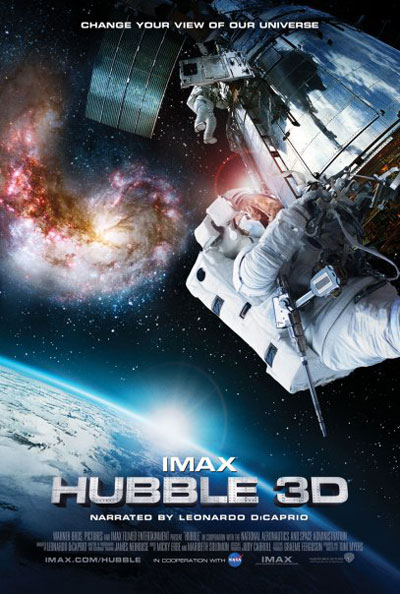
Hubble

And it had to come to this, that on April 1st, I had to call in sick due to severe grogginess caused by lack of sleep. After I snoozed my way to recovery, I then had to make a quick escape from the oncoming harrows of the waking life. I headed for the Liberty Science Center to see Hubble in the IMAX dome.

For my case, this short film turned out to be ok for a hurried schedule. For a mere 40 minutes, a lot of substance were crammed into it. It was short but sweet. But of course I would've enjoyed more if it had more of the spacey scenes.

The film tells a mini-story of how the brave astronaut heroes fixed Hubble on the last servicing mission. And it showed spectacular scenes of deep space, with all the galaxies and stars, gliding towards the Orion Nebula, and grazing at "tadpoles" in stellar nurseries, then zooming onto star formations.

The wonders that the Hubble telescope shares to us is already mesmerizing by way of its pictures of stars, nebulae, galaxies and so forth. Yet several times in the film, the narrator (Leonardo DeCaprio) mentioned the search for other worlds. And one of the Astronauts even mentioned how Hubble can study the atmosphere of other planets. Of course, that made my eyes grow wider than the gargantuan dome.

As the film reached its climax and ended with the view of earth, I knew that my little escape from the busy day was over. Yet I realized that even as mankind will always try to escape the planet's pull of gravity, a spacefarer will always look back. And when one scans the starry heavens in search for other earth-like planets, there's no escaping--it always points us back to our own home.