EVE Online, one of my favorite Massively Multiplayer Online Game (MMOG) has just made an important update. They added more details to the exoplanets in their universe.
The last time I've played EVE was almost 4 years ago during the months when I was unemployed. It was one of the virtual worlds I explored, attempting to earn income and hoping it would support my expenses in the real world. Of course, you can't make real money with EVE but it was an awesome experience just simply playing the coolest game ever. I miss my garage setup which I considered as my cockpit. I explored interstellar space through several monitors which I imagined as windows to another universe, a metaverse so to speak.
In EVE there are jump-gates that your ship needs to go through in order to reach a target destination via a series of warp jumps. These gates are somewhat bigger than those in Stargate Universe. Often, these jump-gates are near Extrasolar Systems, and the view is splendid. But then, I was virtually confined to my cockpit. The best I could do was to admire the view of planets and suns from afar because I cannot land on any planet and walk on it's surface. To that effect, I was simultaneously running several instances of Second Life and Entropia Universe on several other CPU/monitors--to give me the feel of being on the surface of another planet.
Today, Eve players still cannot land on any extrasolar planet "in-world". And with the recent upgrade concerning the details of the planets, I can only wonder how much Science they put into the Dominion update. Did they incorporate parameters for gas giants, super-earths, waterworlds or earth-like planets? Did they include exomoons? How did they incorporate the planetary details in the gameplay? Can the players mine the planets? How do the planets fit in the new storyline? These questions only draws me closer to sign up and set up my rig once again to find out.
As I reflect on my virtual-immersion days I realize that my past experience with virtual worlds was a valuable part of my journey to fully appreciate our natural world--our real universe. And though in the back of my mind the Ontological question remains whether any universe--virtual or otherwise--is real or not, the adventure to learn more about the wonders of our Cosmos remains steadfast.
Because exoplanets remain unseen, they provide ample ground for the mind to play between the real and the imaginary, or the wonderful and the mysterious. Exoplanets are a natural bridge between Science and the Arts.
Eve online's potential as a great teaching tool for Science is enormous. It's also a good source of inspiration for space travel, specially for this generation trapped in an age where human space exploration is not yet a reality.
But in my mind's eye, I can see that day when the first Exoplaneteer will brave the Cosmos, the first Exonaut who will visit Worlds I've never seen or imagined.
Links:
EVE's planetary graphics kicked up yet another notch for Dominion expansion
Eve's New Look at it's Planets
More Clips
October 31, 2009
October 23, 2009
An Exoplanet By Any Other Name
I came across an ArXiv post today calling for the noble attempt to name all exoplanets using the traditional Greek/Roman system. I commend the effort but unfortunately it would fail for some reasons.
One flaw lies with the system itself. Even all characters in the Greek/Roman mythology will not suffice. There's not enough of them to match all the exoplanets--which will probably number up to thousands in the next few decades.
Another thing is that the state of affairs in human politics involved in naming things is out of whack. We can't even agree what a planet is. So i understand why IAU does not want to jump in on it.
So if you'll allow me, I'd like to suggest a fun way to name exoplanets.
Let me start by saying that I have trouble remembering names, and that I love mnemonics. Thus it only leads me to one simple idea and one simple system to go about naming exoplanets.
I think that the host stars should be given more memorable nicknames. Then the names of the exoplanets they hold will follow from that.
For example, instead of HD80606, lets call it "Bogog". Then we'll have "Bogogbee" for its exoplanet.
HD156411 b will then be called "Isgaiibee", HD16141 b will be "Igiaibee". HD190360 b will be "Ipoegobee". And it's sibling will be "Ipoegocee".
If you look closely, you'll notice a very complex multi-dimensional pattern in how I name it. I'll let you figure that out, all you geniuses!
I know that using my system makes the exoplanets sound all weird but hey, it's fun! It makes me laugh just reading those numbers.
Links:
List of Proposed Exoplanet Names
One flaw lies with the system itself. Even all characters in the Greek/Roman mythology will not suffice. There's not enough of them to match all the exoplanets--which will probably number up to thousands in the next few decades.
Another thing is that the state of affairs in human politics involved in naming things is out of whack. We can't even agree what a planet is. So i understand why IAU does not want to jump in on it.
So if you'll allow me, I'd like to suggest a fun way to name exoplanets.
Let me start by saying that I have trouble remembering names, and that I love mnemonics. Thus it only leads me to one simple idea and one simple system to go about naming exoplanets.
I think that the host stars should be given more memorable nicknames. Then the names of the exoplanets they hold will follow from that.
For example, instead of HD80606, lets call it "Bogog". Then we'll have "Bogogbee" for its exoplanet.
HD156411 b will then be called "Isgaiibee", HD16141 b will be "Igiaibee". HD190360 b will be "Ipoegobee". And it's sibling will be "Ipoegocee".
If you look closely, you'll notice a very complex multi-dimensional pattern in how I name it. I'll let you figure that out, all you geniuses!
I know that using my system makes the exoplanets sound all weird but hey, it's fun! It makes me laugh just reading those numbers.
Links:
List of Proposed Exoplanet Names
October 20, 2009
The Holy Grail in Exoplanet Science
A couple of weeks ago, I enjoyed a great evening of exoplanets, music, cocktail and science at the SciCafe Event which launched with a topic about Exoplanets and the Search for Life in the Universe.
Ben Oppenheimer's lecture and presentation was stylish and unique. A 3D map of the known exoplanets around our stellar neighborhood was shown in multiple widescreens scattered across the museum space. He gave some background on adaptive optics, coronal shields (coronagraphy) and spectography. He showed animation clips across the different wavelengths of light seen from a star: the resulting animation is a function not of time but of color. He also gave a hint that soon he will release some new findings they gained using their technique.
The whole aura during the event was simply hip and cool. Just imagine sipping red wine inside the American Museum of Natural History (Rose Center) with some ambient music while being immersed in planetary stuff. Of course, seeing some twitter friends, @leebillings and @bnroberts at the event was nice. And did I mention that I wore my nerdy Kepler shirt and a beautiful woman commented on it? "Nice shirt!" she said, nodding in approval.
After the lecture, during the Q & A portion I kept raising my hand for the last question but I wasn't picked. But I was glad that Ben picked someone else who asked an excellent question, "What is the Holy Grail in Exoplanet Science?"
And I appreciated the answer I heard: For Ben Oppenheimer, the Holy Grail in Exoplanet Science is simply being part of it. He says that the Holy Grail is not making the best exoplanet discovery and being in the news and in the papers. The Holy Grail is simply being part of the collective efforts of a myriad of people that revolves around the Science of Exoplanets. Ultimately, he says, Exoplanet Science will be done by society as a whole. Now that's the Holy Grail of Exoplanet Science. Amen!
Ben Oppenheimer's lecture and presentation was stylish and unique. A 3D map of the known exoplanets around our stellar neighborhood was shown in multiple widescreens scattered across the museum space. He gave some background on adaptive optics, coronal shields (coronagraphy) and spectography. He showed animation clips across the different wavelengths of light seen from a star: the resulting animation is a function not of time but of color. He also gave a hint that soon he will release some new findings they gained using their technique.
The whole aura during the event was simply hip and cool. Just imagine sipping red wine inside the American Museum of Natural History (Rose Center) with some ambient music while being immersed in planetary stuff. Of course, seeing some twitter friends, @leebillings and @bnroberts at the event was nice. And did I mention that I wore my nerdy Kepler shirt and a beautiful woman commented on it? "Nice shirt!" she said, nodding in approval.
After the lecture, during the Q & A portion I kept raising my hand for the last question but I wasn't picked. But I was glad that Ben picked someone else who asked an excellent question, "What is the Holy Grail in Exoplanet Science?"
And I appreciated the answer I heard: For Ben Oppenheimer, the Holy Grail in Exoplanet Science is simply being part of it. He says that the Holy Grail is not making the best exoplanet discovery and being in the news and in the papers. The Holy Grail is simply being part of the collective efforts of a myriad of people that revolves around the Science of Exoplanets. Ultimately, he says, Exoplanet Science will be done by society as a whole. Now that's the Holy Grail of Exoplanet Science. Amen!
October 19, 2009
The 400 Mark
Something remarkable happened today.
We have just reached the 400th mark of total known exoplanets on the same year that we are celebrating the 400th Anniversary of Astronomy. It was only 400 years ago when Galileo started to point the telescope at the heavens. And look how far we have gone since then! It's a welcome note that the biggest catch of new extrasolar planets occurs on the International Year of Astronomy 2009.
More so that hidden beneath the numbers is something even more remarkable--the exponential rate of acceleration of new exoplanet discoveries. You see, it's not that a new exoplanet is being discovered for every year since 400 years ago. It's that there has been an upward trend in exoplanet count within the 15 years since the announcement of the first exoplanet in 1995.
As every futurist knows, it's the exponential rate that must noted. Exponential thinking is something that must be understood by the populace to get a better grip of what is to come. The power and capabilites of telescopes also follows an upward curve comparable to Moore's Law. In this same year a few months ago, the Kepler Mission was launched, ensuring another surge of exoplanet discoveries within 2 to 3 years from now and beyond. And shortly after then, the James Webb Space Telescope (JWST) will be launched to bring us even more exoplanets.
So what lies beyond the 400 mark?
We will find earth-like planets soon, habitable in many regards. Perhaps we may even find habitable exomoons as well. I have a gut feeling that all these will culminate on the discovery of exolife on a planet a few light years away. Then we would have answered one of man's greatest questions.
To live in such an era of profound discoveries is exhilarating. There may never come a period as wonderful as the coming era. Mark my words.
We have just reached the 400th mark of total known exoplanets on the same year that we are celebrating the 400th Anniversary of Astronomy. It was only 400 years ago when Galileo started to point the telescope at the heavens. And look how far we have gone since then! It's a welcome note that the biggest catch of new extrasolar planets occurs on the International Year of Astronomy 2009.
More so that hidden beneath the numbers is something even more remarkable--the exponential rate of acceleration of new exoplanet discoveries. You see, it's not that a new exoplanet is being discovered for every year since 400 years ago. It's that there has been an upward trend in exoplanet count within the 15 years since the announcement of the first exoplanet in 1995.
As every futurist knows, it's the exponential rate that must noted. Exponential thinking is something that must be understood by the populace to get a better grip of what is to come. The power and capabilites of telescopes also follows an upward curve comparable to Moore's Law. In this same year a few months ago, the Kepler Mission was launched, ensuring another surge of exoplanet discoveries within 2 to 3 years from now and beyond. And shortly after then, the James Webb Space Telescope (JWST) will be launched to bring us even more exoplanets.
So what lies beyond the 400 mark?
We will find earth-like planets soon, habitable in many regards. Perhaps we may even find habitable exomoons as well. I have a gut feeling that all these will culminate on the discovery of exolife on a planet a few light years away. Then we would have answered one of man's greatest questions.
To live in such an era of profound discoveries is exhilarating. There may never come a period as wonderful as the coming era. Mark my words.
Biggest Dump of New Exoplanets
In what could be the biggest dump of new exoplanet discoveries ever announced in one day, today marks the announcement of 30+ new exoplanet discoveries. Plus some new Brown Dwarfs to go along with it.
As of writing, we now have 403 total known exoplanets!
And here's what even more remarkable: We have just reached the 400th mark of total known exoplanets on the same year that we are celebrating the 400th Anniversary of Astronomy. Isn't it amazing?!
Though my list is not complete, here are some of the new exoplanet discoveries:
HIP5158 b
HD103197 b
GJ 433 b
GJ 667C b
HIP 12961 b
GJ 676A b
New Exoplanets that belong to Multiple Planet Systems:
HD215497 b, c
HD125612 b, c, d
BD-082823 b, c
HD103197 b, c
New Brown Dwarfs:
HIP103019 b
HD103197 b
*HD125612 b was previously known, so it's re-announcement can be considered as a verification.
There is so much to look into that i will leave it at this for now. You may head to the Exoplanet Encyclopedia (http://www.exoplanet.eu) to get more details on the new exoplanets.
One thing to note are the Brown Dwarf discoveries, one of which has been decided into being considered as an exoplanet (HD 85390 b) within the last few hours. We all know that some low mass Brown Dwarfs lie occupy the same mass range as those of large gas giant planets.
Some even consider Brown Dwarfs as "failed stars". A few years ago there have been some debate as to whether some low-mass Brown Dwarfs be considered as planets or stars. As more and more of them are discovered, i expect a mild resurgence of this healthy debate in the exoplanet communities.
But for now, I'd just like to smile. It's just great to start a monday with this kind of news.
As of writing, we now have 403 total known exoplanets!
And here's what even more remarkable: We have just reached the 400th mark of total known exoplanets on the same year that we are celebrating the 400th Anniversary of Astronomy. Isn't it amazing?!
Though my list is not complete, here are some of the new exoplanet discoveries:
HIP5158 b
HD103197 b
GJ 433 b
GJ 667C b
HIP 12961 b
GJ 676A b
New Exoplanets that belong to Multiple Planet Systems:
HD215497 b, c
HD125612 b, c, d
BD-082823 b, c
HD103197 b, c
New Brown Dwarfs:
HIP103019 b
HD103197 b
*HD125612 b was previously known, so it's re-announcement can be considered as a verification.
There is so much to look into that i will leave it at this for now. You may head to the Exoplanet Encyclopedia (http://www.exoplanet.eu) to get more details on the new exoplanets.
One thing to note are the Brown Dwarf discoveries, one of which has been decided into being considered as an exoplanet (HD 85390 b) within the last few hours. We all know that some low mass Brown Dwarfs lie occupy the same mass range as those of large gas giant planets.
Some even consider Brown Dwarfs as "failed stars". A few years ago there have been some debate as to whether some low-mass Brown Dwarfs be considered as planets or stars. As more and more of them are discovered, i expect a mild resurgence of this healthy debate in the exoplanet communities.
But for now, I'd just like to smile. It's just great to start a monday with this kind of news.
October 11, 2009
Pandorum: Bad News for Extrasolar Spacefarers
The good news: We've found another habitable planet. And we're on our way there.
The bad news: Pandorum.
Pandorum outlines some horrifying things that could happen to spacefaring humans during a trip to another habitable exoplanet. A psychological sickness called "Pandorum" is just one of the many problems that humans may encounter along the way...plus some flesh-eating mutants.
Inside the colony spaceship called Elysium is where most of the action happens: the psychological thriller, battle with mutant creatures, gore, suspense, terror, and mystery.
Mystery is a key part of the movie. Pandorum must be treated as a puzzle to appreciate it. Thus it may not appeal to those who think linearly.
The Elysium spaceship is a kind of mystery in itself. I wondered about how the human colony of tens of thousands would grow their food to support such a large number of people on such a long journey. It is, however not a problem for the "other" passengers on the ship: The humans are their food! The designer of the colony ship seem not a big fan of windows, for a big reason: windows would've obliterated the punchline of the movie. You have to see it to solve the mystery. :)
I have to give credit to Pandorum for being the first scifi thriller movie that deals with the plot that has all the hallmarks of Exoplanetology: Mankind detects a habitable world, successfully sends a probe there, receives back the probe's signal that confirms the presence of life, then Humanity sends the first colony to explore that exoplanet.
Furthermore, the creators of this movie were able to fuse a spine-tingling story around that plot in an excellent manner. Thus it makes Pandorum my favorite scifi thriller movie.
The bad news: Pandorum.
Pandorum outlines some horrifying things that could happen to spacefaring humans during a trip to another habitable exoplanet. A psychological sickness called "Pandorum" is just one of the many problems that humans may encounter along the way...plus some flesh-eating mutants.
Inside the colony spaceship called Elysium is where most of the action happens: the psychological thriller, battle with mutant creatures, gore, suspense, terror, and mystery.
Mystery is a key part of the movie. Pandorum must be treated as a puzzle to appreciate it. Thus it may not appeal to those who think linearly.
The Elysium spaceship is a kind of mystery in itself. I wondered about how the human colony of tens of thousands would grow their food to support such a large number of people on such a long journey. It is, however not a problem for the "other" passengers on the ship: The humans are their food! The designer of the colony ship seem not a big fan of windows, for a big reason: windows would've obliterated the punchline of the movie. You have to see it to solve the mystery. :)
I have to give credit to Pandorum for being the first scifi thriller movie that deals with the plot that has all the hallmarks of Exoplanetology: Mankind detects a habitable world, successfully sends a probe there, receives back the probe's signal that confirms the presence of life, then Humanity sends the first colony to explore that exoplanet.
Furthermore, the creators of this movie were able to fuse a spine-tingling story around that plot in an excellent manner. Thus it makes Pandorum my favorite scifi thriller movie.
October 7, 2009
SETI+Exoplanetology on TED
Those glaring eyes peered deep into my soul. Jill Tarter speaks and produces an inspiring piece at TED. Please take a moment to watch the entirety of this wonderful talk. It is special.
With Subtitle:
With Subtitle:
October 4, 2009
Exoplanetology on TED Talks
I love TED Talks. A few months ago, I wished that someone do a talk on Exoplanets. And here's a dream come true! Please welcome Garik Israelian talk about stars, exoplanets and how spectroscopy could reveal alien life.
September 22, 2009
Exoplanetology and Methuselarity
On Immortality and Reaching Other Worlds
I know, i know. I've been been reading too much Science Fiction lately. Unfortunately, I can't help it. Because the world itself is treading hauntingly close into the realm of sci-fi. For example, just a few days ago I've come across the concept called "Methuselarity".Methuselarity is the point where we achieve the "Longevity Escape Velocity" (LEV) in the rate of progress of our anti-aging efforts. Longevity and Life-expectancy increases each year as new anti-aging treatments improve. The rate of progress of these technology and therapies will improve exponentially. And similar to the curve that leads to the Singularity, a point may be reached where a person can be constantly treated by life-extension technologies and regenerative medicine. Thus, this person can live longer than Methuselah himself. And, barring fatal accidents--this person can actually live forever. This "immortal" would be similar to the genetic experiments called the "Kildren" in the anime The Sky Crawlers who never grow old.
And it's amazing to think that if Methuselarity does indeed occur, a human being alive or born today might actually get the chance to set foot on an Exoplanet. That scenario, although far-fetched in all respects--may be considered as another culmination of human Space Exploration, especially that mankind must leave earth sooner or later.
The technology that will bring about Methuselarity will also be vital for humans in traversing interstellar space. A debatable issue is whether that person can still be called "human" after being treated with all sorts of radical life-extension technologies. Although "Posthuman" may be a better term, it may not capture the essence of what it means to be human anymore when the technology finally reveals itself.
The technology for anti-aging therapies and life-extension can be carried on "Exodus" ships that will leave the earth to populate other habitable worlds. And mind you, the arrival of Methuselarity would make it a must for Humanity to move off-world from Earth. Why? Because over-population would make Earth a living hell for Methuselarians. A crammed world would drive every "immortal" being on any planet mad. Call it Cabin Fever on a planetary scale.
The idea of a mass exodus of humanity from earth in search of other worlds has already been told in many science fiction novels. Some that i've encountered recently are "The Saga of Seven Suns" and the conceptual book "Exodyssey".
Although the plot of these stories does not mention the ramifications of the Methuselarity that I outlined above, perhaps a story on this Exoplanetology-Methuselarity connection will probably be written by a sci-fi novelist soon. And mind you, when a sci-fi story gets itself written, some aspects of it becomes a reality...in due time.
Owing to his out-of-this world ideas, some critics said that "Aubrey de Grey is effectively a science fiction writer", not knowing that it would turn out to be a compliment. But the Methuselarity is no sci-fi to him. He is directly involved in making it come into fruition via the SENS Foundation that he steers.
Perhaps the seeds for immortality are being planted. Will it's fruit take us to the stars and into other worlds?
September 12, 2009
Poetic Planetary Exploration: The Swamps of Sleethe
Today, I indulged the child in me by exploring other Worlds with child-like eyes through poetry. With bite-sized Exo-poems from Jack Prelutsky, The Swamps of Sleethe is a literary exploration of exoplanetary proportions. It is nicely complemented by the illustrations of Jimmy Pickering.The moment I saw this book, I knew instantly that I had to show it to my kids, and review it. The blurb confirms that this is an enjoyable take on Exoplanets:
"Imagine that you're...travelling to unexplored planets far beyond our solar system...Travel to these far-flung worlds at your own risk!"
Of course, my 9-year-old loved it!
Indeed, wonder and terror is nicely woven by imagination within this book, plus an added fun to go with the play of words. The Swamps of Sleethe has an anagram game where the readers can decipher the word that describes the property of the planet in each poem. Take peek at these anagrams and see what you can come up with: Driffig, Fesstor, Gub, Skreber, Ogdofod, Sarbro, Theentor, Thade, Ning-fa-dee. They're actually cute names for exoplanets!
My favorite poem from the compilation is The Beholder in the Silence which I interpret to be about a Planemo--a sunless planet wandering the cosmos. Here's an excerpt:
Beholder in the Silence
On a planet gray and airless,
at the universe's rim,
Where the night is everlasting,
And the stars are ever dim...
The Beholder in the Silence,
With its one unblinking eye,
Stares into the boundless cosmos
Far beyond its sunless sky.
I also like the fact that the local inhabitants of the planets in the poems are given due attention. For example:
The Demon Birds of Lonithor
They soar above their planet
On perennial patrol-
To feast on otherworlders
Is their all-consuming goal.
And yes, believe it or not, the most poetic description of Extremophiles can be found on this book! The excerpt below suits well to inspire our young future astrobiologists!
The Swamps of Sleethe
On sweltering Sleethe, in swamps aseethe,
Malignant beings thrive,
Abhorrent things that need not breathe,
And yet are quite alive.
We are witnessing the arrival of the plurality of worlds, heralded by accelerating discoveries of weird planets way beyond our imagination. This book nicely introduces to young readers what is truly happening in our midst: bizarre new exoplanets are continually being found by planet-hunters that can only be described via imaginative prose and poetry, as how they can be magnificently rendered in The Swamps of Sleethe.
September 3, 2009
Epsilon Aurigae and Exoplanets in Auriga Constellation
I've never really seen a star go dim. Stars may twinkle, but to actually notice a star become less brighter than previous observations over a period of weeks and months is worth an experience.Determining the apparent magnitude of stars is an observational skill worth acquiring in Astronomy. Very useful for observing Variable Stars, Cepheids, and Eclipsing Binaries.
Observing one of these eclipsing binaries called Epsilon Aurigae was the first time i ever tried seriously estimating the magnitude of stars. My experience with it was variably less than stellar (pun intended). I had to cheat by first knowing the magnitudes of other stars around it and comparing them to each other. And there is one rule that i keep repeating to myself: The brighter the star, the lower the value of its magnitude. It's well worth mentioning again because it's quite confusing. Thus it helps to remember the magnitude of a few stars near the target to set the scale. I started with Capella, the brightest star of the Auriga Constellation which has a magnitude of 0.91, while the three "kids" around it range from 3.0 to 3.88. Epsilon Aurigae (Eps Aur) is the strangest of these kids, and one that lures me into it's mystery.
The strange thing about Eps Aur is that it brightens a bit midway through it's eclipse. Some say that its eclipsing companion is a cloud that has a hole in the middle which causes the strange phenomenon. This theory is but one among many and none of them is satisfactory at this point.
Thus, the appeal of helping to solve this mystery is energized by the fact that you can join a horde of Citizen Astronomers in the effort. The folks at CitizenSky.org makes this campaign possible. And they are doing a wonderful job.

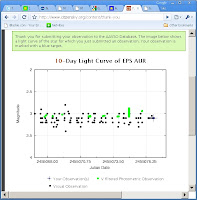
The experience i went through to submit my observations were very smooth. I admire how they accomplished the whole setup of tying in data with AAVSO to seamlessly provide me with an ID, present friendly forms to register and input my data, and then show me the graph--marked where my submission appears among the data crowd. Instant feedback!
I wanted to relate my enthusiasm with exoplanets to the mystery of Epsilon Aurigae by charting the known exoplanets within it's constellation. The result is a KMZ file for google sky, and a list at Freebase. As you can see, there is no known exoplanets nearby Eps Aur at this time. It would have been cool to compare it's magnitude with an exoplanet-host star within the same binocular field of view. I currently use my 15x50 Image-Stabilized Binoculars to compare Eta, Zeta and Epsilon's magnitudes since they all fit nicely within it's 4.5 degree FOV. I've pretty much "photographically" etched their view in my mind. And it would be exciting indeed to see the mysterious Epsilon star go dim in the coming months.
Whether exoplanets are involved or not, this is a very exciting thing to be part of. The mystery awaits!
Auriga Exoplanets:
HD 43691 b
WASP-12 b
HAT-P-9 b
HD 49674 b
HD 45350 b
HD 40979 b
Links:
CitizenSky.org
AAVSO
Epsilon Auriga
August 20, 2009
District 9: Prawns from a Planet with Seven Moons
The young little prawn is endearing. The scene where he was curiously studying about his home planet is my favorite. Learning that they come from an exoplanet with se7en moons make me a happy camper, too. I would love to hang out with that cute little prawn and learn more about their planet which I speculate is earth-like in many respects. The temperature, atmosphere, terrain and gravity of their home world must be quite similar to Earth's, otherwise the prawns would not survive here if their planetary characteristics were any different.District 9 is like a comic book, more enjoyable when viewed as such. Many loopholes in the plot are over-ruled by great cinematography. I'm only nagged by a single question of why the humans treated the aliens unintelligently. One would have naturally dealt with these prawns in a civilized way, as one would treat any visitor. Nevertheless, the movie gives homage to the directing prowess of Neill Blomkamp.
The movie will prove to be a great discussion for Xenosociology, the study of Alien Cultures and their social behaviours. It gets steamy when they interact with Humans in a complex setting (apartheid) where the dark elements of the human psyche is displayed. The aliens themselves are reduced to high-tech scavenger bugs.
It makes one think whether an Advanced Technological Civilization would make a race "civilized" at all. However, the drama that ensues manages to reveal the virtues common to both species.
District 9 is a neat little package that gives the freedom to draw one's own metaphors from. It is a great Sci-Fi movie that will reverberate in our culture for quite a while.
Subscribe to:
Posts (Atom)


![Reblog this post [with Zemanta]](http://img.zemanta.com/reblog_e.png?x-id=abcd5fe2-6fe5-4c10-a7d8-1aeaff1854d3)
![Reblog this post [with Zemanta]](http://img.zemanta.com/reblog_e.png?x-id=468b67fc-1685-4cc5-8d2a-f705f7f9e569)